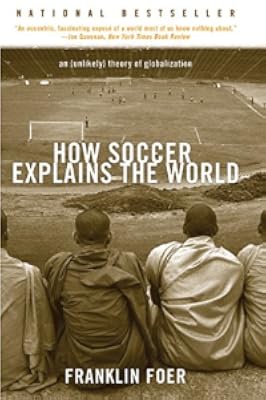
How Soccer Explains the World: An Unlikely Theory of Globalization
by Franklin Foer
On This Page
Description
"Soccer is a perfect window into the crosscurrents of today's world ... Franklin Foer takes us on a tour through the world of soccer, shattering the myths of our new global age along the way"--jacket.Tags
Recommendations













Member Reviews
This book was very interesting and I read through it quite quickly. It is a series of essays about how soccer, and more specifically love for a particular local soccer team, has affected politics, class identification and ethnic animosities in different countries and cities, mostly in Europe but also in Brazil, Iran and, finally, the U.S. The ways in which politicians, corrupt (mostly) and otherwise have used soccer clubs as bases for political power and the ways in which ethnic hatreds have been stokes and/or exacerbated around them make for frequently fascinating and informative reading. But Foer's thesis that taken together these examples provide a coherent theory of globalization seems forced, to me, perhaps a "unifying theme" show more suggested by an editor or publisher. Each chapter has a title beginning with "How Soccer Explains . . . ." As in "How Soccer Explains the Sentimental Hooligans," for example. Those chapter titles, too, seem a publisher's conceit rather than an author's wish. More often than actually explaining the cultural phenomenon Foer is describing in any given chapter, soccer comes across in the chapters as a symptom of that phenomenon. So while sneezing might be a symptom of my hay fever, I wouldn't write a chapter called "How Sneezing Explains Hay Fever."
That said, almost all of the individual chapters are informative and enlightening. Particularly interesting and horrifying to me was the early chapter about how soccer was used as a rallying point for ethnic hatred and murder in Serbia at the time of the Balkan Wars. The book was published in 2004, and not all of Foer's cultural observations still seem to ring true. His predictions about the continuing liberalization of society in Iran seem to me on thin ice at this point, for example. Overall, though, there's lots to learn here about Brazil, Italy, Spain, Serbia, Scotland, England, the Ukraine and other spots around the globe where soccer is a mania that's often intertwined with politics, big business and, yes, the effects of globalization. show less
That said, almost all of the individual chapters are informative and enlightening. Particularly interesting and horrifying to me was the early chapter about how soccer was used as a rallying point for ethnic hatred and murder in Serbia at the time of the Balkan Wars. The book was published in 2004, and not all of Foer's cultural observations still seem to ring true. His predictions about the continuing liberalization of society in Iran seem to me on thin ice at this point, for example. Overall, though, there's lots to learn here about Brazil, Italy, Spain, Serbia, Scotland, England, the Ukraine and other spots around the globe where soccer is a mania that's often intertwined with politics, big business and, yes, the effects of globalization. show less
Foer’s thematic essays take on many aspects of the beautiful game and much of the ugliness that manifests itself or attaches itself to sport as a way of exploring globalization. Each of the essays is fascinating and insightful, and if they do not fulfill the unlikely theory of globalization, they do make for an excellent read.
How soccer explains…
1. the Gangster’s Paradise – a frightening look of how gangs of soccer supporters and even the team organizations themselves propagated the ethnic warfare in the Balkans of the 1990’s.
2. the Pornography of Sects – examines the Old Firm rivalry of Glasgow Celtic and Glasgow Rangers, a seeming aberration of sectarianism in a modern Scotland prolonged by fans of the clubs.
3. the show more Jewish Question – tells the history of a pre-Second World War Jewish soccer club in Austria, and a modern Hungarian team with Jewish history as well as non-Jewish teams that have adopted a Jewish identity in half-tribute/half-mocking way akin to American sports teams naming themselves for Indians.
4. the Sentimental Hooligan – an interview with an aged Chelsea hooligan looks back proudly on his violent past and helps train a younger generation amid the yuppification of English football
5. the Survival of the Top Hats – despite dominating the world football scene, Brazillian football clubs play to near-empty stadiums caught in a morass of corruption that even Pelé cannot overcome.
6. the Black Carpathians – the clash of cultures as top African footballers are signed to play on Ukranian clubs, with touches of colonialism as well as sadness for a soccer backwater.
7. the New Oligarchs – comparisons of the old guard football powers Juventus to the nouveau riche of AC Milan and how they symbolize a corrupt, capitalist control of Italy. A nod also given to the socialist leanings of Inter Milan supporters.
8. the Discreet Charm of Bourgeois Nationalism – the story of FC Barcelona as an outlet for Catalan nationalism as well as symbol of purity in an increasingly commercial soccer world. “Critics of soccer contend that the game inherently culminates in death and destruction. They argue that the game gives life to tribal identities which should be disappearing in a world where a European Union and globalization are happily shedding such ancient sentiments. Another similarly widespread thesis holds that the root cause of violence can be found in the pace of the game itself. Because goals come so irregularly, fans spend far too much time sublimating their emotions, anticipating but not ever releasing. When those emotions swell and become uncontainable, the fans erupt into dark, Dionsyian fits of ecstatic violence. Barca redeems the game from these criticisms, by showing that fans can love a club and a country with passion and without turning into a thug or terrorist. (p. 197) “There’s no reason that nationalism should inherently culminate in these ugly feelings. To blame the Croatian and Bosnian wars on excessive love of country drastically underestimates the pathologies of Serb culture. Besides, in theory, patriotism and cosmopolitainism should be perfectly compatible. You could love your country – even consider it a superior group – without desiring to dominate other groups or closing yourself off to foreign impulses. And its not just theory. This is the spirit of Barca.” (p. 199)
9. Islam’s Hope – the liberalizing effect of football in Iran, where women risk execution disguising themselves as men to attend games.
10. the American Culture Wars – soccer is disliked in the United States because it is associated with the upper class and carries an air of snobbishness. On a greater scale soccer’s a symbol of globalization hated by many with isolationist feelings. “Multinational corporations are just that, multinational: they don’t represent American interests of American culture. Just as much as they change the tastes and economies of other countries, they have tried to change the taste and economy of the United States… No other country has been subjected to the free flows of capital and labor, so constantly remade by migration, and found its national identity so constantly challenged. In short, America may be an exception, but it is not exceptionally immune to globalization. And we fight about it, whether we know it or not, just like everyone else.” (p. 248) show less
How soccer explains…
1. the Gangster’s Paradise – a frightening look of how gangs of soccer supporters and even the team organizations themselves propagated the ethnic warfare in the Balkans of the 1990’s.
2. the Pornography of Sects – examines the Old Firm rivalry of Glasgow Celtic and Glasgow Rangers, a seeming aberration of sectarianism in a modern Scotland prolonged by fans of the clubs.
3. the show more Jewish Question – tells the history of a pre-Second World War Jewish soccer club in Austria, and a modern Hungarian team with Jewish history as well as non-Jewish teams that have adopted a Jewish identity in half-tribute/half-mocking way akin to American sports teams naming themselves for Indians.
4. the Sentimental Hooligan – an interview with an aged Chelsea hooligan looks back proudly on his violent past and helps train a younger generation amid the yuppification of English football
5. the Survival of the Top Hats – despite dominating the world football scene, Brazillian football clubs play to near-empty stadiums caught in a morass of corruption that even Pelé cannot overcome.
6. the Black Carpathians – the clash of cultures as top African footballers are signed to play on Ukranian clubs, with touches of colonialism as well as sadness for a soccer backwater.
7. the New Oligarchs – comparisons of the old guard football powers Juventus to the nouveau riche of AC Milan and how they symbolize a corrupt, capitalist control of Italy. A nod also given to the socialist leanings of Inter Milan supporters.
8. the Discreet Charm of Bourgeois Nationalism – the story of FC Barcelona as an outlet for Catalan nationalism as well as symbol of purity in an increasingly commercial soccer world. “Critics of soccer contend that the game inherently culminates in death and destruction. They argue that the game gives life to tribal identities which should be disappearing in a world where a European Union and globalization are happily shedding such ancient sentiments. Another similarly widespread thesis holds that the root cause of violence can be found in the pace of the game itself. Because goals come so irregularly, fans spend far too much time sublimating their emotions, anticipating but not ever releasing. When those emotions swell and become uncontainable, the fans erupt into dark, Dionsyian fits of ecstatic violence. Barca redeems the game from these criticisms, by showing that fans can love a club and a country with passion and without turning into a thug or terrorist. (p. 197) “There’s no reason that nationalism should inherently culminate in these ugly feelings. To blame the Croatian and Bosnian wars on excessive love of country drastically underestimates the pathologies of Serb culture. Besides, in theory, patriotism and cosmopolitainism should be perfectly compatible. You could love your country – even consider it a superior group – without desiring to dominate other groups or closing yourself off to foreign impulses. And its not just theory. This is the spirit of Barca.” (p. 199)
9. Islam’s Hope – the liberalizing effect of football in Iran, where women risk execution disguising themselves as men to attend games.
10. the American Culture Wars – soccer is disliked in the United States because it is associated with the upper class and carries an air of snobbishness. On a greater scale soccer’s a symbol of globalization hated by many with isolationist feelings. “Multinational corporations are just that, multinational: they don’t represent American interests of American culture. Just as much as they change the tastes and economies of other countries, they have tried to change the taste and economy of the United States… No other country has been subjected to the free flows of capital and labor, so constantly remade by migration, and found its national identity so constantly challenged. In short, America may be an exception, but it is not exceptionally immune to globalization. And we fight about it, whether we know it or not, just like everyone else.” (p. 248) show less
I'm hardly the first person to point out that the book's title is overblown; a better one might have been "How soccer reflects the world". However, that's not nearly so snappy, and wouldn't have sold as many copies, so I won't quibble. While this 2004-vintage book could use some updating, for the most part many of the aspects of soccer as a global sport that Foer identifies haven't much changed: soccer is still beset by hooligans, trapped by ancient rivalries, riddled with corruption, and burdened with uneasy relationships to global and national politics, religious divides, the challenges of modernity, and questions of identity. Soccer is unique in that it's the only truly transnational sport, which makes it a good lens to magnify show more various interesting cultural traits for closer inspection. While it's unlikely that soccer will ever get its hooks into American culture the way it's done in most other countries, it's worth thinking about why the US is so globalized in terms of people yet so insular in sports, and what our own half-embrace of soccer says about our attitudes towards the world.
Hooliganism takes up much of the first part of the book. To me it's probably the most interesting aspect of soccer fandom, since in American sports you just don't have the kind of organized violence that you have in other countries. Sure, you have fans with a reputation for being jackasses (Philadelphia Eagles) or for shocking the bourgeoisie (Oakland Raiders), but the gangs of thugs that are endemic in many countries are simply absent here. Foer discusses the Serbian hooligans of Red Star Belgrade, whose leader Arkan became a major figure of Serb nationalism under Slobodan Milosevic. The members of the Red Star fan club Foer talks to sound like some cool guys:
"Draza especially relishes describing a game against Partizan the previous season. Thirty minutes before kick off, the Ultra Bad Boys had quietly gathered their toughest guys at one end of the stadium by a small outcropping of trees. Each thug carried a metal bar or wooden bat. They formed a V-shaped formation and began to rampage their way around the stadium, beating anyone in their path. First, they attacked the visiting fans. Then, they slugged their way through a horde of police. The Ultra Bad Boys attacked so quickly that neither the cops nor the Partizan fans had time to respond. In their path, they left lines of casualties, like the fresh tracks of a lawnmower. 'We made it around the stadium in five minutes,' says Draza. 'It was incredible.'"
"Incredible" is one word for it, and I'm glad that America chose tailgating over gang warfare. Even in "more civilized countries" like Scotland, sectarian strife manifests itself in soccer. The economic transformations that lead Glasgow to become the British Empire's "second city" in the Victorian era brought Irish immigrants to work in the factories and dockyards, and animosity between the Irish Catholics and the Protestant Scots manifested itself on the pitch as well, to the extent that the Protestant club Rangers FC was founded in 1872, but didn't hire a Catholic, Maurice Johnston, until 1989. And this in one of the most educated places in the entire world! Perhaps every society has its parochial elements lurking beneath the face it tries to show to the world, as Foer suggests:
"Scottish society is a paradox. It has more or less eradicated discrimination in the public sphere. Catholics have their fair share of representation in the universities and workforce. Nevertheless, bigotry against them persists. There was no civil rights movement to sweep away anti-Catholicism - discrimination only faded thanks to globalization. Glasgow's shipyards and steel mills, which had practiced blatantly anti-Catholic hiring, folded in the wake of the '73 oil shocks. Much of the industry that survived came under the ownership of Americans and Japanese, a new economic order that came from 'places where they are not nearly so obsessed with defending Derry's walls against the Whore of Babylon,' as the critic Patrick Reilly has put it. Catholics gained their social equality without forcing Scotland into a reckoning with its deeply held beliefs. That's why Scottish society continues to harbor, and even reward, Donald Findlay, Rangers fans, and their ideology."
The next few chapters discuss globalization as both a progressive force, and also as a way to further entrench existing elements of corruption. In Brazil, where even heroes like Pele get into legal trouble, and Ukraine, where imported Nigerian players add new life to a moribund culture, as in England, foreign players add an outside element that challenges traditional notions of soccer clubs as the emotional property of the cities they're based in. I somewhat sympathize with the "localists", as I think it's weird when Americans develop completely arbitrary attachments to EPL teams, and I wonder what foreigners must be thinking when they start deliberately becoming fans of odd NFL teams like the Jaguars. Isn't there still room in the world for some sense of proprietary local interest, something that belongs to a single place specifically because of uniqueness? As Foer recounts during a discussion with a Chelsea fan about how the influx of money and foreign talent into the traditionally small-market Premier League has done to the formerly working-class atmosphere of the matches:
"Unwittingly, Alan boiled down the essential cultural argument against globalization made by No Logo author Naomi Klein, the McDonald's-smashing French farmer José Bove, and countless others: multinational capitalism strips local institutions of their localness, it homogenizes, destroys traditions, and deprives indigenous proletariats and peasants of the things they love most. It's easy to understand how this argument would apply to English soccer in general and Chelsea in particular."
Of course, another term for "our thing" is "cosa nostra", and few countries do attachment to local traditions, including corruption, better than Italy. The chapter on Italian soccer uses the rivalry of AC Milan and Juventus as a way of contrasting the power of new money against old money, the open corruption of Berlusconi against the genteel behind-the-scenes string-pulling of the Agnelli family, and newer empires like Berlusconi's media properties against the traditional businesses like Fiat owned by the Agnellis. Is there really a good guy in this battle, even if it's unlikely that the average fan sees the conflicts between the clubs in those terms? Foer doesn't seem to think so, and even his dinners with polite Italian leftists leave him unhappy with the entire terms of the debate. He seems happier in the next chapter discussing FC Barcelona, who he sees as heralding a new type of soccer fandom that jettisons much of both the crass materialism of modern soccer and the ugly parochialism (as a side note, Italians have a fun word for parochialism: "campanilismo", which literally means that your world is limited to what's near your town's campanile, or belltower). Though his adulation is a little out-of-date (the club did start selling ads in 2006, a mere 2 years after this book went to print), and they might not be quite the avatar of humanism he makes them out to be, much of what he admires about the club remains true:
"But if Barca's enemies objectively considered the club they despise, they would find an important reason to stand up and bathe it in applause. Critics of soccer contend that the game inherently culminates in death and destruction. They argue that the game gives life to tribal identities which should be disappearing in a world where a European Union and globalization are happily shredding such ancient sentiments. Another similar widely spread thesis holds that the root cause of violence can be found in the pace of the game itself. Because goals come so irregularly, fans spend far too much time sublimating their emotions, anticipating but not ever releasing. When those emotions swell and become uncontainable, the fans erupt into dark, Dionysian fits of ecstatic violence."
The final chapter is about soccer's popularity in the US, which I found very relatable. Like Foer, I played youth soccer and wasn't very good at it, immediately losing interest after middle school. Unlike Foer, but like most Americans, my soccer fandom is limited to the World Cup and that's about it. I can name some players and some teams, but I can't bring myself to follow MLS or even the EPL, so the intricacies of CONCACAF standings or rankings for the Supporter's Shield are beyond me. Fandom is primarily inherited, and my parents brought me only a vestigial interest in sports, so I had to pick up my Longhorns fandom myself (hook 'em Horns!). As Foer acknowledges, soccer fandom in the US is mainly limited to either Hispanics or upper-class whites, without the crucial working-class white support that forms its base in other Western countries, or the cross-class fandom of non-Western countries. Perhaps the emotional role soccer plays elsewhere has already been filled by our other sports - baseball has the heritage, pro football has the glitz, college football has the traditions, hockey has the aggression outlet.
Even 13 years after this book was published, mild American success in the World Cup has not brought much many kids into the crucial middling levels past youth soccer and below the pro tier; it seems like the parent-child transmission of soccer fandom instead of baseball or football fandom will take major deliberate effort. Is it worth it? There are scads of sociology studies puzzling about what the American attachment to football says about our culture (Jonathan Chait wrote a particularly good one, with the unfortunate and misleading title "In Defense of Male Aggression"). I wouldn't say that soccer is like the metric system, in that our aversion to an international standard imposes real costs on people beyond the extra risk of player concussions; maybe the American disdain for soccer is just a higher-order version of the same phenomenon that makes highly-educated Scottish lawyer spew anti-Catholic vitriol, or a Serbian wax nostalgic for beating rival fans with chunks of metal. America has avoided much of the good parts of soccer, but also much of the bad, and any theory of how soccer relates to the rest of the world would have to explain its failure to take root here. Perhaps it's just how we are, and perhaps there's still room for parochialism in a world hastening to homogeneity. show less
Hooliganism takes up much of the first part of the book. To me it's probably the most interesting aspect of soccer fandom, since in American sports you just don't have the kind of organized violence that you have in other countries. Sure, you have fans with a reputation for being jackasses (Philadelphia Eagles) or for shocking the bourgeoisie (Oakland Raiders), but the gangs of thugs that are endemic in many countries are simply absent here. Foer discusses the Serbian hooligans of Red Star Belgrade, whose leader Arkan became a major figure of Serb nationalism under Slobodan Milosevic. The members of the Red Star fan club Foer talks to sound like some cool guys:
"Draza especially relishes describing a game against Partizan the previous season. Thirty minutes before kick off, the Ultra Bad Boys had quietly gathered their toughest guys at one end of the stadium by a small outcropping of trees. Each thug carried a metal bar or wooden bat. They formed a V-shaped formation and began to rampage their way around the stadium, beating anyone in their path. First, they attacked the visiting fans. Then, they slugged their way through a horde of police. The Ultra Bad Boys attacked so quickly that neither the cops nor the Partizan fans had time to respond. In their path, they left lines of casualties, like the fresh tracks of a lawnmower. 'We made it around the stadium in five minutes,' says Draza. 'It was incredible.'"
"Incredible" is one word for it, and I'm glad that America chose tailgating over gang warfare. Even in "more civilized countries" like Scotland, sectarian strife manifests itself in soccer. The economic transformations that lead Glasgow to become the British Empire's "second city" in the Victorian era brought Irish immigrants to work in the factories and dockyards, and animosity between the Irish Catholics and the Protestant Scots manifested itself on the pitch as well, to the extent that the Protestant club Rangers FC was founded in 1872, but didn't hire a Catholic, Maurice Johnston, until 1989. And this in one of the most educated places in the entire world! Perhaps every society has its parochial elements lurking beneath the face it tries to show to the world, as Foer suggests:
"Scottish society is a paradox. It has more or less eradicated discrimination in the public sphere. Catholics have their fair share of representation in the universities and workforce. Nevertheless, bigotry against them persists. There was no civil rights movement to sweep away anti-Catholicism - discrimination only faded thanks to globalization. Glasgow's shipyards and steel mills, which had practiced blatantly anti-Catholic hiring, folded in the wake of the '73 oil shocks. Much of the industry that survived came under the ownership of Americans and Japanese, a new economic order that came from 'places where they are not nearly so obsessed with defending Derry's walls against the Whore of Babylon,' as the critic Patrick Reilly has put it. Catholics gained their social equality without forcing Scotland into a reckoning with its deeply held beliefs. That's why Scottish society continues to harbor, and even reward, Donald Findlay, Rangers fans, and their ideology."
The next few chapters discuss globalization as both a progressive force, and also as a way to further entrench existing elements of corruption. In Brazil, where even heroes like Pele get into legal trouble, and Ukraine, where imported Nigerian players add new life to a moribund culture, as in England, foreign players add an outside element that challenges traditional notions of soccer clubs as the emotional property of the cities they're based in. I somewhat sympathize with the "localists", as I think it's weird when Americans develop completely arbitrary attachments to EPL teams, and I wonder what foreigners must be thinking when they start deliberately becoming fans of odd NFL teams like the Jaguars. Isn't there still room in the world for some sense of proprietary local interest, something that belongs to a single place specifically because of uniqueness? As Foer recounts during a discussion with a Chelsea fan about how the influx of money and foreign talent into the traditionally small-market Premier League has done to the formerly working-class atmosphere of the matches:
"Unwittingly, Alan boiled down the essential cultural argument against globalization made by No Logo author Naomi Klein, the McDonald's-smashing French farmer José Bove, and countless others: multinational capitalism strips local institutions of their localness, it homogenizes, destroys traditions, and deprives indigenous proletariats and peasants of the things they love most. It's easy to understand how this argument would apply to English soccer in general and Chelsea in particular."
Of course, another term for "our thing" is "cosa nostra", and few countries do attachment to local traditions, including corruption, better than Italy. The chapter on Italian soccer uses the rivalry of AC Milan and Juventus as a way of contrasting the power of new money against old money, the open corruption of Berlusconi against the genteel behind-the-scenes string-pulling of the Agnelli family, and newer empires like Berlusconi's media properties against the traditional businesses like Fiat owned by the Agnellis. Is there really a good guy in this battle, even if it's unlikely that the average fan sees the conflicts between the clubs in those terms? Foer doesn't seem to think so, and even his dinners with polite Italian leftists leave him unhappy with the entire terms of the debate. He seems happier in the next chapter discussing FC Barcelona, who he sees as heralding a new type of soccer fandom that jettisons much of both the crass materialism of modern soccer and the ugly parochialism (as a side note, Italians have a fun word for parochialism: "campanilismo", which literally means that your world is limited to what's near your town's campanile, or belltower). Though his adulation is a little out-of-date (the club did start selling ads in 2006, a mere 2 years after this book went to print), and they might not be quite the avatar of humanism he makes them out to be, much of what he admires about the club remains true:
"But if Barca's enemies objectively considered the club they despise, they would find an important reason to stand up and bathe it in applause. Critics of soccer contend that the game inherently culminates in death and destruction. They argue that the game gives life to tribal identities which should be disappearing in a world where a European Union and globalization are happily shredding such ancient sentiments. Another similar widely spread thesis holds that the root cause of violence can be found in the pace of the game itself. Because goals come so irregularly, fans spend far too much time sublimating their emotions, anticipating but not ever releasing. When those emotions swell and become uncontainable, the fans erupt into dark, Dionysian fits of ecstatic violence."
The final chapter is about soccer's popularity in the US, which I found very relatable. Like Foer, I played youth soccer and wasn't very good at it, immediately losing interest after middle school. Unlike Foer, but like most Americans, my soccer fandom is limited to the World Cup and that's about it. I can name some players and some teams, but I can't bring myself to follow MLS or even the EPL, so the intricacies of CONCACAF standings or rankings for the Supporter's Shield are beyond me. Fandom is primarily inherited, and my parents brought me only a vestigial interest in sports, so I had to pick up my Longhorns fandom myself (hook 'em Horns!). As Foer acknowledges, soccer fandom in the US is mainly limited to either Hispanics or upper-class whites, without the crucial working-class white support that forms its base in other Western countries, or the cross-class fandom of non-Western countries. Perhaps the emotional role soccer plays elsewhere has already been filled by our other sports - baseball has the heritage, pro football has the glitz, college football has the traditions, hockey has the aggression outlet.
Even 13 years after this book was published, mild American success in the World Cup has not brought much many kids into the crucial middling levels past youth soccer and below the pro tier; it seems like the parent-child transmission of soccer fandom instead of baseball or football fandom will take major deliberate effort. Is it worth it? There are scads of sociology studies puzzling about what the American attachment to football says about our culture (Jonathan Chait wrote a particularly good one, with the unfortunate and misleading title "In Defense of Male Aggression"). I wouldn't say that soccer is like the metric system, in that our aversion to an international standard imposes real costs on people beyond the extra risk of player concussions; maybe the American disdain for soccer is just a higher-order version of the same phenomenon that makes highly-educated Scottish lawyer spew anti-Catholic vitriol, or a Serbian wax nostalgic for beating rival fans with chunks of metal. America has avoided much of the good parts of soccer, but also much of the bad, and any theory of how soccer relates to the rest of the world would have to explain its failure to take root here. Perhaps it's just how we are, and perhaps there's still room for parochialism in a world hastening to homogeneity. show less
The title of this book promises to use the game of soccer to explain globalization. It doesn't. It is more likely that globalization explains soccer. The chapters that come the closest to explaining the stated thesis are the last two - the one on Islam and the one on the U. S. The chapters in the rest of the book are superficial and don't explain anything about soccer or its appeal. I kept hoping for more and the book never delivers.
Franklin Foer's excellent book delves into some of the rivalries and associated corruption that make world football the intriguing sport it is.
He visits and writes about Scotland, Austria, Serbia, England, Brazil, Ukraine, Italy, Spain, Iran and the USA. He discusses football's place in those societies using religion, racism, nationalism, corruption, money, feminism and defensiveness.
His love of football is clear, and as a result, he writes with affection and wonder, but at times I think he is too forgiving or accepting of some behaviours.
If only he had written a few years later, he could have delved into the corruption that underlies FIFA itself, and the awarding of the World Cup to Qatar.
Anyway, a great read for lovers of world sport show more and football in particular. show less
He visits and writes about Scotland, Austria, Serbia, England, Brazil, Ukraine, Italy, Spain, Iran and the USA. He discusses football's place in those societies using religion, racism, nationalism, corruption, money, feminism and defensiveness.
His love of football is clear, and as a result, he writes with affection and wonder, but at times I think he is too forgiving or accepting of some behaviours.
If only he had written a few years later, he could have delved into the corruption that underlies FIFA itself, and the awarding of the World Cup to Qatar.
Anyway, a great read for lovers of world sport show more and football in particular. show less
Those looking for an actual coherent & viable theory of globalization will be stymied by this cheekily titled book, unless they succumb to its actual pleasures—those of the good tale well told. This crisply reported, smoothly edited series of essays about 10 different nations' experiences of soccer has all of the best qualities of feature-length journalism. It's a quick, engaging read that focuses on stories and personalities of soccer culture, not on accounts of matches (soccer diehards beware), and only one extended profile of a player (possibly the best chapter in the book, about a Nigerian player plying his trade in the Ukraine).
In the final two chapters, Foer does succumb to the urge to actually construct an argument, and this is show more somewhat to the detriment of the book. In the penultimate chapter, he shows himself a couple of degrees out of his depth on the question of Islam & politics (those Muslim countries just aren't ready for democracy, he confidently assures us), and in the final one, he has a somewhat unrealistic take on the relationship between the U.S. and global capital (the U.S. is at the mercy of the transnational corporations just like every other country—no, really).
Yet I could recommend this on the basis of the Italy chapter alone, and Foer's encomium to his beloved FC Barcelona does have an interesting take on nationalism. The opening chapter on Red Star Belgrade is revealing, as well, of culture in the age of globalization. Foer may be soccer writing's answer to Pico Iyer, and that is meant as a compliment. show less
In the final two chapters, Foer does succumb to the urge to actually construct an argument, and this is show more somewhat to the detriment of the book. In the penultimate chapter, he shows himself a couple of degrees out of his depth on the question of Islam & politics (those Muslim countries just aren't ready for democracy, he confidently assures us), and in the final one, he has a somewhat unrealistic take on the relationship between the U.S. and global capital (the U.S. is at the mercy of the transnational corporations just like every other country—no, really).
Yet I could recommend this on the basis of the Italy chapter alone, and Foer's encomium to his beloved FC Barcelona does have an interesting take on nationalism. The opening chapter on Red Star Belgrade is revealing, as well, of culture in the age of globalization. Foer may be soccer writing's answer to Pico Iyer, and that is meant as a compliment. show less
I am football mad and as soon as I saw this book, I had to read it. Using vignettes/reportages, the author attempts to shed light on the world and globalization through the prism of football. What he finds – the shrinking of the footballing world, violence, contending identities, social and class fault lines reflected through allegiance to football clubs and hope in the redeeming value of the game – makes for some powerful and entertaining reading. I especially found the chapters on Barca (where the Spanish Civil War still resonates), Chelsea (where we meet a Jewish reformed hooligan) and the Old Firm clubs (where football fans from Northern Ireland recreate sectarian violence through their support of either Glaswegian clubs) show more utterly compelling – but at the same time lacking because I wanted more. This is my problem with the book: it felt too much like a piece of journalism, with some vignettes stronger than others, and I could not find an overarching thesis/idea to tie all these disparate elements together and offer an answer as to how football explains the world. show less
Members
- Recently Added By
Lists

Books Referenced by Montague's 1312: Among the Ultras
29 works; 1 member

Books Read in 2024
4,623 works; 126 members
Author Information

7+ Works 2,222 Members
Franklin Foer is the editor of The New Republic. His writing has also appeared in the New York Times, the Atlantic Monthly, Slate, and New York magazine. He lives in Washington, D.C.
Some Editions
Awards and Honors
Distinctions
Common Knowledge
- Canonical title*
- Wie man mit Fußball die Welt erklärt
- Original title
- How Soccer explains the World
- Original publication date
- 2004
- Dedication*
- Für meine Frau Abby.
Und die Familie meines brasilianischen Cousins Marcelo Waimberg. - First words*
- Ich bin ein lausiger Spieler.
- Last words*
- (Click to show. Warning: May contain spoilers.)Kurz, Amerika mag eine Sonderrolle spielen, besonders immun gegenüber der Globalisierung ist es aber nicht. Und wie jedes andere Land haben wir damit zu kämpfen, ob wir uns dessen nun bewusst sind oder nicht.
- Blurbers*
- Klinsmann, Jürgen
- Original language*
- Amerikanisch
*Some information comes from Common Knowledge in other languages. Click "Edit" for more information.
Classifications
- Genres
- Sports and Leisure, Nonfiction, Sociology, Economics, General Nonfiction, History, Politics and Government
- DDC/MDS
- 327.1 — Society, government, & culture Political science International Relations: Spies Foreign policy and specific topics in international relations
- LCC
- GV943.9 .S64 .F64 — Geography, Anthropology and Recreation Recreation. Leisure Recreation. Leisure Sports Ball games: Baseball, football, golf, etc.
- BISAC
Statistics
- Members
- 1,570
- Popularity
- 14,537
- Reviews
- 35
- Rating
- (3.55)
- Languages
- 12 — Danish, Dutch, English, Finnish, German, Indonesian, Italian, Norwegian (Bokmål), Norwegian, Portuguese, Spanish, Swedish
- Media
- Paper, Ebook
- ISBNs
- 24
- ASINs
- 6