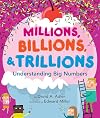
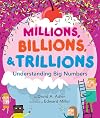
Millions, Billions, & Trillions: Understanding Big Numbers
by David A. Adler
On This Page
Description
Huge numbers are hard to comprehend. This book explains quantities in terms children can understand. For example, one million dollars could buy two full pizzas a day for more than sixty-eight years.Tags
Recommendations










Member Reviews
"Millions, Billions & Trillions," is an interesting math-related Children's book. The book gives children an easier approach for understanding big numbers since the author uses real life applications, comparisons and fun facts to keep readers engaged. The illustrations provide children with the exact number of zero's needed for each number while supplying a visual representation. This book enables discoveries with the fun facts given about the numbers. It may also give children a sense of wonder to learn that it takes more than eleven days to count to a million or it is impossible to count to a trillion during one lifetime. The book has an obvious logical structure and intention to teach children about big numbers in a way which is show more easily understood. Although I believe, overall, this book is a great way to make children more knowledgable regarding the concept of large numbers, there may be some confusion for some children about certain aspects of the book. Teachers should be prepared to further explain the meaning of some of the text in the book in order to assure that every child is fully understanding and grasping the those big numbers. show less
I thought the books was fun and a great way to dive into a lesson plan about large numbers. The book takes large quantities (millions, billions, and trillions) and uses fun examples that children can relate to in order to expand children's understanding of these numbers. For example, "How many pizzas can a million dollars buy?" or "there are a million grains of sugar in a 1/4 cup of sugar". I was not a fan of all of the examples and thought that some of them might even be confusing to some students. However, the idea of the book is great and can be a fun way to introduce a lesson on large numbers. I would recommend the use of this book for motivation to a lesson.
This is one of the funnest math books I have read. It easily describes big numbers with well organized text. Specifically, it talks about how much a million, a billion, and a trillion are. This is a book that definitely makes numbers fun and interesting to children. It is also fun how it gives examples like "One trillion dollars would make a stack about seven hundred millions high" with a picture of an astronaut counting stacks of one-hundred-dollar bills in outer space. But the best part of this book is the relation of money with the United States spending, "the amount of money the United States government spends each year and the amount it owes are measured in trillions".
Millions, Billions, & Trillions: Understanding Big Numbers, is a concept book that was written to be aligned with the fourth grade Common Core Standards related to Number and Operations in Base 10. The book explores the larger numbers are gives students a visualization (sometimes physical, mostly imaginative) of what counting to a million (and more) would be like. The depictions described in the book given students an idea of when millions, billions and trillions are counted and used and how it relates to our daily lives in instances like sugar crystals, slices of pizza, popcorn kernels and even the money our government spends and owes each year.
The book is written in a narrative fashion that holds the interest of the reader and works show more well with illustrations. The cover is very colorful and shows a large cupcake with sprinkles. The cover does not make any suggestions regarding the content of the book; it simply displays the title with an inviting picture that most children would look at simply because it’s a cupcake and looks like the book would be “fun”.
There are many non-fiction features missing from this book such as: a table of contents, index, glossary, pronunciation guides, sidebars, bibliography, introduction, preface, afterword, appendix, photos, maps and tables. Although it may seem that many different features are missing, I would argue that due to the nature of the book, some features would be unnecessary for students in attaining an accurate understanding of the material.
For instance, pronunciation guides and sidebars would not have greatly enhanced the textual section of the book. Perhaps adding a pronunciation for a few words in the author’s note would aid in the student’s reading experience when encountering words such as quadrillion, quintillion, and sextillion, however being that the book is written to coincide with a fourth grade Common Core skill, students are expected to be able to segment and chunk those types of words by that point in the academic studies. A bibliography would not be essential in the research aspect for the book but it would have been an added bonus to have a listing of some other books students could utilize to continue their own learning about larger numbers and their representations. A preface, introduction and afterword would not be essential as the information in the text is quite specific and does not require much interpretation or recollection based on background information. The language in in the book is easy to read and coincides with illustrations therefore eliminating the need for further explanation of the text and pictures. The book is also devoid of page numbers. It would be rather hard for a student to reference information if they had to count pages each time or refer to a page quickly without the written representation of the number.
There are a few non-fiction features that I would have liked to see in Millions, Billions, & Trillions, such as a glossary for quick reference, an appendix with various experiments or activities that students (and educators) could use to give students a visual representation of the largest numbers and perhaps a table that depicted the name of the number, the written form, and even the name that it is referred to in other countries. There is a small blurb on the last page, which is also the copyright page, which says, “The names for large numbers are not the same everywhere. In some parts of the world…” (Adler, 2013) . This section almost seems as if it were an afterthought and could have been a quite informative piece to include in the main text.
The illustrations are very welcoming and childlike. I can see how they would be engaging to students but not necessarily encapsulating to the content. The pictures almost seem like cartoons created to “go along” with the text rather than supporting the content and the actual learning that could have taken place given the knowledge the text is intending to give to readers. Although it would have been difficult, perhaps, to include photographs that would accurately represent millions, billions, trillions and so forth, it may have been more beneficial to represent these numbers in such a way that one could visualize the magnitude in many different ways rather than a single representation and several cartoons to go along with the words on the page.
The author’s note was an added bonus and answered questions that I have actually heard adults ask - what is greater than a trillion. The author’s note include a digital representation of quadrillion, quintillion and a sextillion. Although that was the extent of the author’s note, the information given was valuable and would be useful to an inquisitive student who wanted to know more about numbers beyond hundreds and thousands.
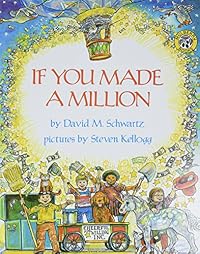
Overall, given the text features and the content information, this book would be a nice addition to the library collection. Given titles such as How Much is A Million and If You Made a Million, (authored by David Schwartz), Millions, Billions, & Trillions: Understanding Big Numbers offers a different look at numbers in a way that is fun and inviting for students. This book is a decent representation of how literacy can be used in a mathematics class and how experimentation and physical examples can enhance a student’s learning.
I brought this book into my second grade classroom after discussion just how large some numbers are after an impromptu addition problem with numbers in the millions (just to prove to my students that they could, in fact, add millions.) This book was interesting for them and they were able to glean many new questions after reading the book. We went on to actually measure a quarter cup of sugar and spread it out on construction paper (as recommended in the text) to see what a million sugar granules looked like. For my class, this book was perfect. Although as a teacher, I see room for improvement in the text, my students thought it was spectacular. It gave them reasons to ponder and question which I believe shows success in itself.
If I were to use this book again, which is highly likely, I might use it within a literature lesson and use it to teach across the curriculum. Perhaps have my students analyze the parts of a non-fiction book and expand on the text by creating their own table of contents and chapter titles. I see many uses for this book in my future. I am so glad I chose to read this book and share it with my students. show less
The book is written in a narrative fashion that holds the interest of the reader and works show more well with illustrations. The cover is very colorful and shows a large cupcake with sprinkles. The cover does not make any suggestions regarding the content of the book; it simply displays the title with an inviting picture that most children would look at simply because it’s a cupcake and looks like the book would be “fun”.
There are many non-fiction features missing from this book such as: a table of contents, index, glossary, pronunciation guides, sidebars, bibliography, introduction, preface, afterword, appendix, photos, maps and tables. Although it may seem that many different features are missing, I would argue that due to the nature of the book, some features would be unnecessary for students in attaining an accurate understanding of the material.
For instance, pronunciation guides and sidebars would not have greatly enhanced the textual section of the book. Perhaps adding a pronunciation for a few words in the author’s note would aid in the student’s reading experience when encountering words such as quadrillion, quintillion, and sextillion, however being that the book is written to coincide with a fourth grade Common Core skill, students are expected to be able to segment and chunk those types of words by that point in the academic studies. A bibliography would not be essential in the research aspect for the book but it would have been an added bonus to have a listing of some other books students could utilize to continue their own learning about larger numbers and their representations. A preface, introduction and afterword would not be essential as the information in the text is quite specific and does not require much interpretation or recollection based on background information. The language in in the book is easy to read and coincides with illustrations therefore eliminating the need for further explanation of the text and pictures. The book is also devoid of page numbers. It would be rather hard for a student to reference information if they had to count pages each time or refer to a page quickly without the written representation of the number.
There are a few non-fiction features that I would have liked to see in Millions, Billions, & Trillions, such as a glossary for quick reference, an appendix with various experiments or activities that students (and educators) could use to give students a visual representation of the largest numbers and perhaps a table that depicted the name of the number, the written form, and even the name that it is referred to in other countries. There is a small blurb on the last page, which is also the copyright page, which says, “The names for large numbers are not the same everywhere. In some parts of the world…” (Adler, 2013) . This section almost seems as if it were an afterthought and could have been a quite informative piece to include in the main text.
The illustrations are very welcoming and childlike. I can see how they would be engaging to students but not necessarily encapsulating to the content. The pictures almost seem like cartoons created to “go along” with the text rather than supporting the content and the actual learning that could have taken place given the knowledge the text is intending to give to readers. Although it would have been difficult, perhaps, to include photographs that would accurately represent millions, billions, trillions and so forth, it may have been more beneficial to represent these numbers in such a way that one could visualize the magnitude in many different ways rather than a single representation and several cartoons to go along with the words on the page.
The author’s note was an added bonus and answered questions that I have actually heard adults ask - what is greater than a trillion. The author’s note include a digital representation of quadrillion, quintillion and a sextillion. Although that was the extent of the author’s note, the information given was valuable and would be useful to an inquisitive student who wanted to know more about numbers beyond hundreds and thousands.
Overall, given the text features and the content information, this book would be a nice addition to the library collection. Given titles such as How Much is A Million and If You Made a Million, (authored by David Schwartz), Millions, Billions, & Trillions: Understanding Big Numbers offers a different look at numbers in a way that is fun and inviting for students. This book is a decent representation of how literacy can be used in a mathematics class and how experimentation and physical examples can enhance a student’s learning.
I brought this book into my second grade classroom after discussion just how large some numbers are after an impromptu addition problem with numbers in the millions (just to prove to my students that they could, in fact, add millions.) This book was interesting for them and they were able to glean many new questions after reading the book. We went on to actually measure a quarter cup of sugar and spread it out on construction paper (as recommended in the text) to see what a million sugar granules looked like. For my class, this book was perfect. Although as a teacher, I see room for improvement in the text, my students thought it was spectacular. It gave them reasons to ponder and question which I believe shows success in itself.
If I were to use this book again, which is highly likely, I might use it within a literature lesson and use it to teach across the curriculum. Perhaps have my students analyze the parts of a non-fiction book and expand on the text by creating their own table of contents and chapter titles. I see many uses for this book in my future. I am so glad I chose to read this book and share it with my students. show less
I enjoyed reading this story because I think it is very appropriate and engaging for young students. The book takes seemingly large and unimaginable numbers in the millions, billions and trillions and presents them in a reliable way for the reader to understand. I especially liked the illustrations because it showed exactly how many zero's were need to represent the number with a visual representation. The writing in the book was organized and simple to understand. All of the examples that were used were relatable to the children's lives like salt, popcorn and ice-cream. The main idea of the text was to inform the reader on how to understand large number in a clever and relatable way.
This book shows big numbers in a fun way! Every wonder what the number 1 million looks like, well this book visuals these numbers for kids! Readers receive real world visuals of numbers as big as a trillion. I think this book would be a good book to show to kids who are learning just how high numbers go. The book mentioned that it fulfilled a common core state standard for fourth graders, so it would be a good book to share with this age group.
Overall, I think this is a great book. The illustrations were outstanding, and could keep kids not only engaged, but allow them to think about other objects in large quantities!
Overall, I think this is a great book. The illustrations were outstanding, and could keep kids not only engaged, but allow them to think about other objects in large quantities!
This book succinctly and graphically explains huge numbers like millions, billions, and trillions. Want to have a concept of what a million is? Take a quarter cup of sugar and pour it out onto a piece of dark construction paper. You have about a million grains of sugar there. The book uses solid examples that will help kids conceptualize these huge numbers. I can see using this book in a library program about math - pair it with David Schwartz's HOW MUCH IS A MILLION? and his IF YOU HOPPED LIKE A FROG for estimatey fun.
Members
- Recently Added By
Author Information

311 Works 92,808 Members
David A. Adler was born in New York City. He attended Queen's College in New York City and later, earned an MBA in Marketing from New York University. He writes both fiction and non-fiction. He is the author of Cam Jansen mysteries and the Andy Russell titles. His titles has earned him numerous awards including a Sydney Taylor Book Award for his show more title "The Number on My Grandfather's Arm," "A Picture Book of Jewish Holidays" was named a Notable Book of 1981 by the American Library Association and "Our Golda" was named a Carter G. Woodson Award Honor Book. (Bowker Author Biography) show less
Awards and Honors
Awards
Notable Lists
Common Knowledge
- Original publication date
- 2013
- Dedication
- For my brother Nathan, who works daily with large numbers
Classifications
Statistics
- Members
- 427
- Popularity
- 71,896
- Reviews
- 21
- Rating
- (3.50)
- Languages
- English, French, Korean
- Media
- Paper, Ebook
- ISBNs
- 6
- ASINs
- 1