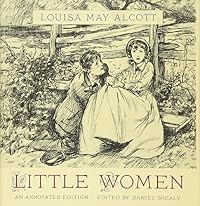
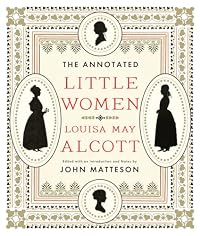
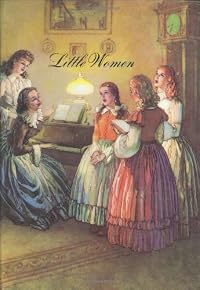
Little Women: An Annotated Edition
by Louisa May Alcott, Daniel Shealy (Editor)
On This Page
Description
"In this richly annotated, illustrated edition, Daniel Shealy illuminates the novel's deep engagement with issues such as social equality, reform movements, the Civil War, friendship, love, loss, and of course the passage into adulthood. The editor provides running commentary on biographic contexts, social and historical contexts, literary allusions, and words likely to cause difficulty to modern readers. With Shealy as a guide, we appreciate anew the confusions and difficulties that beset show more the March sisters as they overcome their burdens and journey toward maturity and adulthood. This edition examines the novel's central question: How does one grow up well?-- show lessTags
Recommendations












Member Reviews
3½***. I'm not at all crazy about Little Women to begin with (I find it terribly preachy, in contrast with Anne of Green Gables), but this Belknap (Harvard) Press annotated edition (ISBN 9780674059719) is a lush coffee-table production worth reading for its illustrations and for its screen-shots from some of the film adaptations, particularly George Cukor's (1933) and Mervyn LeRoy's (1949). But Christopher Columbus! if the 1933 film adaptation in particular isn't vastly superior to the Alcott novel, particularly for Kate Hepburn's Jo.
If a reader is going to choose just one edition for academic study, the Norton Critical is probably to be preferred. This Belknap (Harvard) Press edition does contain some valuable annotation, but one show more criticism I have is an excessive and somewhat too overly certain reliance on the OED for words-and-phrases origins.
A particularly egregious example can be found on page 144, note 37: "The OED defines fuss and feathers as 'bustle and display,' and gives the first use of the term as 1866, just two years before the publication of Little Women." Ouch! but anyone familiar with American military history should be aware that "Old Fuss and Feathers" was the not-so-affectionate nickname bestowed in the mid-1840s by his enlisted men on General Winfield Scott during the Mexican War — something of which Alcott would certainly have been aware (though I don't mean to imply that this use of the phrase in Little Women had any reference to Scott). The antislavery-leaning Scott was the unsuccessful Whig presidential candidate in 1852, defeated by the pro-slavery Democrat Franklin Pierce, the lifelong friend of Alcott's Concord neighbor Nathaniel Hawthorne. show less
If a reader is going to choose just one edition for academic study, the Norton Critical is probably to be preferred. This Belknap (Harvard) Press edition does contain some valuable annotation, but one show more criticism I have is an excessive and somewhat too overly certain reliance on the OED for words-and-phrases origins.
A particularly egregious example can be found on page 144, note 37: "The OED defines fuss and feathers as 'bustle and display,' and gives the first use of the term as 1866, just two years before the publication of Little Women." Ouch! but anyone familiar with American military history should be aware that "Old Fuss and Feathers" was the not-so-affectionate nickname bestowed in the mid-1840s by his enlisted men on General Winfield Scott during the Mexican War — something of which Alcott would certainly have been aware (though I don't mean to imply that this use of the phrase in Little Women had any reference to Scott). The antislavery-leaning Scott was the unsuccessful Whig presidential candidate in 1852, defeated by the pro-slavery Democrat Franklin Pierce, the lifelong friend of Alcott's Concord neighbor Nathaniel Hawthorne. show less
Ratings
Members
- Recently Added By
Author Information

463+ Works 108,396 Members
Louisa May Alcott was born in Germantown, Pennsylvania, in 1832. Two years later, she moved with her family to Boston and in 1840 to Concord, which was to remain her family home for the rest of her life. Her father, Bronson Alcott, was a transcendentalist and friend of Ralph Waldo Emerson and Henry David Thoreau. Alcott early realized that her show more father could not be counted on as sole support of his family, and so she sacrificed much of her own pleasure to earn money by sewing, teaching, and churning out potboilers. Her reputation was established with Hospital Sketches (1863), which was an account of her work as a volunteer nurse in Washington, D.C. Alcott's first works were written for children, including her best-known Little Women (1868--69) and Little Men: Life at Plumfield with Jo's Boys (1871). Moods (1864), a "passionate conflict," was written for adults. Alcott's writing eventually became the family's main source of income. Throughout her life, Alcott continued to produce highly popular and idealistic literature for children. An Old-Fashioned Girl (1870), Eight Cousins (1875), Rose in Bloom (1876), Under the Lilacs (1878), and Jack and Jill (1881) enjoyed wide popularity. At the same time, her adult fiction, such as the autobiographical novel Work: A Story of Experience (1873) and A Modern Mephistopheles (1877), a story based on the Faust legend, shows her deeper concern with such social issues as education, prison reform, and women's suffrage. She realistically depicts the problems of adolescents and working women, the difficulties of relationships between men and women, and the values of the single woman's life. (Bowker Author Biography) show less
Common Knowledge
- Disambiguation notice
- This edition is an annotated edition. Please do not combine with editions that are not annotated.
Classifications
Statistics
- Members
- 52
- Popularity
- 581,216
- Reviews
- 1
- Rating
- (4.58)
- Languages
- English
- Media
- Paper, Ebook
- ISBNs
- 1
- ASINs
- 1