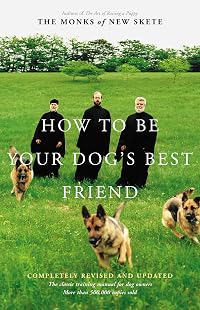
How to Be Your Dog's Best Friend: The Classic Training Manual for Dog Owners
by The Monks of New Skete
On This Page
Description
Thoroughly revised to incorporate the latest trends in training and reflections on the canine-human relationship, a new edition of the classic illustrated guide to dog training helps the dog owner understand his dog's nature, know when and how to discipline, and to select a dog breed that is appropriate to the owner's lifestyle.Tags
Recommendations
































Member Reviews
Best book on the topic, hands down. We purchased this book many years ago and used it to train two rescue dogs, one of whom was a huge HUGE handful (especially destructive and out of control misbehavior). Using this book as a guide, we guided those two dogs into becoming extremely well behaved, loving life partners. And that "handful of a dog" was often cited by friends and neighbors as turning into the "perfect" dog. And he was. He lived a long happy life, but has since passed.
Since we gifted that book and several other copies to friends to help them, today we received in the mail the new revised version of the book. The timing compliments our two new rescues! Again it will help guide us developing these precious challenges into show more becoming the next generation of "perfect" dogs.
Buy this book. There is no better. Follow their advice to a T and we wish you a happy journey towards your "perfect" dog. show less
Since we gifted that book and several other copies to friends to help them, today we received in the mail the new revised version of the book. The timing compliments our two new rescues! Again it will help guide us developing these precious challenges into show more becoming the next generation of "perfect" dogs.
Buy this book. There is no better. Follow their advice to a T and we wish you a happy journey towards your "perfect" dog. show less
I got this book as a recommended dog training manual (from an internet list somewhere). Unfortunately, only maybe 50 of 350 pages were about actually training your dog, and the rest was,
"If you/your dog has a problem, make sure to take them to obedience training! / Solve it when they're a puppy! / Breeding takes out these undesirable traits! / etc."
Okay, but that doesn't ... help me ... that much now.
Plus, it's obvious the authors are pretty much elitists when it comes to dogs, and there's maybe a generation gap that makes me dislike their attitude so much. They mention shelter dogs once in passing, I think? Otherwise: get dogs from a breeder, or else! Or else you're supporting and pushing pet shop sales! And purebreds? VERY IMPORTANT. show more Gotta breed all undesirable traits out, you know, unless your dog is going to have behavior problems --FOREVER.
I also kept waiting for the moment actual training tips would begin, but the authors kept sending me other places: read more from the recommended reading pages in the back, take your dog to obedience training--and not just "park" obedience training, take your dog to a specialist, etc. Apparently the first thing you need to do to train your dog is take them to obedience training. You can't do anything on your own ?
And apparently you can't buy adult dogs, either (esp. at a shelter, where you don't know the dogs' bloodlines!!). You need to buy a puppy from a breeder to send them to "ktp" --> Kindergarten Puppy Classes, and then to obedience training. ("Since your dog already has a basic understanding of sit from puppy classes ...")
There's also a very handy section on how to name your dog! "Two-syllable words are recommended, and one syllable is not, even though they're common", etc. Don't name your dogs after something about their appearance (i.e. Spot), and don't name your dog cutesy things like Cupcake! Excuse you, me and my rottweiler, Cupcake, will be happy together forever (I had rottweilers growing up, and most of them were huge softies; Cupcake would fit perfectly).
I wish this was a simple manual on how to teach (or re-teach, in this case) my dog basic things, but the actual lessons it contained were overshadowed by a bunch of elitist blather. show less
"If you/your dog has a problem, make sure to take them to obedience training! / Solve it when they're a puppy! / Breeding takes out these undesirable traits! / etc."
Okay, but that doesn't ... help me ... that much now.
Plus, it's obvious the authors are pretty much elitists when it comes to dogs, and there's maybe a generation gap that makes me dislike their attitude so much. They mention shelter dogs once in passing, I think? Otherwise: get dogs from a breeder, or else! Or else you're supporting and pushing pet shop sales! And purebreds? VERY IMPORTANT. show more Gotta breed all undesirable traits out, you know, unless your dog is going to have behavior problems --FOREVER.
I also kept waiting for the moment actual training tips would begin, but the authors kept sending me other places: read more from the recommended reading pages in the back, take your dog to obedience training--and not just "park" obedience training, take your dog to a specialist, etc. Apparently the first thing you need to do to train your dog is take them to obedience training. You can't do anything on your own ?
And apparently you can't buy adult dogs, either (esp. at a shelter, where you don't know the dogs' bloodlines!!). You need to buy a puppy from a breeder to send them to "ktp" --> Kindergarten Puppy Classes, and then to obedience training. ("Since your dog already has a basic understanding of sit from puppy classes ...")
There's also a very handy section on how to name your dog! "Two-syllable words are recommended, and one syllable is not, even though they're common", etc. Don't name your dogs after something about their appearance (i.e. Spot), and don't name your dog cutesy things like Cupcake! Excuse you, me and my rottweiler, Cupcake, will be happy together forever (I had rottweilers growing up, and most of them were huge softies; Cupcake would fit perfectly).
I wish this was a simple manual on how to teach (or re-teach, in this case) my dog basic things, but the actual lessons it contained were overshadowed by a bunch of elitist blather. show less
This revised edition of the classic dog owner's guide is even better than the original edition, which was itself invaluable. The monks, who first published their guide to dog acquisition, dog ownership, and dog training in 1978, have thoroughly revised and updated their book in the light of 35 years of experience, and who knows how many dogs. This book covers all the basics of dog training, of both varieties: behavioral training (mostly teaching your dog what not to do) and obedience training (teaching your dog to do what you tell it through specific commands). But the discussion of training goes way beyond those specifics. There is a continued emphasis on dog training as the building over time of a relationship between one being (a show more human) and another (a dog). The way in which the human guides that relationship is critical to the way it evolves, and to the well-being of the dog.
I wish that I still had my old edition of "How to Be Your Dog's Best Friend", so I could see exactly what changes the monks have made, but it's long gone in the wear and tear of raising two dogs from puppiehood. One big shift is evident, however -- a shift towards positive reinforcement (treats, praise and so on) from the negative kind (physical checks). They explicitly discuss the positive/negative debate in dog training in a helpful chapter called “Discipline: The Taboo Topic”, and argue strongly for the use of “enlightened discipline”. But they are never punitive, and always focus on discipline as a means of communication, not an expression of emotion.
If I could only use one dog training book, this might well be it. Fortunately, I can use more than one, and I find that using two additional books is helpful to me. Still and all, thanks for the monks, and thanks to the monks.
If I could only use one dog training book, this might well be it. Fortunately, I can use more than one, and I find that using two additional books is helpful to me. Still and thanks for the monks, and thanks to the monks. show less
I wish that I still had my old edition of "How to Be Your Dog's Best Friend", so I could see exactly what changes the monks have made, but it's long gone in the wear and tear of raising two dogs from puppiehood. One big shift is evident, however -- a shift towards positive reinforcement (treats, praise and so on) from the negative kind (physical checks). They explicitly discuss the positive/negative debate in dog training in a helpful chapter called “Discipline: The Taboo Topic”, and argue strongly for the use of “enlightened discipline”. But they are never punitive, and always focus on discipline as a means of communication, not an expression of emotion.
If I could only use one dog training book, this might well be it. Fortunately, I can use more than one, and I find that using two additional books is helpful to me. Still and all, thanks for the monks, and thanks to the monks.
If I could only use one dog training book, this might well be it. Fortunately, I can use more than one, and I find that using two additional books is helpful to me. Still and thanks for the monks, and thanks to the monks. show less
Lots of useful practical advice about grooming, socialization, exercise, feeding, how to read a pedigree. But the parts about disciplining your dog - shakedowns and the like - are awfully outdated. Ilana Reisner's "The learning dog: a discussion of training methods" is a neat review of the scientific research on training methods and worth reading. It shows that dogs that are "dominance-trained" have way more behavior problems than dogs that are trained with positive reinforcement methods. Also, Brian Hare's "The genius of dogs" shows that the very assumptions underlying dominance-based training are false. For instance, there are no "alphas" in packs of wolves, but simply parents and children. In sum, look elsewhere for training advice. show more I suggest Ian Dunbar's "Before and after getting your puppy" and Zak George's "Dog training revolution". show less
The Monks deliver many promising guides to training many different dogs,
yet their use of spiked collars takes away alll the beauty.
yet their use of spiked collars takes away alll the beauty.
I give this book four stars because I think its helped me a little. I like the Monks balanced view of training, including both discipline and positive reinforcement. They recommend singing to your dog, so I made my dog a playlist. They also recommend things like eye contact and being as jubilant with your dog as you would with a grandchild. They also recommend not making goodbyes and hellos overly dramatic, it makes the whole ordeal harder on your dog. They are very clear about their views and approach to dogs, but strongly suggest reading three or more training books to form your own techniques. I really enjoy reading the book, and I think my dog is happier because I have improved my own attitude because of the book.
If you're looking for a book that helps you understand how your canine companion's brain works, this is it. However, if you're looking for a book that describes specifically how to train your dog beyond the basics (sit, stay, come, down), then this is probably not the book for you. But the Monks do a wonderful job describing how to train the basics - better than most books out there.
Members
- Recently Added By
Lists

Best Dog Stories
109 works; 13 members
Author Information

35 Works 2,616 Members
Some Editions
Awards and Honors
Awards
Common Knowledge
- Canonical title
- How to Be Your Dog's Best Friend: The Classic Training Manual for Dog Owners
- Original publication date
- 2002-09 (revised edition) (revised edition)
Classifications
Statistics
- Members
- 1,012
- Popularity
- 25,758
- Reviews
- 8
- Rating
- (3.81)
- Languages
- English
- Media
- Paper, Audiobook, Ebook
- ISBNs
- 8
- UPCs
- 1
- ASINs
- 9