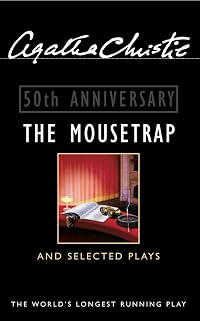
The Mousetrap and Selected Plays
by Agatha Christie
On This Page
Description
"Four Christie plays: "Go Back for Murder" -- "Appointment with Death" -- "The Hollow" -- and "The Mousetrap"--the longest running play in the history of London's West End"--Tags
Recommendations














Member Reviews
The Mousetrap and Selected Plays is a collection of four plays by Agatha Christie. It was published in the UK by Harper Collins in 1993.
The book contains four plays, And Then There Were None, Appointment with Death, The Hollow and The Mousetrap. All of these plays are based on some other previously published Christie work.
The first play in the book is And Then There Were None. It is a 1943 play. The play is based on the 1939 novel of the same name. This three act play takes place in an Island off the coast of Devon.
This play has a different conclusion from the novel as the novel’s conclusion was deemed unusable for the stage. I haven’t read the novel so I can’t say which is better or worse but the play is good. The way the tension show more builds up right till the very end is quite impressive.
As for the characters this is more of an ensemble act (just the way a play should have) so no single character stands out.
Appointment with Death is a 1945 three act play. It is based on her 1938 novel novel of the same name, which featured her famous creation Hercule Poirot.
This is not one of the usual ‘British countryside’ Christies. The play takes place in and around Petra, among its deserts and caves. The scorching heat of the desert plays a significant role here.
This adaptation is known as one of the most drastic reworking of a novel Christie ever did. Firstly, it eliminates the central figure of the story, Hercule Poirot. Secondly, it changes the identity of the killer.
The character of Mrs. Boynton is menacing to say the least. The kind of hold she has over her family is just plain frightening. The rest of the Boyntons are rather uninteresting. But that is the impression (of themselves) they are supposed to give to the audience/reader as it shows how much like lifeless dummies they have become at the hands of their tormentor. The characters of Dr Gerard and Sarah King are interesting. The scenes between Alderman Higgs and Lady Westholme are fun, especially as Higgs gets to have the last word (literally).
The next play, The Hollow is a 1951 three act play based on a 1946 Hercule Poirot novel of the same name.
I’ve read The Hollow both as a novel and as a play and in my opinion it works better as a play (is it any surprise that Christie herself felt that the novel would make a good play when many of the others felt it wouldn’t?)
She also maintained that the novel, The Hollow was “ruined” by the appearance of Poirot, which is again something I totally agree with. She decided to cut him out all together from the play and rework the story accordingly.
Among the characters, Lady Angkatell stands out. She may be a bit odd but she’s definitely a very original person. I liked her. The character of Dr John Christow is very self-centred. But so is Henrietta Angkatell. With Christow it’s obvious whereas with Henrietta it is less so.
And finally, The Mousetrap. The origins of this two act play is sort of complex. It was initially a short radio play named Three Blind Mice. This version of the play is based on a short story that was based on the original radio play! The name The Mousetrap comes (somewhat surprisingly) from the play Hamlet.
I found Mollie and Giles Ralston to be annoying. I didn’t like them and couldn’t really connect with them. I was especially irritated when Giles began to jump to conclusions regarding Mollie’s visit to London and her relationship with Christopher. Most of the other characters are bland and wooden or stereotypical.
Having said all that I must say that the story, the central theme, the setting, the narrative and the final twist are all simply splendid! I know of no other story where the setting and the plot of the story rises above its mundane characters! Just the isolation of the Monkswell Manor and the ever increasing suspense is enough for me to say that this play is definitely worth a read!
It is interesting to see how Christie reworked her own ideas and created new entities. To me a play only manages to intensify the suspenseful elements of her stories. The Mousetrap and Selected Plays is one of my favourites and I highly recommend it. show less
The book contains four plays, And Then There Were None, Appointment with Death, The Hollow and The Mousetrap. All of these plays are based on some other previously published Christie work.
The first play in the book is And Then There Were None. It is a 1943 play. The play is based on the 1939 novel of the same name. This three act play takes place in an Island off the coast of Devon.
This play has a different conclusion from the novel as the novel’s conclusion was deemed unusable for the stage. I haven’t read the novel so I can’t say which is better or worse but the play is good. The way the tension show more builds up right till the very end is quite impressive.
As for the characters this is more of an ensemble act (just the way a play should have) so no single character stands out.
Appointment with Death is a 1945 three act play. It is based on her 1938 novel novel of the same name, which featured her famous creation Hercule Poirot.
This is not one of the usual ‘British countryside’ Christies. The play takes place in and around Petra, among its deserts and caves. The scorching heat of the desert plays a significant role here.
This adaptation is known as one of the most drastic reworking of a novel Christie ever did. Firstly, it eliminates the central figure of the story, Hercule Poirot. Secondly, it changes the identity of the killer.
The character of Mrs. Boynton is menacing to say the least. The kind of hold she has over her family is just plain frightening. The rest of the Boyntons are rather uninteresting. But that is the impression (of themselves) they are supposed to give to the audience/reader as it shows how much like lifeless dummies they have become at the hands of their tormentor. The characters of Dr Gerard and Sarah King are interesting. The scenes between Alderman Higgs and Lady Westholme are fun, especially as Higgs gets to have the last word (literally).
The next play, The Hollow is a 1951 three act play based on a 1946 Hercule Poirot novel of the same name.
I’ve read The Hollow both as a novel and as a play and in my opinion it works better as a play (is it any surprise that Christie herself felt that the novel would make a good play when many of the others felt it wouldn’t?)
She also maintained that the novel, The Hollow was “ruined” by the appearance of Poirot, which is again something I totally agree with. She decided to cut him out all together from the play and rework the story accordingly.
Among the characters, Lady Angkatell stands out. She may be a bit odd but she’s definitely a very original person. I liked her. The character of Dr John Christow is very self-centred. But so is Henrietta Angkatell. With Christow it’s obvious whereas with Henrietta it is less so.
And finally, The Mousetrap. The origins of this two act play is sort of complex. It was initially a short radio play named Three Blind Mice. This version of the play is based on a short story that was based on the original radio play! The name The Mousetrap comes (somewhat surprisingly) from the play Hamlet.
I found Mollie and Giles Ralston to be annoying. I didn’t like them and couldn’t really connect with them. I was especially irritated when Giles began to jump to conclusions regarding Mollie’s visit to London and her relationship with Christopher. Most of the other characters are bland and wooden or stereotypical.
Having said all that I must say that the story, the central theme, the setting, the narrative and the final twist are all simply splendid! I know of no other story where the setting and the plot of the story rises above its mundane characters! Just the isolation of the Monkswell Manor and the ever increasing suspense is enough for me to say that this play is definitely worth a read!
It is interesting to see how Christie reworked her own ideas and created new entities. To me a play only manages to intensify the suspenseful elements of her stories. The Mousetrap and Selected Plays is one of my favourites and I highly recommend it. show less
A collection of short mysteries. Pleasing not so much for the difficulty of solving them, they're not difficult, but for the charm of the detectives and the stories.
Collection of 4 playscripts including The Mousetrap, and 3 other plays, adapted by Christie from her books.
The plays in this volume are: "The Mousetrap", "The Hollow", "And Then There Were None" (a.k.a "Ten little Indians"), & "Appointment With Death".
A nice addition to your Christie collection, and interesting to see how the plays were later novelised, or vice versa.
Note: This is the UK edition.
There's a different US edition; "The Mousetrap and Other Plays", which appears to have more plays in it than this one.
The plays in this volume are: "The Mousetrap", "The Hollow", "And Then There Were None" (a.k.a "Ten little Indians"), & "Appointment With Death".
A nice addition to your Christie collection, and interesting to see how the plays were later novelised, or vice versa.
Note: This is the UK edition.
There's a different US edition; "The Mousetrap and Other Plays", which appears to have more plays in it than this one.
Classic story of murder in a guest house - hampered by a snowstorm and cut phone lines. I enjoyed the story but I'd like to see the play performed.
Ratings
Members
- Recently Added By
Lists

Books Read in 2010
631 works; 11 members
Author Information

2,164+ Works 441,549 Members
One of the most successful and beloved writer of mystery stories, Agatha Mary Clarissa Christie was born in 1890 in Torquay, County Devon, England. She wrote her first novel, The Mysterious Affair at Styles, in 1920, launching a literary career that spanned decades. In her lifetime, she authored 79 crime novels and a short story collection, 19 show more plays, and six novels written under the name of Mary Westmacott. Her books have sold over a billion copies in the English language with another billion in 44 foreign languages. Some of her most famous titles include Murder on the Orient Express, Mystery of the Blue Train, And Then There Were None, 13 at Dinner and The Sittaford Mystery. Noted for clever and surprising twists of plot, many of Christie's mysteries feature two unconventional fictional detectives named Hercule Poirot and Miss Jane Marple. Poirot, in particular, plays the hero of many of her works, including the classic, The Murder of Roger Ackroyd (1926), and Curtain (1975), one of her last works in which the famed detective dies. Over the years, her travels took her to the Middle East where she met noted English archaeologist Sir Max Mallowan. They married in 1930. Christie accompanied Mallowan on annual expeditions to Iraq and Syria, which served as material for Murder in Mesopotamia (1930), Death on the Nile (1937), and Appointment with Death (1938). Christie's credits also include the plays, The Mousetrap and Witness for the Prosecution (1953; film 1957). Christie received the New York Drama Critics' Circle Award for 1954-1955 for Witness. She was also named Dame Commander of the Order of the British Empire in 1971. Christie died in 1976. (Bowker Author Biography) show less
Work Relationships
Common Knowledge
- Canonical title
- The Mousetrap and Selected Plays
- Disambiguation notice
- This anthology contains And then there were none, Appointment with death, The hollow, and The mousetrap. Please do not combine with other collections.
Classifications
Statistics
- Members
- 141
- Popularity
- 232,645
- Reviews
- 4
- Rating
- (3.83)
- Languages
- English, Finnish
- Media
- Paper
- ISBNs
- 3