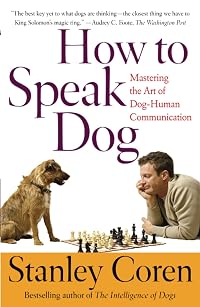
How To Speak Dog: Mastering the Art of Dog-Human Communication
by Stanley Coren
On This Page
Description
Parlez-vous Doggish? At long last, dogs will know just how smart their owners can be. By unlocking the secrets of the hidden language of dogs, psychologist Stanley Coren allows us into the doggy dialogue, or "Doggish," and makes effective communication a reality. Drawing on substantial research in animal behavior, evolutionary biology, and years of personal experience, Coren demonstrates that the average house dog can understand language at about the level of a two-year-old human. While show more actual conversation of the sort Lassie seemed capable of in Hollywood mythmaking remains forever out of reach, Coren shows us that a great deal of real communication is possible beyond the giving and obeying of commands. How to Speak Dog not only provides the sounds, words, actions, and movements with which we can effectively communicate with our dogs, but also deciphers the signs that our dogs give to us. With easy-to-follow tips on how humans can mimic the language dogs use to talk with one another, How to Speak Dog gives dog lovers the skills they need to improve their relationships with their pets. show lessTags
Recommendations


























Member Reviews
Coren very systematically looks at the "language" of dogs- how well they understand spoken human words and human gestures, or can be trained to do so. What the wide variety of sounds they make specifically mean, plus all the different uses of body language, and the combinations thereof- which can vary meaning and nuance more than I had realized. How cross-communication works, why cats and dogs are classic enemies (many of their basic body signals mean opposite things). How dogs communicate with scent (hilarious story in here about a man who tried urinating around his wife's flower bed to deter neighborhood dogs from digging in it). He uses scientific studies, personal observations and carefully examined anecdotes to demonstrate the show more discussed communications (or miscommunications, as it were). Even points out why some methods used by humans to dominate their dogs, or teach them who's "leader of the pack" such as flipping a dog forcefully on its back or biting it on the nose (!) are misguided and won't get the result you want. Through it all there are interesting passages on the evolution of dogs, comparison of dogs to wolves, comparison of dog intelligence to that of children (about equal to a two-year-old's, although their concerns with social status and the doings of other dogs are more adult in nature), descriptions of studies on animal intelligence and communication with other species.
To sum it all up- yes, dogs have their own form of language. They understand a lot, and can read incredibly subtle body language... I was surprised at how many kinds of dog expression are often misunderstood by humans... Fascinating stuff. A book I think every dog owner should read.
from the Dogear Diary show less
To sum it all up- yes, dogs have their own form of language. They understand a lot, and can read incredibly subtle body language... I was surprised at how many kinds of dog expression are often misunderstood by humans... Fascinating stuff. A book I think every dog owner should read.
from the Dogear Diary show less
As a dog lover I found this book highly entertaining, informative, rewarding, enlightening, and renewing. As a retired history teacher and wanna-be archaeologist/anthropologist, I have often concluded that there developed in our evolutionary past three distinct branches of human beings. These being homo sapien sapien, homo sapien neanderthal, and homo sapien canine :). So I found it especially interesting that early in the book the author, Stanley Coren, mentions a theory that our domestication of dogs might have been far earlier than commonly accepted. Perhaps as far back as 100,000 years ago. And because of this early date, we relied more and more on their smelling and tracking skills for the hunt than our own, which allowed our early show more human ancestors to evolve different facial features which resulted in the ability to form complex speech patterns. Our other human ancestors, Neanderthal, never developed a relationship with dogs, and they disappeared! (pp. 17-19). Could it be we owe our very survival to our domestication of dogs? show less
Stanley Cohen writes in a very personal, easy to digest manner about how to read the body language and vocalizations of your dog. Some of the chapters are "The Dog Speaks", "Body Talk", Tail Talk", "Eye Talk" and even "Dogs Talking To Cats". It has thorough behavior descriptions with wonderful insights on how to communicate effectively with your pet.
Should not be used as your only guide if you are new to dog training, best as a companion to a more formal training "how-to" guide.
Personally, I loved this book. It helped me understand my dogs' behavior and vastly improve their training, in a short amount of time. I finally realized that it was I producing mixed signals which confused my message. What a revelation...and so easily solved too!
Should not be used as your only guide if you are new to dog training, best as a companion to a more formal training "how-to" guide.
Personally, I loved this book. It helped me understand my dogs' behavior and vastly improve their training, in a short amount of time. I finally realized that it was I producing mixed signals which confused my message. What a revelation...and so easily solved too!
Another great book by Stanley Coren to help us better understand our canine friends. In this book, he explains not only how to interpret the different sound signals of dogs (eg. barks, growls,howls, whines etc.)but also the visual cues they provide with their body positions, ears,eyes, and faces. (The comprehensive appendix at the end
has a great reference section of visual cues and 'doggish phrases'.) He also offers advice on how people can best communicate with our dogs, so we can train them more easily and so that they better understand what we're saying. There is a lot to absorb in this book, and sometimes there is almost too much information. Overall, I enjoyed it and learned a lot, and I can see revisiting it as a reference tool.
has a great reference section of visual cues and 'doggish phrases'.) He also offers advice on how people can best communicate with our dogs, so we can train them more easily and so that they better understand what we're saying. There is a lot to absorb in this book, and sometimes there is almost too much information. Overall, I enjoyed it and learned a lot, and I can see revisiting it as a reference tool.
A great book that I love is "How to Speak Dog". It does not tell you how to have a convo with your dog or anything silly like that. What it does do is go into in depth body language of a dog. How wolves communicate with each other through body language....and how we can mimic a little. It was one of the best books I read.
Cairo's Mom
Cairo's Mom
Mastering the art of dog-human communication
One of the most famous and beloved experts in dog psychology shows us how to communicate with our canine companions. This is the only book to show us what dogs are trying to tell us, not just how we can control them.
Parlez-vous Doggish?
At long last, dogs will know just how smart their owners can be. By unlocking the secrets of the hidden language of dogs, psychologist Stanley Coren allows us into the doggy dialogue, or “Doggish,” and makes effective communication a reality.
Drawing on substantial research in animal behavior, evolutionary biology, and years of personal experience, Coren demonstrates that the average house dog can understand language at about the level of a two-year-old human. While actual conversation of the show more sort Lassie seemed capable of in Hollywood mythmaking remains forever out of reach, Coren shows us that a great deal of real communication is possible beyond the giving and obeying of commands.
How to Speak Dog not only provides the sounds, words, actions, and movements with which we can effectively communicate with our dogs, but also deciphers the signs that our dogs give to us. With easy-to-follow tips on how humans can mimic the language dogs use to talk with one another, original drawings illustrating the subtleties of their body language, and a handy visual glossary and “Doggish” phrasebook, How to Speak Dog gives dog lovers the skills they need to improve their relationships with their pets. show less
Parlez-vous Doggish?
At long last, dogs will know just how smart their owners can be. By unlocking the secrets of the hidden language of dogs, psychologist Stanley Coren allows us into the doggy dialogue, or “Doggish,” and makes effective communication a reality.
Drawing on substantial research in animal behavior, evolutionary biology, and years of personal experience, Coren demonstrates that the average house dog can understand language at about the level of a two-year-old human. While actual conversation of the show more sort Lassie seemed capable of in Hollywood mythmaking remains forever out of reach, Coren shows us that a great deal of real communication is possible beyond the giving and obeying of commands.
How to Speak Dog not only provides the sounds, words, actions, and movements with which we can effectively communicate with our dogs, but also deciphers the signs that our dogs give to us. With easy-to-follow tips on how humans can mimic the language dogs use to talk with one another, original drawings illustrating the subtleties of their body language, and a handy visual glossary and “Doggish” phrasebook, How to Speak Dog gives dog lovers the skills they need to improve their relationships with their pets. show less
Members
- Recently Added By
Lists

Favorite Animal Non-Fiction
293 works; 144 members
Author Information

25 Works 2,434 Members
Stanley Coren is a professor emeritus of psychology at the University of British Columbia. He is the author of The Intelligence of Dogs and other bestsellers about dogs and is the winner of the Maxwell Medal of Excellence from the Dog Writers Association of America. He, his wife, and their three dogs live in Vancouver, British Columbia.
Common Knowledge
- Original publication date
- 2000
Classifications
Statistics
- Members
- 515
- Popularity
- 58,475
- Reviews
- 8
- Rating
- (3.75)
- Languages
- 8 — Czech, Dutch, English, French, German, Italian, Polish, Spanish
- Media
- Paper, Audiobook, Ebook
- ISBNs
- 16
- ASINs
- 7