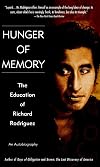
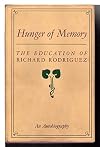
Hunger of Memory : The Education of Richard Rodriguez
by Richard Rodriguez
On This Page
Description
Hunger of Memory is the story of Mexican-American Richard Rodriguez, who begins his schooling in Sacramento, California, knowing just fifty words of English, and concludes his university studies in the stately quiet of the reading room of the British Museum. Here is the poignant journey of a "minority student" who pays the cost of his social assimilation and academic success with a painful alienation-from his past, his parents, his culture-and so describes the high price of "making it" in show more middle-class America. Provocative in its positions on affirmative action and bilingual education, Hunger of Memory is a powerful political statement, a profound study of the importance of language . . . and the moving, intimate portrait of a boy struggling to become a man. show lessTags
Recommendations

Member Reviews
A beautifully written book by a sad man alienated from his family, his past, and ultimately, himself.
The son of immigrants, Rodríguez believes that the only option for minorities is to "assimilate" (that is, live up to the majority's expectations and standards), and he thinks the only way to do that is by turning away from one's past and heritage. He also seems to think that racism (at least towards brown people) is mostly a matter of class and education.
I disagree with all of his conclusions, but I admit that I enjoyed his writing and sympathized with his sorrow.
The son of immigrants, Rodríguez believes that the only option for minorities is to "assimilate" (that is, live up to the majority's expectations and standards), and he thinks the only way to do that is by turning away from one's past and heritage. He also seems to think that racism (at least towards brown people) is mostly a matter of class and education.
I disagree with all of his conclusions, but I admit that I enjoyed his writing and sympathized with his sorrow.
Richard Rodriguez is a man whose education bifurcated his life into a private life and a public life. In the public sphere he was driven to obtain an education that has led him to become one of the most interesting essayists of our time. His description of his inner life, especially his reading life is one of many exceptional aspects of this book. His liberation from the private sphere into the public, where he has become a literary light for others, was made possible in part by this reading life; a life driven by a compulsion to become part of the "public sphere" that was centered in the culture apart from his family. This was a part of his life that I personally identified with and believe that many individuals who love the reading show more life will also.
In this memoir he explores his own coming-of-age in an America that challenged him to understand what it is to be a Mexican American and what it is to be a Catholic in America. At the heart of the memoir is Rodríguez’s recognition that his is a position of alienation, a position that he accepts with resignation and regret. As the title of this collection of autobiographical pieces suggests, he remembers his early childhood with nostalgia, while acknowledging that his coming-of-age has resulted in his displacement from that simple, secure life.
Another center for his autobiography is language and the importance of it in his life. He did not speak English until he started to go to school and even then it was difficult for him to learn the language for it was not spoken at home. One exciting moment in his education occurred when three nuns from his grade school visited his home and encouraged his parents to support their children's English language skills. Although they were indifferent speakers of English, his parents from that point forward asked their children, Richard and his brother and sisters, to speak English each evening. Richard, through this practice and his own diligence in reading and writing, would go on to major in English in college eventually doing postgraduate work in Renaissance Studies.
He shares the hard work that all this entailed and his critical reaction to the growth of bi-lingual education. His courage in developing and maintaining an independent voice for his beliefs in this regard also help to make his story unique. In his view bilingual education prevents children from learning the public language that will be their passport to success in the public world, and he uses his own experience—being a bilingual child who was educated without bilingual education as it was introduced into the American school system in the 1960’s—as an example.
Rodríguez offers himself as another example in criticizing affirmative action programs. Turning down offers to teach at various post secondary educational institutions that he believed wanted to hire him simply because he was Latino, Rodríguez began what has been his persistent criticism of affirmative action policies in America. His uncompromising position in this matter led him to leave academia and pursue his writing skills as a journalist and essayist. His devotion to education in language and life helped him develop the voice that he shares in his journalistic and readable prose style.
I first encountered his voice while watching the News Hour on PBS where he was an essayist for many years. The style he demonstrated there is present on every page of his autobiography. I would highly recommend this for anyone interested in the development of a humane intellectual. show less
In this memoir he explores his own coming-of-age in an America that challenged him to understand what it is to be a Mexican American and what it is to be a Catholic in America. At the heart of the memoir is Rodríguez’s recognition that his is a position of alienation, a position that he accepts with resignation and regret. As the title of this collection of autobiographical pieces suggests, he remembers his early childhood with nostalgia, while acknowledging that his coming-of-age has resulted in his displacement from that simple, secure life.
Another center for his autobiography is language and the importance of it in his life. He did not speak English until he started to go to school and even then it was difficult for him to learn the language for it was not spoken at home. One exciting moment in his education occurred when three nuns from his grade school visited his home and encouraged his parents to support their children's English language skills. Although they were indifferent speakers of English, his parents from that point forward asked their children, Richard and his brother and sisters, to speak English each evening. Richard, through this practice and his own diligence in reading and writing, would go on to major in English in college eventually doing postgraduate work in Renaissance Studies.
He shares the hard work that all this entailed and his critical reaction to the growth of bi-lingual education. His courage in developing and maintaining an independent voice for his beliefs in this regard also help to make his story unique. In his view bilingual education prevents children from learning the public language that will be their passport to success in the public world, and he uses his own experience—being a bilingual child who was educated without bilingual education as it was introduced into the American school system in the 1960’s—as an example.
Rodríguez offers himself as another example in criticizing affirmative action programs. Turning down offers to teach at various post secondary educational institutions that he believed wanted to hire him simply because he was Latino, Rodríguez began what has been his persistent criticism of affirmative action policies in America. His uncompromising position in this matter led him to leave academia and pursue his writing skills as a journalist and essayist. His devotion to education in language and life helped him develop the voice that he shares in his journalistic and readable prose style.
I first encountered his voice while watching the News Hour on PBS where he was an essayist for many years. The style he demonstrated there is present on every page of his autobiography. I would highly recommend this for anyone interested in the development of a humane intellectual. show less
Unlike Richard Rodriguez I'm not a Mexican-American, but I did grow up in a Spanish-speaking household since my mother is Puerto Rican. Of all the books about and by Hispanics I've read before or since, this is the one I most identified with, that really resonated and spoke to me. I could see much about my family reflected in his--attitudes towards education, skin color, religion... This book indeed was assigned reading in a Sociology class, because it does fit into that discipline. But it's also known for Rodriguez' positions within it on Affirmative Action and Bilingual Education--which I agreed with--particularly after reading this. He talks about what he lost with the intimacy built by speaking Spanish, yes--but that to function in show more America what he needed was a public language--which in this country means English first and foremost. And that to gain that public voice and move into the mainstream of American society such a sacrifice is crucial and necessary. It's also a moving, powerful, and beautifully written biography. show less
I was privileged to meet the author at a writer's workshop in Sacramento years ago, and used to enjoy his essays on PBS New Hour. Though not Mexican myself, I spent several years in Mexico and am fairly fluent in Spanish, and I still identify with Mexico as my home away from home. Both in Texas and California, I've had many Mexican-American co-workers who have never been to Mexico and do not speak Spanish. So I read Richard's essay with interest, wanting more insights into the Mexican immigrant experience.
Now, reading the reviews, I'm a little surprised at the strong negative reactions. Yes, he believes that affirmative action and bilingual ed do more harm than good -- which is controversial -- but he's wanting the same thing we all show more want: for Mexican-Americans to succeed. He offers one possible path to the same goal. (Which I might agree with, as long as they retain their Spanish and their culture, which is such a rich heritage. My adopted kids are retaining their culture in Spanish Immersion school, but they didn't have to learn English.)
Whether you agree with Richard nor not, I think his heart is in the right place. But he gets only 4 stars, as his writing could be a little more polished. show less
Now, reading the reviews, I'm a little surprised at the strong negative reactions. Yes, he believes that affirmative action and bilingual ed do more harm than good -- which is controversial -- but he's wanting the same thing we all show more want: for Mexican-Americans to succeed. He offers one possible path to the same goal. (Which I might agree with, as long as they retain their Spanish and their culture, which is such a rich heritage. My adopted kids are retaining their culture in Spanish Immersion school, but they didn't have to learn English.)
Whether you agree with Richard nor not, I think his heart is in the right place. But he gets only 4 stars, as his writing could be a little more polished. show less
An internal memoir, more an explanation of who he is instead of a transformative or redemptive memoir. He relates his thoughts and feelings about external events and the external world, as opposed to following a classic character arc of challenge and change. I disagreed with much of what he said, but agreed with just as much. It is a complex, deeply personal autobiography, and overall recommended as an exemplar of its form.
Groundbreaking in its day, the now-predictable story of a latino youth overcoming race, poverty and hardship to gain an education. Straightforward clean writing with honest and clear, nonjudging viewpoint.
The history of a bilingual education. An intellectual biography of a Mexican American from a Catholic school kid to a college professor.. Richard Rodriguez's assimilation is distinct. Although his academic achievement amazed himself and others it came with great loss of family closeness. He is opinionated about the affirmative action that others assumed enabled but was not the case for him. Highly recommended for high school seniors and first year college students or anyone wanting a better understanding of how education brings about deeper changes than one would ever expect. Contemplating this autobiography may cause the reader to be more reflective about their own life long learning.
Members
- Recently Added By
Lists

The Well-Educated Mind Reading Challenge
75 works; 7 members

Well-Educated Mind
150 works; 3 members

Mustich's 1000 Books to Read Before You Die: A Life Changing List
1,001 works; 19 members

The Well-Educated Mind, Susan Wise Bauer, 2016
179 works; 3 members
Author Information

16+ Works 1,885 Members
Richard Rodriguez works as an editor at the Pacific News Service in San Francisco and is a contributing editor for Harper's magazine and the Sunday "Opinion" section of the Los Angeles Times.
Awards and Honors
Awards
Distinctions
Work Relationships
Has as a student's study guide
Common Knowledge
- Original title
- Hunger of Memory: The education of Richard Rodriguez
- Alternate titles
- Hambre de memoria: la educación de Richard Rodriguez
- Original publication date
- 1982
Classifications
- Genres
- Biography & Memoir, Nonfiction, General Nonfiction
- DDC/MDS
- 420.4261 — Language English & Old English languages English and Old English (Anglo-Saxon) Special topics of subdivisions of individual languages and language families Bilingualism Spanish, Portuguese, Galician Spanish
- LCC
- F870 .M5 .R62 — Local History of the United States, Canada and Latin America United States local history California
- BISAC
Statistics
- Members
- 993
- Popularity
- 26,418
- Reviews
- 18
- Rating
- (3.44)
- Languages
- English, Spanish
- Media
- Paper, Audiobook, Ebook
- ISBNs
- 12
- ASINs
- 13