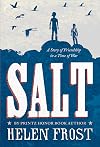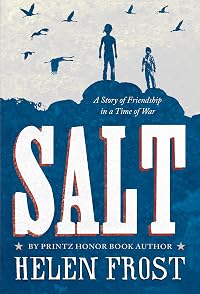
Salt: A Story of Friendship in a Time of War
by Helen Frost
On This Page
Description
Twelve-year-olds Anikwa, of the Miami village of Kekionga, and James, of the trading post outside Fort Wayne, find their friendship threatened by the rising fear and tension brought by the War of 1812.Tags
Recommendations















Member Recommendations
Member Reviews
I have loved all of Helen Frost's books. This one was a little more special to me. I grew up in Indiana. I lived on a farm until we moved to Florida when I was fourteen. One of my favorite past-times along with my sisters was looking for arrowheads on our property. Helen's book about a friendship between a Native American Family and a white family was hopeful and hard at the same time. What do you do when you hear rumblings of war? For James and his family who have a trading post outside the fort, they continue on the way they have always gone. They trade with the Indians, who are their friend. James best friend is Anikwa, a young boy of the Kekionga, a part of the Miami tribe. He too has heard rumblings of war. Many of his people have show more decided they will side with the British if it comes to war.
I felt so terrible for James and his family. James had to witness his friend Isaac's hatred for the Native Americans. He really has no basis to his hatred, which makes it all the more tragic. As I read and saw what each side did I wondered if Anikwa and James could remain friends. You will need to read the book to find out what happened. show less
I felt so terrible for James and his family. James had to witness his friend Isaac's hatred for the Native Americans. He really has no basis to his hatred, which makes it all the more tragic. As I read and saw what each side did I wondered if Anikwa and James could remain friends. You will need to read the book to find out what happened. show less
Anikwa and James, twelve years old in 1812, spend their days fishing, trapping, and exploring together in the forests of the Indiana Territory. To Anikwa and his family, members of the Miami tribe, this land has been home for centuries. As traders, James's family has ties to the Miami community as well as to the American soldiers in the fort. Now tensions are rising—the British and American armies prepare to meet at Fort Wayne for a crucial battle, and Native Americans from surrounding tribes gather in Kekionga to protect their homeland. After trading stops and precious commodities, like salt, are withheld, the fort comes under siege, and war ravages the land. James and Anikwa, like everyone around them, must decide where their show more deepest loyalties lie. Can their families—and their friendship—survive? show less
James is a young American settler living at Ft. Wayne. His father runs the trading post there. Anikwa is a Native American boy living with his family in a nearby village. The two boys play, hunt, and fish together, and the families are on friendly terms and trade for the things they need -- salt to cure the meat Anikwa's family hunts, moccasins for James, which he finds more comfortable than the stiff boots his friends wear. But war is coming. Neither James' family nor the Miami tribe want to fight, but they may not have a choice when troops of British and American soldiers are pouring into the area, and nearby tribes have made agreements with the British that they will fight with them in exchange for land rights. Can James and Anikwa's show more friendship survive the turmoil of war?
I find stories like this bittersweet, since we all know where the story goes from here for Anikwa's people. I felt the sensitive cultural details were handled better in this book than in some, though the scant text of a verse novel leaves little room for any kind of description, context, or development. Perhaps the verse format is my largest issue with this book: I have read many verse novels, but few stand out as exemplary either as verse or as novels. I often feel constricted by the format, or frustrated at the sparseness of the text. Many times it just seems like chopped-up prose, and though there were a few pages where I felt that the format of this book worked, in most cases it was just an interesting visual effect. The author has chosen to arrange Anikwa's segments of the story in an undulating pattern resembling Miami ribbonwork, while James' lines run in stripes across the page -- my initial thought was that it was meant to bring to mind a log cabin, but the author's note indicated that it's meant to represent the stripes of the American flag. I did enjoy reading this book, don't get me wrong -- I'm just not sold on the format, which I think undercuts some of what the author is trying to accomplish in this story. However, readers who enjoy verse novels in general might find this one worth a look. show less
I find stories like this bittersweet, since we all know where the story goes from here for Anikwa's people. I felt the sensitive cultural details were handled better in this book than in some, though the scant text of a verse novel leaves little room for any kind of description, context, or development. Perhaps the verse format is my largest issue with this book: I have read many verse novels, but few stand out as exemplary either as verse or as novels. I often feel constricted by the format, or frustrated at the sparseness of the text. Many times it just seems like chopped-up prose, and though there were a few pages where I felt that the format of this book worked, in most cases it was just an interesting visual effect. The author has chosen to arrange Anikwa's segments of the story in an undulating pattern resembling Miami ribbonwork, while James' lines run in stripes across the page -- my initial thought was that it was meant to bring to mind a log cabin, but the author's note indicated that it's meant to represent the stripes of the American flag. I did enjoy reading this book, don't get me wrong -- I'm just not sold on the format, which I think undercuts some of what the author is trying to accomplish in this story. However, readers who enjoy verse novels in general might find this one worth a look. show less
CW: racism, starvation
Well that was an interesting verse novel about a friendship at odds with the shifting views prior to the 1812 war.
Twelve year olds Anikwa and James struggle to understand the growing tension between their people as preparations for a seige at Fort Wayne are underway. James' trading community are starting to turn against Anikwa's Native American Miami tribe with devastating consequences. I didn't know anything about this period in US history and spent quite some time after on the intermaweb with Mrs Google learning about the seige at Fort Wayne and the 1812 war. An interesting middle school novel that would be a good introduction to this period of conflict.
Well that was an interesting verse novel about a friendship at odds with the shifting views prior to the 1812 war.
Twelve year olds Anikwa and James struggle to understand the growing tension between their people as preparations for a seige at Fort Wayne are underway. James' trading community are starting to turn against Anikwa's Native American Miami tribe with devastating consequences. I didn't know anything about this period in US history and spent quite some time after on the intermaweb with Mrs Google learning about the seige at Fort Wayne and the 1812 war. An interesting middle school novel that would be a good introduction to this period of conflict.
Both James and Anikwa understand the need for their families survival, as War (1812) approaches, this has never been more clear to the fraying friendship of the son of Indiana Settlers and the son of a Miami Tribe. The constraints of their language barriers have complicated a series of misunderstandings which now jeopardize not only their friendship, once built upon companionable activities of fishing, etc but now threatened by the dwindling food supplies and growing tensions, will be stretched to the limits of their sense of decency and trust of each other. Frost brings the very real life and death struggles of their communities home, while keeping the concerns of the friendship foremost in the reader's heart.
 This review was written for LibraryThing Early Reviewers.
A must read (or listen!) for fans of middle grade historical fiction! Set in 1812 at the onset of the war, twelve year old white settler, James, and twelve year old Miami Indian, Anikwa, discover what it is that separates them and what it is that binds them. Can they remain friends as war looms closer to Fort Wayne, Indiana?Their days were spent trapping, fishing, playing, and exploring, but now they must grow up and be men. They need to decide whose side they're on: the British, the Americans, The Indians, or their own.
Told through the alternating perspectives of both James and Anikwa, this story brings to life their friendship and the cultures that surrounded them. As the tagline suggested, this truly is "A story of friendship in the show more time of war." Boys especially, will like the hunting and wilderness aspects, but there is enough historical intrigue and friendship to interest female readers as well.
The audiobook edition to which I listened to, also added an entire new dimension to the story. The narrators were brilliant and really helped narrarted the concerns and emotions of the two twelve year old friends.
I received this book for free from Librarything Early Reviewers in return for my honest and unbiased opinion. show less
Told through the alternating perspectives of both James and Anikwa, this story brings to life their friendship and the cultures that surrounded them. As the tagline suggested, this truly is "A story of friendship in the show more time of war." Boys especially, will like the hunting and wilderness aspects, but there is enough historical intrigue and friendship to interest female readers as well.
The audiobook edition to which I listened to, also added an entire new dimension to the story. The narrators were brilliant and really helped narrarted the concerns and emotions of the two twelve year old friends.
I received this book for free from Librarything Early Reviewers in return for my honest and unbiased opinion. show less
This review was written for LibraryThing Early Reviewers.Set in 1812 Indiana, Salt tells in alternating prose and poetry, the story of two boys, James and Anikwa, a European settler and a Miama native, who are friends. When the British and American armies converge on their villages, the boys are caught between opposing views. James' mother is based loosely on thehistorical figure of Angeline Chapeteau Peltier, who was a peacemaker. My favorite prose sections are the interludes about salt: "THIS GAZE. THESE DEEP BROWN EYES. People follow deer/through the forest,/watching where they lick the ground.//The people scrape salt/into their hands, their baskets. They taste/the salt, bring it home.//Again and again, does and bucks and fawns,/porcupines and people,/meet at the salt place. Beautiful, show more heartbreaking, unique form. Includes map, character list, notes on form, salt, and names, and a glossary of Miami (Myaamia) words. show less
Members
- Recently Added By
Lists

Novels in verse -- children's/young adult fiction
28 works; 7 members
Author Information

137+ Works 8,674 Members
Author Helen Frost was born in Brookings, South Dakota in 1949. She received a Bachelors degree in Elementary Education with an English concentration from Syracuse University and a Masters degree in English from Indiana University. She has taught writing from pre-school through university and has published poetry, children's books, anthologies, a show more play, and a book about teaching writing. Skin of a Fish, Bones of a Bird, a collection of poetry, won the Women Poets Series Competition in 1993. Poems from that collection were awarded the Robert H. Winner Memorial Award and the Mary Carolyn Davies Memorial Award by the Poetry Society of America. She worked with the Fort Wayne YWCA and the Fort Wayne Youtheatre to help high school students write about how they had been affected by violence. This workshop led to a play and an anthology of student writing, both entitled Why Darkness Seems So Light. Keesha's House was awarded a Michael L. Printz Honor from the American Library Association in 2004. (Bowker Author Biography) show less
Awards and Honors
Awards
Distinctions
Notable Lists
Common Knowledge
- Original publication date
- 2013
- People/Characters
- Anikwa; James
- Important places
- Fort Wayne, Indiana, USA
- Important events
- War of 1812
- Epigraph
- "We told each other that we would in future be friends, doing all the good we could to each other, and raise our children in peace and quietness." -Mihsihkinaahkwa, Miami Chief (Little Turtle) to William H. Harrison, Governor... (show all) of the Indiana Territory, September 4, 1811
- Dedication
- For/Frances Foster/salt of the earth/beloved editor/and friend
- First words
- SALT IN THE SEA, SALT ON THE EARTH // A shallow sea/moves over the earth,/salty, sun-warmed./Water rises/as mist,/fog, clouds,/leaving a thin coat/of salt on the ground.
JAMES: Dang mosquito bit me right where I can't reach it. - Last words
- (Click to show. Warning: May contain spoilers.)ANIKWA: We send/our music out into the darkening sky/and let the river carry it.
(Click to show. Warning: May contain spoilers.)NOW THE SUGAR MAPLE // As they once led us to salt,/now they sow us/hw to find this small sweet taste,/moving up and out/into new buds, each branch/offering to sky/a gift of light and shadow.
Classifications
- Genres
- Poetry, Fiction and Literature, Tween, Kids, Children's Books
- DDC/MDS
- 813.0835 — Literature & rhetoric American literature in English American fiction in English By type Genre fiction Realistic fiction
- LCC
- PZ7.5 .F76 .S — Language and Literature Fiction and juvenile belles lettres Fiction and juvenile belles lettres Juvenile belles lettres
- BISAC
Statistics
- Members
- 348
- Popularity
- 90,775
- Reviews
- 25
- Rating
- (3.85)
- Languages
- English
- Media
- Paper, Audiobook, Ebook
- ISBNs
- 10
- ASINs
- 4