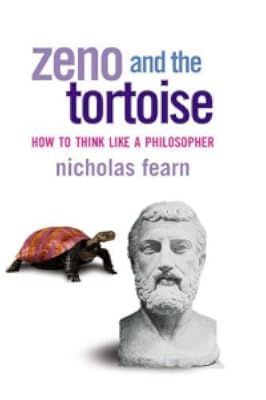
Zeno and the Tortoise: How to Think Like a Philosopher
by Nicholas Fearn
On This Page
Description
From the author of The Latest Answers to the Oldest Questions, a philosophical guide that's "great for sounding cleverer than you really are" ( Men's Health ). For those who don't know the difference between Lucretius's spear and Hume's fork, Zeno and the Tortoise explains not just who each philosopher was and what he thought, but exactly how he came to think in the way he did. In a witty and engaging style that incorporates everything from Sting to cell phones to Bill Gates, Fearn show more demystifies the ways of thought that have shaped and inspired humanity-among many others, the Socratic method, Descartes's use of doubt, Bentham's theory of utilitarianism, Rousseau's social contract, and, of course, the concept of common sense. Along the way, there are fascinating biographical snippets about the philosophers themselves: the story of Thales falling down a well while studying the stars, and of Socrates being told by a face-reader that his was the face of a monster who was capable of any crime. Written in twenty-five short chapters, each readable during the journey to work, Zeno and the Tortoise is the ideal course in intellectual self-defense. Acute, often irreverent, but always authoritative, this is a unique introduction to the ideas that have shaped us all. "A large, crafty bag of brilliant tools... an academic arsenal of philosophical weapons that are keen for slicing and stabbing through the slippery profoundities of day-to-day decision-making and right into the middle of dinner-party conversations of which you would have otherwise been left out." - Philosophy Now show lessTags
Recommendations



















Member Reviews
I really enjoyed reading this book and if the topic of philosophy and thinking is of interest but seems somewhat impenetrable, this could be a book you’d enjoy.
The book is divided into 25 brief chapters each covering a major philosopher and their ideas. I was initially attracted by the intriguing title and the accessible format of the book. Each chapter is limited to around half a dozen pages which immediately creates confidence that even if you felt you were drowning, the far bank is close at hand. Add to this Nicholas Fearn’s style and approach and you have an entertaining and engaging read and actually learn something of philosophy.
The danger with any book on this topic is that philosophy can feel somewhat distant and crusty. To show more counter this within each chapter the relevance of each idea and the desire to read on is established by setting the idea in a modern situation. For example the chapter on Plato’s thinking relates this to the anti-trust law suit brought against Microsoft for including an internet browser within Windows and the thinking of Protagoras is related to the efforts of Sting to help the Kayapo Indians of the Amazon. Each chapter provides background to the philosopher’s life and those ideas and other thinkers that influenced and sometimes competed with them.
The book provides a roughly chronological view of some of the key thinkers who have made a significant contribution to the development of understanding and links their work to the social, technical and other changes that have accompanied the advances, It includes one or two interesting modern names that I hadn’t thought of as philosophers which further helps break down the barriers between philosophy as a subject and its application in our everyday lives. For example Alan Turing the computing pioneer who played a key role in breaking the German Enigma codes is included for his thinking on consciousness.
If philosophy is one of those topics that you would like to know a little more about but never quite get around to this could be what you need. It an educational and fun read and I suspect that can’t be said for many books on the topic.
Incidentally the book title is taken from the paradox described by Zeno of a race between Achilles and a tortoise. The tortoise is given a 10 yard head start and in the time taken by Achilles to cover these ten yards the tortoise advances a further yard. Achilles advances this further yard and in the time it takes the tortoise advances three inches. Achilles now covers this three inches but in this time the tortoise advances a further inch. As Achilles advances this one inch the tortoise again moves some albeit small distance forwards. Zeno’s parable argues that no matter how fast Achilles runs he can never overtake the tortoise as he must first draw level with it. An interesting thought. show less
The book is divided into 25 brief chapters each covering a major philosopher and their ideas. I was initially attracted by the intriguing title and the accessible format of the book. Each chapter is limited to around half a dozen pages which immediately creates confidence that even if you felt you were drowning, the far bank is close at hand. Add to this Nicholas Fearn’s style and approach and you have an entertaining and engaging read and actually learn something of philosophy.
The danger with any book on this topic is that philosophy can feel somewhat distant and crusty. To show more counter this within each chapter the relevance of each idea and the desire to read on is established by setting the idea in a modern situation. For example the chapter on Plato’s thinking relates this to the anti-trust law suit brought against Microsoft for including an internet browser within Windows and the thinking of Protagoras is related to the efforts of Sting to help the Kayapo Indians of the Amazon. Each chapter provides background to the philosopher’s life and those ideas and other thinkers that influenced and sometimes competed with them.
The book provides a roughly chronological view of some of the key thinkers who have made a significant contribution to the development of understanding and links their work to the social, technical and other changes that have accompanied the advances, It includes one or two interesting modern names that I hadn’t thought of as philosophers which further helps break down the barriers between philosophy as a subject and its application in our everyday lives. For example Alan Turing the computing pioneer who played a key role in breaking the German Enigma codes is included for his thinking on consciousness.
If philosophy is one of those topics that you would like to know a little more about but never quite get around to this could be what you need. It an educational and fun read and I suspect that can’t be said for many books on the topic.
Incidentally the book title is taken from the paradox described by Zeno of a race between Achilles and a tortoise. The tortoise is given a 10 yard head start and in the time taken by Achilles to cover these ten yards the tortoise advances a further yard. Achilles advances this further yard and in the time it takes the tortoise advances three inches. Achilles now covers this three inches but in this time the tortoise advances a further inch. As Achilles advances this one inch the tortoise again moves some albeit small distance forwards. Zeno’s parable argues that no matter how fast Achilles runs he can never overtake the tortoise as he must first draw level with it. An interesting thought. show less
Very interesting concept, poorly carried out.
Bu kitap içindeki felsefeciler nüanslar ve bu kitap içindeki felsefeciler hakkındaki linkler konuşmalar vs. bulunacak ve kitap yeniden göz atılırcasına okunacak.
Um guia inteligente e bem-humorado para algumas das maiores ideias da filosofia ocidental, Aprendendo a filosofar em 25 lições demonstra exatamente como cada filósofo veio a pensar da maneira que pensou, e liga as contribuições essenciais de cada um deles a situações práticas e eventos recentes. Com isso, pretende que qualquer leitor seja capaz de raciocinar em linhas semelhantes, colocando em prática o pensamento filosófico de Tales a Derrida, passando por Platão, Maquiavel, Kant, Nietzsche e muitos outros. Não se trata de um inventário exaustivo de filósofos e ideias – a preocupação do autor é dar ao leitor comum a informação mais útil e facilmente assimilável. São 25 capítulos curtos, escritos em linguagem show more clara, que podem ser consultados separadamente. Um livro para leigos e interessados em geral, e ideal para as salas de aula. show less
Jun 4, 2024Portuguese (Brazil)
Ratings
Members
- Recently Added By
Lists

Books I Would Like to Acquire
20 works; 1 member
Author Information
3+ Works 467 Members
Nicholas Fearn, a philosophy graduate from King's College, London, is a contributor to the Independent on Sunday, Financial Times, Spectator, and New Statesman
Classifications
Statistics
- Members
- 335
- Popularity
- 94,752
- Reviews
- 4
- Rating
- (3.10)
- Languages
- 14 — Czech, Danish, Dutch, English, Finnish, French, German, Greek, Hungarian, Italian, Polish, Portuguese, Spanish, Swedish
- Media
- Paper, Ebook
- ISBNs
- 22
- ASINs
- 2