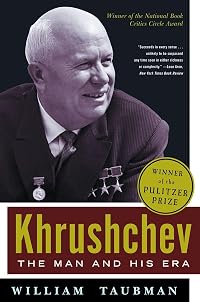
Khrushchev: The Man and His Era
by William Taubman
On This Page
Description
What was known about Soviet premier Nikita Khrushchev during his career was strictly limited by the secretive Soviet government. Little more information was available after he was ousted and became a "non-person" in the USSR in 1964. This pathbreaking book draws for the first time on a wealth of newly released materials-documents from secret former Soviet archives, memoirs of long-silent witnesses, the full memoirs of the premier himself-to assemble the best-informed analysis of the show more Khrushchev years ever completed. The contributors to this volume include Russian, Ukrainian, American, and British scholars; a former key foreign policy aide to Khrushchev; the executive secretary of a Russian commission investigating Soviet-era repressions and rehabilitations; and Khrushchev's own son Sergei. The book presents and interprets new information on Khrushchev's struggle for power, public attitudes toward him, his role in agricultural reform and cultural politics, and such foreign policy issues as East-West relations, nuclear strategy, and relations with Germany. It also chronicles Khrushchev's years in Ukraine where he grew up and began his political career, serving as Communist party boss from 1938 to 1949, and his role in mass repressions of the 1930's and in destalinization in the 1950's and 1960's. Two concluding chapters compare the regimes of Khrushchev and Gorbachev as they struggled to reform Communism, to humanize and modernize the Soviet system, and to answer the haunting question that persists today: Is Russia itself reformable? show lessTags
Recommendations




Member Recommendations

by anonymous user
Member Reviews
This is a splendidly detailed and expertly researched biography, while still being eminently readable. It brings out the enormous strengths and exuberant humanity of its subject, as well as his fatal weaknesses, hypocrisies and explosive tendency to alienate those who politically could have been his allies, e.g. the intelligentsia. I am always sorry for him when I read accounts of his ouster, though (one minor flaw) the material on that is all at the beginning of the book, not in its chronological place in the narrative, so that when I went back to skim through it again after the penultimate chapter ended 10 days before the ouster, I felt a little less sorry for him, being able to understand how impossible he must have been to work show more with. The final chapter details the sorry and shabby treatment he and his family received following his ouster, including being immediately expunged from the media. I have read editions of Pravda from the day of his ouster onwards and he really does literally vanish from the Soviet political world in print, no personal mentions at all, even negative ones. There is no entry for him in editions of the Great Soviet Encyclopaedia published afterwards. Perhaps the most apposite epitaph is Roy Medvedev's, though some qualification must be added: Khrushchev rehabilitated 20 million people sent to the Gulag under Stalin and this outweighs all his faults and mistakes, albeit that Khrushchev was himself complicit in many of these repressions. show less
I found the book, ultimately, rather boring, which is sad because K was not a boring man. I was also confused for about the first tbird of the book because I was constantly confused as to "when" I was. It took me that long to realize Taubman's biography was a mix of topical and chronological but with the emphasis on topical. Because of this, some events and conversations were covered more than once. In a book this long, that is irritating.
I felt I gained a better understand of the goals and efforts of the Soviet Union under K as well as a much better understanding of the US fear of communistic goals to take over smaller third world countries and the Soviet pledge to encourage rebellion wherever there was any dissent. I appreciated the show more irony that, toward the end of his life, he became almost a dissident but actually became a political criminal. And his son Sergei carried out the greatest irony of all:
"In 1991, Sergei Khurshchev (K's son) moved to Providence Rhode Island where he has since been a fellow at ... Brown University, teaching.... Sergei and his wife, Velentina, obtained American citizenship in 1999, an act that outraged many Russians. Even those who aren't nostalgic for communism are chagrined at how empty Nikita Khrushchev's boasts turned out to be. Khrushchev crowed that grandchildren of Americans he met would live under communism. Instead his own son is living under capitalism."
Asked if there was anything he regretted, Nikita Khrushchev said it was all the blood, that he was up to his elbows in blood.
One other thing struck me as I read was how similar in personality are Khrushchev and President Trump. For both, disagreement is defined as disloyalty. Like K, Trump will get an idea that he wants to implement some policy and refuses to listen to advisers explaining why that is impractical or inadvisable. He wants it, it will be done. Don't talk to him about compromise. Both tout pseudo science and fake science as real and important. And neither had/has a concept of decorum. One remembers the tale of K's banging his shoe on the table at the UN. Following that, he was proud he did it. As he was ousted from office, K's detractors pointed out that, after several years, he still saw it as something of valor rather than embarrassing for a world leader to do and harmful to the reputation of the nation. Of similar vein, Trump chiding on Twitter to North Korea's threats of nuclear attacks that "we have a bigger button". The world saw, with both events. What An Idiot. But the Soviet Union had an excuse -- Khruschev took over. Trump was elected.
Yet, ultimately, although K did many, many very harmful things to the Soviet Union, his move away from the horrors of Stalinism and his move toward reforms paved the way for the glastnost of Gorbachov. As much harm as he did to his country, he also did good. Will Trump be seen, historically, in the same way, despite his harm did he also do good and will the good outweigh the harm? With Khrushchev, it did not. show less
I felt I gained a better understand of the goals and efforts of the Soviet Union under K as well as a much better understanding of the US fear of communistic goals to take over smaller third world countries and the Soviet pledge to encourage rebellion wherever there was any dissent. I appreciated the show more irony that, toward the end of his life, he became almost a dissident but actually became a political criminal. And his son Sergei carried out the greatest irony of all:
"In 1991, Sergei Khurshchev (K's son) moved to Providence Rhode Island where he has since been a fellow at ... Brown University, teaching.... Sergei and his wife, Velentina, obtained American citizenship in 1999, an act that outraged many Russians. Even those who aren't nostalgic for communism are chagrined at how empty Nikita Khrushchev's boasts turned out to be. Khrushchev crowed that grandchildren of Americans he met would live under communism. Instead his own son is living under capitalism."
Asked if there was anything he regretted, Nikita Khrushchev said it was all the blood, that he was up to his elbows in blood.
One other thing struck me as I read was how similar in personality are Khrushchev and President Trump. For both, disagreement is defined as disloyalty. Like K, Trump will get an idea that he wants to implement some policy and refuses to listen to advisers explaining why that is impractical or inadvisable. He wants it, it will be done. Don't talk to him about compromise. Both tout pseudo science and fake science as real and important. And neither had/has a concept of decorum. One remembers the tale of K's banging his shoe on the table at the UN. Following that, he was proud he did it. As he was ousted from office, K's detractors pointed out that, after several years, he still saw it as something of valor rather than embarrassing for a world leader to do and harmful to the reputation of the nation. Of similar vein, Trump chiding on Twitter to North Korea's threats of nuclear attacks that "we have a bigger button". The world saw, with both events. What An Idiot. But the Soviet Union had an excuse -- Khruschev took over. Trump was elected.
Yet, ultimately, although K did many, many very harmful things to the Soviet Union, his move away from the horrors of Stalinism and his move toward reforms paved the way for the glastnost of Gorbachov. As much harm as he did to his country, he also did good. Will Trump be seen, historically, in the same way, despite his harm did he also do good and will the good outweigh the harm? With Khrushchev, it did not. show less
This is a recent biography of Nikita Sergeyevitch Khrushchev, written in English and taking advantage of all the recent scholarship and documents made available in Russia. In addition, the author worked extensively with Sergei Khrushchev, the son who is now an American citizen.
Khrushchev celebrated his birthday on 17 April (when his birth was registered) but was actually born on 15 April 1894 (or 3 April by the old style calendar used before the revolution) in the small village of Kalinovka in Southern Russia. He lived there until 1908 when he moved to the eastern Ukranian town of Yuzovka where his father worked in the mines.
But the biography doesn’t begin with his birth, rather with this paragraph: “Ask many Westerners, and not a show more few Russians, and they’re likely to recall Nikita Khrushchev as a crude, ill-educated clown who banged his shoe at the United Nations. But the short, thick-set man with small piercing eyes, protruding ears and apparently unquenchable energy wasn’t a Soviet joke even though he figures in so many of them. Rather, he was a complex man whose story combines triumph and tragedy for his country as well as himself.”
There is no film and no still picture of Khrushchev banging his shoe at the UN, though most people in attendance that day in October of 1960 agreed that he did slip off his shoe (a loafer type) and wave it around. Some will swear he banged it on the desk to emphasize his point and others will vociferously deny it. All will probably agree that both the waving and the banging were Khrushchev-like gestures.
Khrushchev is most remembered by those interested in Soviet history for his “secret speech” at the 20th annual Congress (1956) of the communist party when, in a session open only to high ranking communist members from the USSR, Khrushchev spoke for 4 hours attacking Stalin and the abuses of power which had become everyday occurrences in the USSR. For someone who had risen to power under Stalin and participated in the central government during the 30ies and 40ies, it was almost unthinkable. Khrushchev told his audience how thousands and thousands of citizens had been arrested, tried in completely illegal trials, and then deported to labor camps or executed. The counter-revolutionary charges were always “absurd, wild and contrary to common sense.” Characteristic of Khrushchev, the speech was bold—even rash—daring. No one but Khrushchev in his generation could possibly have been imagined to do such a thing. It was undoubtedly both the smartest and the dumbest thing he ever did.
I always thought that the CIA lucked out and got a copy early on—not that they had much clue what the speech meant. In fact, Khrushchev arranged for it to be subtly leaked, first to the rest of the communist bloc and then to the rest of the world.
But Khrushchev’s whole story is far more interesting than just the secret speech. Taubman says that “beneath the surface Khrushchev’s efforts at de-Stalinization, awkward and erratic though they had been, had allowed a nascent civil society to take shape where Stalinism had once created a desert.” His efforts at reform and his reaching out to the rest of the world paved the way for Gorbachev and Yeltsin in the next generation. Even though he boasted that the grandchildren of Americans would live under communism (and it ended up that his own son is now lives under capitalism), in spite of the naiveté and the bluster and the inconsistencies, Khrushchev left an important legacy. In a 1998 poll of young Russian adults who were asked to evaluate their 20th century leaders, most (Lenin, Stalin, Brezhnev but also Gorbachev and Yeltsin) were considered to have done more harm that good while Tsar Nicholas II was assessed positively. Opinion on Khrushchev was evenly divided. Though they were surely wrong about the Tsar, they at least recognized in Khrushchev something which made an important impression.
If you’re interested in Russian history of the 20th or 21st century, you couldn’t go wrong with this book. If you're interested in the cold war of the US in the 20th century, you shouldn't miss it either. It’s interesting—inspiring in spots—well-researched and well-written. show less
Khrushchev celebrated his birthday on 17 April (when his birth was registered) but was actually born on 15 April 1894 (or 3 April by the old style calendar used before the revolution) in the small village of Kalinovka in Southern Russia. He lived there until 1908 when he moved to the eastern Ukranian town of Yuzovka where his father worked in the mines.
But the biography doesn’t begin with his birth, rather with this paragraph: “Ask many Westerners, and not a show more few Russians, and they’re likely to recall Nikita Khrushchev as a crude, ill-educated clown who banged his shoe at the United Nations. But the short, thick-set man with small piercing eyes, protruding ears and apparently unquenchable energy wasn’t a Soviet joke even though he figures in so many of them. Rather, he was a complex man whose story combines triumph and tragedy for his country as well as himself.”
There is no film and no still picture of Khrushchev banging his shoe at the UN, though most people in attendance that day in October of 1960 agreed that he did slip off his shoe (a loafer type) and wave it around. Some will swear he banged it on the desk to emphasize his point and others will vociferously deny it. All will probably agree that both the waving and the banging were Khrushchev-like gestures.
Khrushchev is most remembered by those interested in Soviet history for his “secret speech” at the 20th annual Congress (1956) of the communist party when, in a session open only to high ranking communist members from the USSR, Khrushchev spoke for 4 hours attacking Stalin and the abuses of power which had become everyday occurrences in the USSR. For someone who had risen to power under Stalin and participated in the central government during the 30ies and 40ies, it was almost unthinkable. Khrushchev told his audience how thousands and thousands of citizens had been arrested, tried in completely illegal trials, and then deported to labor camps or executed. The counter-revolutionary charges were always “absurd, wild and contrary to common sense.” Characteristic of Khrushchev, the speech was bold—even rash—daring. No one but Khrushchev in his generation could possibly have been imagined to do such a thing. It was undoubtedly both the smartest and the dumbest thing he ever did.
I always thought that the CIA lucked out and got a copy early on—not that they had much clue what the speech meant. In fact, Khrushchev arranged for it to be subtly leaked, first to the rest of the communist bloc and then to the rest of the world.
But Khrushchev’s whole story is far more interesting than just the secret speech. Taubman says that “beneath the surface Khrushchev’s efforts at de-Stalinization, awkward and erratic though they had been, had allowed a nascent civil society to take shape where Stalinism had once created a desert.” His efforts at reform and his reaching out to the rest of the world paved the way for Gorbachev and Yeltsin in the next generation. Even though he boasted that the grandchildren of Americans would live under communism (and it ended up that his own son is now lives under capitalism), in spite of the naiveté and the bluster and the inconsistencies, Khrushchev left an important legacy. In a 1998 poll of young Russian adults who were asked to evaluate their 20th century leaders, most (Lenin, Stalin, Brezhnev but also Gorbachev and Yeltsin) were considered to have done more harm that good while Tsar Nicholas II was assessed positively. Opinion on Khrushchev was evenly divided. Though they were surely wrong about the Tsar, they at least recognized in Khrushchev something which made an important impression.
If you’re interested in Russian history of the 20th or 21st century, you couldn’t go wrong with this book. If you're interested in the cold war of the US in the 20th century, you shouldn't miss it either. It’s interesting—inspiring in spots—well-researched and well-written. show less
3747. Khrushchev: The Man and His Era, by William Taubman (read 23 May 2003) This biography, to which Brian Lamb and Booknotes devoted two full hours, is well-researched, with 631 pages of text, 138 pages of footnotes, and 31 pages of bibliography. It is full of interest: the super-exciting Cuban missile crisis, the events after Stalin's death, the U-2 shooting down, the coup attempt against Khrushchev in 1957, the Stalin unmasking speech in 1956, etc. It is an excellent book. I never knew how crude Khrushchev was, shoe pounding notwithstanding. And after his deposing one cannot but feel sorry for him! An absorbing book.
Excellent chronicle of a man with 'Blood Up to His Knees '.
Khrushchev Bio
Ratings
Members
- Recently Added By
Published Reviews
ThingScore 100
In ''Khrushchev: The Man and His Era,'' which took almost two decades to research and write, William Taubman, a professor of political science at Amherst College, finally gives us what we (and Khrushchev) deserve: a portrait unlikely to be surpassed any time soon in either richness or complexity.
added by Shortride
Lists

All Things Russia
459 works; 11 members

Books in the Bibliography of The Cold War by John Lewis Gaddis
192 works; 1 member
Author Information

9 Works 1,118 Members
William Taubman is the Bertrand Snell Professor of Political Science at Amherst College
Awards and Honors
Awards
Series
Belongs to Publisher Series
Жизнь замечательных людей (1081)
Common Knowledge
- Original title
- Khrushchev: The Man and His Era
- Alternate titles*
- Хрущев
- Original publication date
- 2003 (1st edition, New York, Norton) (1st edition, New York, Norton)
- People/Characters
- Nikita Khrushchev
- Important places
- USSR
- Important events
- Cold War
- Disambiguation notice
- Full title (2003): Khrushchev : the man and his era / William Taubman
*Some information comes from Common Knowledge in other languages. Click "Edit" for more information.
Classifications
- Genres
- History, Nonfiction, Biography & Memoir, General Nonfiction, Politics and Government
- DDC/MDS
- 947.085 — History & geography History of Europe Eastern European Counties and Russia Russian & Slavic History by Period 1855- 1953-1991
- LCC
- DK275 .K5 .T38 — History of Europe, Asia, Africa and Oceania Russia. Soviet Union. Former Soviet Republics – Poland History of Russia. Soviet Union. Former Soviet Republics History Soviet regime, 1918-1991
- BISAC
Statistics
- Members
- 737
- Popularity
- 38,418
- Reviews
- 6
- Rating
- (4.05)
- Languages
- 5 — Czech, English, Estonian, Finnish, Spanish
- Media
- Paper, Audiobook, Ebook
- ISBNs
- 16
- ASINs
- 4