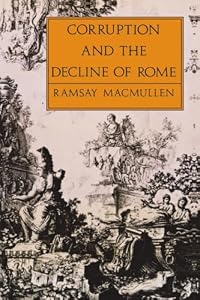
Corruption and the Decline of Rome
by Ramsay MacMullen
On This Page
Description
Prominent historian Ramsay MacMullen here offers a new perspective on the decline and fall of Rome. MacMullen argues that a key factor in Rome's fall was the steady loss of focus and control over government as its aims were thwarted for private gain by high-ranking bureaucrats and military leaders. Written in an informal and lively style, his book-the culmination of years of research and thoughtful analysis-provides a fascinating, fresh line of investigation and shows convincingly that the show more decline of Rome was a gradual, insidious process rather than a climactic event. "An important book which will initiate a long debate. . . . What is new in MacMullen's argument is not the existence of this corruption but its sheer scale and long-term global effects. . . . A vivid and frightening picture of how a great state and civilization, the construction of centuries of painfully acquired political culture, can be cripplingly undermined."-Stephen Williams, History Today "A powerful account of the vices of late Roman society, which certainly helps us to understand some aspects of its partial fall."-Jasper Griffin, New York Review of Books "All students of history must welcome this wide-ranging book from so eminent an authority. MacMullen's knowledge of the ancient evidence is encyclopedic and his deceptively casual style and deliberate avoidance of technical terms make this an accessible and stimulating book for the general reader as well as for the specialist."-Jill Harries, International History Review "MacMullen's book is excellent: rich and learned in detail, lively in style, and in argument and insights highly stimulating."-S. J. B. Barnish, Times Higher Education Supplement show lessTags
Recommendations









Member Reviews
An excellent book that uses all the evidence of other theories (at least that I’ve read) of Rome’s fall and comes with a compelling, thoroughly convincing explanation: rampant governmental corruption crippled the administration militarily and economically. MacMullen illustrates his point with several revealing anecdotes from Roman contemporaries. He shows us how Roman justice and law really worked: by influence and money. He covers how worthless latter Roman troops were -- and how valuable barbarians came to be. He makes the valuable point that the barbarians who destroyed Rome were citizens of the Empire. MacMullen rightly points out that not all the Empire crumpled at once and some traditions (such as civic benficience) continued show more sparingly. He shows a compelling picture of a society gone amok, sunk in a morass of greed, extortion, and influence-pedalling.
Perhaps most importantly the book brilliantly portrays what other books I’ve read seem to only gloss over: the exact nature of the patron-client relationship. MacMullen shows the terror the lower class held the potenti in, how jobs, justice, and favors were parlayed. How dignitas worked into this relationship (which explains more fully Caesar crossing the Rubicon and Domitian’s assassination and the prevalence of unanimous votes in the Senate), how slaves parlayed their position, and why soldiers (especially the Praetorian Guard) became dependant on their commanders (and how brutalized soldiers were by their officers and why they turned to extorting from urban dwellers to survive). I loved the vivid descriptions of corruption and extortion. Despite the lack of a definate chronology, it brought Roman society alive. The subverting of Diocletian’s caste system was well explained.
The only problems were the somewhat strange turns of phrase MacMullen used sometimes. However, some passages were very vivid and clear. The last chapter wasn’t as concise a summing up as it could have been, and it seemed to repeat conclusions of the third chapter. Some of the maps were missing crucial labels and the proofreader seemed absent at times. The book also exhibited the annoying feature of other academic history book’s I’ve read: it assumes the reader knows German and French. (I would expect it to asssume a knowledge of Latin.) show less
Perhaps most importantly the book brilliantly portrays what other books I’ve read seem to only gloss over: the exact nature of the patron-client relationship. MacMullen shows the terror the lower class held the potenti in, how jobs, justice, and favors were parlayed. How dignitas worked into this relationship (which explains more fully Caesar crossing the Rubicon and Domitian’s assassination and the prevalence of unanimous votes in the Senate), how slaves parlayed their position, and why soldiers (especially the Praetorian Guard) became dependant on their commanders (and how brutalized soldiers were by their officers and why they turned to extorting from urban dwellers to survive). I loved the vivid descriptions of corruption and extortion. Despite the lack of a definate chronology, it brought Roman society alive. The subverting of Diocletian’s caste system was well explained.
The only problems were the somewhat strange turns of phrase MacMullen used sometimes. However, some passages were very vivid and clear. The last chapter wasn’t as concise a summing up as it could have been, and it seemed to repeat conclusions of the third chapter. Some of the maps were missing crucial labels and the proofreader seemed absent at times. The book also exhibited the annoying feature of other academic history book’s I’ve read: it assumes the reader knows German and French. (I would expect it to asssume a knowledge of Latin.) show less
This examines how the Roman Empire weakened itself from the top.
Ratings
Members
- Recently Added By
Lists

Best Roman Empire Books
49 works; 18 members

Antigua Roma
39 works; 2 members

Europe
205 works; 6 members

Ancient/Classical World
34 works; 1 member
Author Information

19+ Works 1,950 Members
Ramsay MacMullen is Professor Emeritus of History at Yale University.
Some Editions
Series
Belongs to Publisher Series
Perrin, Tempus (433)
Common Knowledge
- Canonical title
- Corruption and the Decline of Rome
- Original title
- Corruption and the decline of Rome
- Original publication date
- 1988 (1e édition originale américaine, Yale university press) (1e édition originale américaine, Yale university press); 1991-10-25 (1e traduction et édition française, Histoire, Les Belles lettres) (1e traduction et édition française, Histoire, Les Belles lettres); 2012-02-09 (Réédition française, Tempus, Perrin) (Réédition française, Tempus, Perrin)
- Important places
- Ancient Rome; Roman Empire
- First words
- The people who were declining should have known it; therefore I turn to them first for their views.
- Blurbers
- Williams, Stephen; Segal, Erich; Barnish, S. J. B.; William, Callie; Harries, Jill
- Original language*
- Anglais (Etats-Unis) (Etats-Unis)
*Some information comes from Common Knowledge in other languages. Click "Edit" for more information.
Classifications
- Genres
- History, Nonfiction, General Nonfiction, Politics and Government
- DDC/MDS
- 937.06 — History & geography History of ancient world (to ca. 499) Italian Peninsula to 476 and adjacent territories to 476 Empire 31 B.C.-476 A.D.
- LCC
- DG270 .M33 — History of Europe, Asia, Africa and Oceania City History of Italy Ancient Italy. Rome to 476 History By period Empire, 27 B.C. - 476 A.D. General
- BISAC
Statistics
- Members
- 177
- Popularity
- 183,285
- Reviews
- 2
- Rating
- (3.73)
- Languages
- English, French, Italian
- Media
- Paper, Ebook
- ISBNs
- 6
- ASINs
- 1