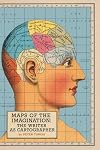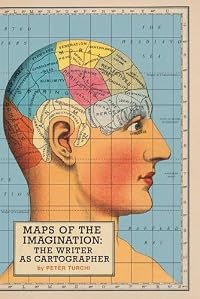
Maps of the Imagination: The Writer as Cartographer
by Peter Turchi
On This Page
Description
In Maps of the Imagination, Peter Turchi posits the idea that maps help people understand where they are in the world in the same way that literature, whether realistic or experimental, attempts to explain human realities. The author explores how writers and cartographers use many of the same devices for plotting and executing their work, making crucial decisions about what to include and what to leave out, in order to get from here to there, without excess baggage or a confusing surplus of show more information. Turchi traces the history of maps, from their initial decorative and religious purposes to their later instructional applications. He describes how maps rely on projections in order to portray a three-dimensional world on the two-dimensional flat surface of paper, which he then relates to what writers do in projecting a literary work from the imagination onto the page. show lessTags
Recommendations


Member Reviews
Books about writing fall into two camps. There are the instructional ones, with writing prompts and exercises, and there are the inspirational ones, that instead of telling you how to write, make the reader want to jump up and grab a pen. Maps of the Imagination: The Writer as Cartographer by Peter Turchi is neither of these things, but rather a look at how writing a book is like making a map. The comparison sometimes gets lost in Turchi's giant enthusiasm for maps and the history of mapmaking and I have to admit that I was with him all the way. If you like maps a lot and write a bit, then this book is for you, and by that I mean that this book was for me. It also helps that the physical book is such a pleasing object, with heavy, show more creamy paper and plentiful maps of many kinds.
Given that our capacity for abstraction is great, greater than we may realize, it isn't necessary for a map user to know the first thing about projection formulas. A map maker, however, is obliged to understand exactly what he is doing.
This isn't an instruction book, but it does present a different angle with which to look at a writing project. Whether it will prove useful is unknown, but the maps were lovely, as was the author's discussions around them. show less
Given that our capacity for abstraction is great, greater than we may realize, it isn't necessary for a map user to know the first thing about projection formulas. A map maker, however, is obliged to understand exactly what he is doing.
This isn't an instruction book, but it does present a different angle with which to look at a writing project. Whether it will prove useful is unknown, but the maps were lovely, as was the author's discussions around them. show less
This is one of the most imaginative books on writing that I have read. Readers who look for very clear, concise prompts and descriptions of the writing process will likely be frustrated by Turchi's approach. However, if you are adventurous and willing to follow where Turchi leads, you will have new inspiration and ideas about how to write and read fiction.
Turchi's innovation is his drawing parallels between cartography and writing. He provides scores of full-color reproductions of many kinds of maps, from beautifully illuminated medieval manuscripts to early modern maps of the New World to utilitarian schemas showing metro stops in Washington DC. His examples from the history of cartography serve as a jumping off point for his show more explorations of the writing process as well as of ways that writers guide readers through their works. His specific examples are not simply drawn from maps, but also from a wide-ranging group of writers, including Anne Carson, Italo Calvino, Ernest Hemingway, and even Chuck Jones' Road Runner cartoons. In the end, this thought-provoking book also serves as an interdisciplinary examination of how humans think -- our need for guides, our approach to organizing a dizzying array of stimuli, and our joy in sometimes forging a new path. Highly recommended for adventurous GRers, both writers and readers. show less
Turchi's innovation is his drawing parallels between cartography and writing. He provides scores of full-color reproductions of many kinds of maps, from beautifully illuminated medieval manuscripts to early modern maps of the New World to utilitarian schemas showing metro stops in Washington DC. His examples from the history of cartography serve as a jumping off point for his show more explorations of the writing process as well as of ways that writers guide readers through their works. His specific examples are not simply drawn from maps, but also from a wide-ranging group of writers, including Anne Carson, Italo Calvino, Ernest Hemingway, and even Chuck Jones' Road Runner cartoons. In the end, this thought-provoking book also serves as an interdisciplinary examination of how humans think -- our need for guides, our approach to organizing a dizzying array of stimuli, and our joy in sometimes forging a new path. Highly recommended for adventurous GRers, both writers and readers. show less
first i will say, this book is gorgeous, and full of good ideas.
but, ultimately, turchi gives us the tools to recognize the failures of his own "map." the book is full of blank spaces that he himself wasn't aware of: why are most of his literary examples white, male, and european? why does his reference to the blues form (and this is one of his only references to the writing of POC) end up in a brief footnote, while countless other writers get pages of close-reading?
for a book that otherwise seems so aware of the politics/biases of maps, this strikes me as a pretty unforgivable mistake.
but, ultimately, turchi gives us the tools to recognize the failures of his own "map." the book is full of blank spaces that he himself wasn't aware of: why are most of his literary examples white, male, and european? why does his reference to the blues form (and this is one of his only references to the writing of POC) end up in a brief footnote, while countless other writers get pages of close-reading?
for a book that otherwise seems so aware of the politics/biases of maps, this strikes me as a pretty unforgivable mistake.
Turchi holds that mapping is a metaphor for writing: "Every writer...is asked for directions; and to the extent that he offers them, he takes on the role of guide in another way, outside of his work." He strings his metaphor out to manuscript length, establishing the correspondences in both writing and mapping: conventions, inclusion and order, shape or matters of form, and the balance of intuition and intention. As he notes of writers: "We want our writing to reflect the world in which we live, and of which we must constantly make sense. We impose order on chaos....we test traditional forms." And yet much as Edward Tufte has noted (in a more succinct and entertaining way I might add), Turchi observes "The tension between our vision for show more the work and the form we choose mirrors the tension between the world in its incomprehensible vastness and our attempts to make sense of it." Turchi should have done a nice little article for The New Yorker rather than making and remaking his same point. He tries to sound poetic, but - in my opinion - ends up merely sounding turgid and abstruse. The quality of his illustrations, on the other hand, is glorious. And the quotations he selects from other authors are well-written and well-chosen. Buy the book for the pictures and the quoted gems; read Tufte alongside them, and you will have cobbled together a "guide" worth following.
(JAF) show less
(JAF) show less
Turchi is most interesting when writing about mapping and less so when writing about writing, but then, that's probably just because I've heard/read so many writers talk/write about writing that not much sounds new on that topic. That's the writer in me resisting the workshop, I guess. I did, however, much appreciate Turchi's discussion/ investigation of maps' blank spaces, distortion formulas, and "conventions of illusion." As I am currently intrigued by all things cartographic, I enjoyed the book.
I don't know what I was expecting when I purchased this book, but it delivers something quite other than the vague thoughts I might have had. Essentially, this is a book for writers, so it is in the wrong category, but that's where I had it originally, and it is sort of about maps. There are many good ideas regarding approaches to writing, style and generally thinking outside the box. It is heavily illustrated with many kinds of "maps," from a simple chess board to a highly schematic way finder for an urban metro system, from a highly imaginative Renaissance mappa mundi to a modern highway map. Turchi tries to relate ways of delivering a story to the functions of the many types of map. He has lectured to writers' workshops about show more imaginative approaches to writing, and in fact this book arose out of just such a lecture. The book is very interesting for readers interested in getting inside the fictional writing process. show less
"Maps of the Imagination" by Peter Turchi is about how the writer is a also a cartographer and how writing is a metaphor for exploring. The books delves into philosophical ideas relating to how human beings cope with the "unknown" and what writing and map making do to better the word by blazing trails and traveling out for the sake of traveling. As a writer, a traveler, and a map-maker, I find the book incredibly inspiring.
Members
- Recently Added By
Lists

Metaphors, etc.
16 works; 3 members
Author Information

8+ Works 748 Members
Peter Turchi is author of the novel "The Girls Next Door", a collection of stories, "Magician", & a book of non-fiction, "The Pirate Prince". He is Director of the MFA Program for Writers, Warren Wilson College. (Bowker Author Biography)
Common Knowledge
- Original title
- Maps of the Imagination: The Writer as Cartographer
- Original publication date
- 2004
Classifications
Statistics
- Members
- 605
- Popularity
- 48,191
- Reviews
- 10
- Rating
- (3.78)
- Languages
- English, German
- Media
- Paper, Ebook
- ISBNs
- 3
- ASINs
- 2