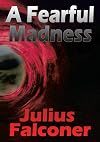
A Fearful Madness (Julius Falconer Series)
by Julius Falconer
On This Page
Description
A police investigation into the violent death of a part-time cathedral verger stalls for lack of incriminating evidence. However, three people have a close interest in clearing the matter up where the police have failed: the victim's sister, and two suspects released without charge and eager to clear their names.Tags
Member Reviews
This is a very short book, and could most likely be read at one sitting. However, it took me more than a week to get through it, and of course that's a sign that I just wasn't connecting with it -- never did. So many things bothered me about this book, it's hard even to begin to review it. The story was all over the place -- plot devices thrown at the reader with no apparent rhyme or reason. The characters were mostly stereotypes and tended to pop up out of nowhere. And the ending wasn't just a surprise -- it was a smack in the face, with yet another new character (or two?) showing up out of the blue. In a way, the ending makes the entire book feel like one big "red herring." It also made me think that maybe I just hadn't read carefully show more enough and missed something important along the way; but I was so frustrated by then, there was no way I could contemplate any rereading to figure out where I lost track. Definitely not a book I'd recommend; but I understand Julius Falconer has published quite a few books and has a devoted following of readers, so maybe A Fearful Madness is just a poor example of his work. show less
 This review was written for LibraryThing Early Reviewers.
Julius Falconer uses language in a more formal way than many other modern authors. His sentences are carefully punctuated, his vocabulary is extensive (meaning there are some words I had to check in the dictionary – and one or two weren’t in my dictionary) and he uses many literary references and illusions. I like his style of writing, although in parts it does tend to be long-winded.
It’s a complex book, following each of the three investigations – some of which seem highly unlikely, but then they do say that truth is stranger than fiction.Two people had been suspected of murdering James Thwaites, the verger, but the police were unable to produce any evidence and the cases against them were dropped. It appeared he had been show more stealing rare and valuable books from the cathedral and selling them on the black market. I was intrigued by the book-trafficking business which on the one hand was highly organised involving the use of white van drivers, and on the other seemed remarkably lax!
A bearded man was seen outside Thwaites’s house on the evening of the murder and Matthias Biddulph, one of the original suspects, who had been in a relationship with Thwaites hires a private investigator to find him. Another possible motive for the murder is Thwaites’s involvement with an eccentric version of Christianity – the Anti-Church of Jesus Christ, set up in opposition to the Anglican Church, which his sister Serenity investigates.
For the most part, I rather enjoyed reading A Fearful Madness, although I had little idea how it would end – the verger’s will is of significance, but that only features towards the end of the book (unless I missed an earlier reference). I think this is possibly the weakest part of the book when the culprit confesses to the murder. show less
It’s a complex book, following each of the three investigations – some of which seem highly unlikely, but then they do say that truth is stranger than fiction.Two people had been suspected of murdering James Thwaites, the verger, but the police were unable to produce any evidence and the cases against them were dropped. It appeared he had been show more stealing rare and valuable books from the cathedral and selling them on the black market. I was intrigued by the book-trafficking business which on the one hand was highly organised involving the use of white van drivers, and on the other seemed remarkably lax!
A bearded man was seen outside Thwaites’s house on the evening of the murder and Matthias Biddulph, one of the original suspects, who had been in a relationship with Thwaites hires a private investigator to find him. Another possible motive for the murder is Thwaites’s involvement with an eccentric version of Christianity – the Anti-Church of Jesus Christ, set up in opposition to the Anglican Church, which his sister Serenity investigates.
For the most part, I rather enjoyed reading A Fearful Madness, although I had little idea how it would end – the verger’s will is of significance, but that only features towards the end of the book (unless I missed an earlier reference). I think this is possibly the weakest part of the book when the culprit confesses to the murder. show less
This review was written for LibraryThing Early Reviewers.Summary - the police fail to solve a murder; three implicated parties follow different, tortuous paths to try to find the answer, the police come in at the end and the answer turns out to be something completely different (cue confession!) Julius Falconer is, I understand, someone who's come to authoring relatively late in life and in considerable volume. WHich makes a lot of sense. This is a novel written by someone who's read a lot of detective fiction and knows the game, but who also wants to give a very idiosyncratic and personal spin to it. No room for ambiguity about his personal opinions about life, his erudition (displayed all over the place) and general cultural assumptions. Not a lot of showing and a lot of telling! If you show more allow for all that, I actually found the book surprisingly enjoyable in a rather bonkers way and mostly readable (skipping some of the judgemental episodes and the quotations..) show less
This review was written for LibraryThing Early Reviewers.I received this book as an Early Review copy from LibraryThing.
I enjoyed the book, and couldn’t wait to find out how it would end.
This was a different take on a murder mystery, in that there were three separate sets of investigators, with an interest in solving the first murder. They eventually shared their investigations with the police who used the findings to finally track down the murderer. It was interesting to see how the first murder affected these three groups of people who needed some kind of resolution after a first inconclusive police investigation.
I especially loved the sense of place – the geography is accurate; the Yorkshire topography was easy to follow especially for people like me living in the area. The show more narrative was firmly grounded in real places. The only place not identified was the cathedral where the victim worked – an interesting source of speculation for me.
My reservations did not spoil the overall effect too much. I was uncomfortable about the treatment of religious people - why do they so often seem to be oddball extremists in fiction? Likewise the treatment of gays in this book. All the religious and/or gay people I know are all ‘normal’, sensible characters! show less
I enjoyed the book, and couldn’t wait to find out how it would end.
This was a different take on a murder mystery, in that there were three separate sets of investigators, with an interest in solving the first murder. They eventually shared their investigations with the police who used the findings to finally track down the murderer. It was interesting to see how the first murder affected these three groups of people who needed some kind of resolution after a first inconclusive police investigation.
I especially loved the sense of place – the geography is accurate; the Yorkshire topography was easy to follow especially for people like me living in the area. The show more narrative was firmly grounded in real places. The only place not identified was the cathedral where the victim worked – an interesting source of speculation for me.
My reservations did not spoil the overall effect too much. I was uncomfortable about the treatment of religious people - why do they so often seem to be oddball extremists in fiction? Likewise the treatment of gays in this book. All the religious and/or gay people I know are all ‘normal’, sensible characters! show less
This review was written for LibraryThing Early Reviewers.I read this book almost at one sitting, that should argue that I thoroughly enjoyed it. However, I have to admit that it was on one of those really dire days when the awful weather would not let me do anything else! On one level I did enjoy it. The story is complex, with several different strands to it, and the author never really loses sight of each strand. The stories are pretty unlikely, but so are many crime novels which depend largely on serendipity. What really irritated was the characterisation. One of the main characters had morphed in a short two years from a timid, easily frightened man into a self confident intelligent man capable of intricate plotting, and able to take on his suspected murderer. Not very likely. Most of the show more other characters were drawn as stereotypes of the worst kind. The original policemen were depicted as homophobic idiots, unable to see farther than the fact that the original victim was gay, and the homosexual characters were. without exception, depicted as grubby. The religious group at the heart of one of the strands are very oddball. They are not known, but have enough followers to be able to have 250 people willing and able to 'take over' a cathedral en masse. Not very likely. I have not heard of the author before, but I see this is not his first novel. I don't think I will be seeking out his other works. show less
This review was written for LibraryThing Early Reviewers.I read this book with great enjoyment, but I should like principally to take issue with another reviewer, Auntie Catherine, who seems to me to have got the wrong end of the stick. Can she quote a single instance in which the narrator sneers, directly or indirectly, at gay people, poor people and religious people? I can find none. For a gay in the book to be a disreputable character says nothing about the author’s own view of homosexuality, does it? If a villain is dark-haired, that does not mean that the author has an antipathy to swarthy people, does it? Furthermore, the book is published by Pneuma Springs, and this is not a self-publishing firm that I know of. A small correction needed here, perhaps. Finally, I can't understand her show more reference to a 'parade of erudition': does she mean simply that the author can write decent English? show less
It's a long time since I've read a book with such an unpleasant authorial voice. The author addresses the reader directly and that wouldn't matter if only that voice was engaging, but it isn't and this reader at least was alienated by the tone which sneers, either directly or indirectly at gay people, poor people, and religious people frequently all on the same page. The parade of erudition got wearying very quickly too.
It also didn't really work as a detective story - A turns up on B's doorstep and is promptly regaled, at improbable length, with detailed conversations about things which are none of their business but which B is apparently panting to share with a complete stranger.
I feel rather guilty that I can't be more positive about show more a book I got for free. Unlike many self-published books, the proofing is excellent and I spotted no grammatical or spelling errors. Um... that's about it, I'm afraid. show less
It also didn't really work as a detective story - A turns up on B's doorstep and is promptly regaled, at improbable length, with detailed conversations about things which are none of their business but which B is apparently panting to share with a complete stranger.
I feel rather guilty that I can't be more positive about show more a book I got for free. Unlike many self-published books, the proofing is excellent and I spotted no grammatical or spelling errors. Um... that's about it, I'm afraid. show less
This review was written for LibraryThing Early Reviewers.Members
- Recently Added By
Author Information

11+ Works 39 Members
Classifications
- Genres
- Fiction and Literature, Mystery
Statistics
- Members
- 13
- Popularity
- 1,766,883
- Reviews
- 9
- Rating
- (2.40)
- Languages
- English
- Media
- Paper
- ISBNs
- 1
- ASINs
- 1