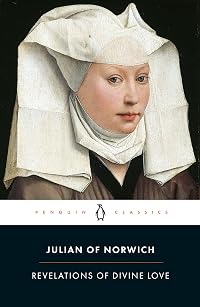
Revelations of Divine Love
by Julian of Norwich
On This Page
Description
And I saw full surely that ere God made us He loved us; which love was never slacked nor ever shall be. And in this love He hath done all His works, and in this love He hath made all things profitable to us, and in this love our life is everlasting.' Julian of Norwich saw this love as the answer to the problems of confusion, division, and evil in the world. More than 600 years later, Christians are still struggling with these issues, and Revelations of Divine Love is persistently powerful. show more At the height of medieval European mysticism, Julian, a Benedictine nun in England received 16 visions of the Trinity and the suffering of Christ. After spending 20 years meditating upon what she had seen during her prolonged ecstasy, she began to write about her visions. Her message to her fellow European mystics and the rest of Christendom was that full knowledge of God required knowledge of self. show lessTags
Recommendations








Member Reviews
Disclaimer first. I'm agnostic, I do not believe in God. I read this as a work of literature, not as a spiritual text.
From what I knew of Julian before I started this, this was not what I expected. She's very ill, received the last rights and experiences a set of vision or "shewings" (I like that the text retained this spelling). So I was expecting something by way of a fever dream or hallucination, highly visual and coloured. and it isn't that. There are maybe 4 distinct passages where she describes a visual image, the rest is far more philosophical.
And it seems rather revolutionary, even to me. There is no mention of Hell. The Devil gets a walk on part by way of tempting us poor humans, but as she clearly believes in predestination, show more even that is part of God's plan. Any sinner will be accepted into God's love by turning to God (this translation does not use the term repentance). Set against the doom paintings of the era, that seems quite unusual.
In one section she described God as the Father & Jesus as taking on the role of Mother, which makes for some very oddly gendered sentences. That came as quite a surprise and strikes a rather feminist note that has resonance.
In a couple of passages she's not entirely complimentary about the Church, which make me wonder how this survived. she comments on the teaching of the Church not matching the shewing.
And the most striking aspect of this is how gentle it all is. It is doused in love. There is no divine retribution, no crusader ethic, nothing like that, just that God loves us, always has, always will and we should love him. At one level it seems a simple philosophy, but it is clearly more complex than that.
In terms of the writing, it was most likely told to a scribe who wrote it down and that is reflected in the conversational nature. I'd guess that one sentence in 4 starts with And, as a thought runs on. It also uses a number of verbal tricks, lists feature a fair amount, as does a thing being in 3 elements. There's also repetition but with different words to alter the emphasis or meaning. At one point the "All shall be well" is rendered as "I may make all things well, I can make all things well, I will make all things well, I shall make all things well; and you shall see, yourself, that all manner of thing shall be well". These often appear in 3s reflecting the different natures of the trinity, or 4 with the 4th being either the combined trinity or the soul's response to it.
As the oldest piece of writing by a woman in English that has come down to us it is worth visiting, even if the faith itself does not speak to you. It's a window into a mind that is form a very different time but seem s quite original. show less
From what I knew of Julian before I started this, this was not what I expected. She's very ill, received the last rights and experiences a set of vision or "shewings" (I like that the text retained this spelling). So I was expecting something by way of a fever dream or hallucination, highly visual and coloured. and it isn't that. There are maybe 4 distinct passages where she describes a visual image, the rest is far more philosophical.
And it seems rather revolutionary, even to me. There is no mention of Hell. The Devil gets a walk on part by way of tempting us poor humans, but as she clearly believes in predestination, show more even that is part of God's plan. Any sinner will be accepted into God's love by turning to God (this translation does not use the term repentance). Set against the doom paintings of the era, that seems quite unusual.
In one section she described God as the Father & Jesus as taking on the role of Mother, which makes for some very oddly gendered sentences. That came as quite a surprise and strikes a rather feminist note that has resonance.
In a couple of passages she's not entirely complimentary about the Church, which make me wonder how this survived. she comments on the teaching of the Church not matching the shewing.
And the most striking aspect of this is how gentle it all is. It is doused in love. There is no divine retribution, no crusader ethic, nothing like that, just that God loves us, always has, always will and we should love him. At one level it seems a simple philosophy, but it is clearly more complex than that.
In terms of the writing, it was most likely told to a scribe who wrote it down and that is reflected in the conversational nature. I'd guess that one sentence in 4 starts with And, as a thought runs on. It also uses a number of verbal tricks, lists feature a fair amount, as does a thing being in 3 elements. There's also repetition but with different words to alter the emphasis or meaning. At one point the "All shall be well" is rendered as "I may make all things well, I can make all things well, I will make all things well, I shall make all things well; and you shall see, yourself, that all manner of thing shall be well". These often appear in 3s reflecting the different natures of the trinity, or 4 with the 4th being either the combined trinity or the soul's response to it.
As the oldest piece of writing by a woman in English that has come down to us it is worth visiting, even if the faith itself does not speak to you. It's a window into a mind that is form a very different time but seem s quite original. show less
This medieval devotional classic gained new readers in the twentieth century through the combination of modern renderings of the Chaucer-era English and a boost from T.S. Eliot.
It’s uncanny how the meditations and visions (“showings”) recorded here, which reflect a medieval form of spirituality and belief, nevertheless speak across the six-century gap between the author’s time and ours.
I think this has to do with the honesty and simplicity with which the author writes. She is self-effacing, yet she saw what she saw. The dogma of her time expected the condemnation and suffering of countless souls. Julian doesn’t deny this; she simply states she saw no trace of condemnation in the “showings” vouchsafed her.
The ultimate show more expression of the view of reconciliation is the single most famous sentence of the book: “But all shall be well, and all manner of things shall be well.” It’s no wonder that we respond to this encouraging message. Yet perhaps we do her injustice when we focus on this statement alone. Indeed, she warns against this: “Beware that you do not take one thing according to your taste and fancy and leave another, for that is what heretics do.”
So while the author plainly yet discretely distances herself from some of the teachings of what she calls “Holy Church,” she only welcomes readers who take her message in its entirety. So I’m in a quandary. If I wanted to engage this text on a theological level, there are several things I’d differ on. But it’s clear she wrote in a simple, reverent spirit, so is it wrong for me to read the text in the same way without discarding the points on which my belief differs from the medieval church? I may not be the reader the author would have approved of, but I remain confident that all will be well. show less
It’s uncanny how the meditations and visions (“showings”) recorded here, which reflect a medieval form of spirituality and belief, nevertheless speak across the six-century gap between the author’s time and ours.
I think this has to do with the honesty and simplicity with which the author writes. She is self-effacing, yet she saw what she saw. The dogma of her time expected the condemnation and suffering of countless souls. Julian doesn’t deny this; she simply states she saw no trace of condemnation in the “showings” vouchsafed her.
The ultimate show more expression of the view of reconciliation is the single most famous sentence of the book: “But all shall be well, and all manner of things shall be well.” It’s no wonder that we respond to this encouraging message. Yet perhaps we do her injustice when we focus on this statement alone. Indeed, she warns against this: “Beware that you do not take one thing according to your taste and fancy and leave another, for that is what heretics do.”
So while the author plainly yet discretely distances herself from some of the teachings of what she calls “Holy Church,” she only welcomes readers who take her message in its entirety. So I’m in a quandary. If I wanted to engage this text on a theological level, there are several things I’d differ on. But it’s clear she wrote in a simple, reverent spirit, so is it wrong for me to read the text in the same way without discarding the points on which my belief differs from the medieval church? I may not be the reader the author would have approved of, but I remain confident that all will be well. show less
This was a more difficult read than I had anticipated, but I'm glad I plowed through it, little by little. My edition (Penguin 1966) was translated and introduced by Clifton Wolters, who is rather patronizing toward Julian . . . thus I made the right decision when I skipped the 45 page introduction until after I had read Julian's revelations. I was a bit disappointed that he chose to translate her most famous passage as "it is all going to be all right; it is all going to be all right; everything is going to be all right" rather than the more traditional/familiar/resonant "All shall be well and all shall be well and all manner of thing shall be well." (Chapter 27)
I terms of Julian's actual revelations, the beginning was a rather bloody show more account of Christ's Passion, thus rather difficult reading. Her later revelations and discussions of God's Love help put the earlier gruesomeness in context. And for those not willing/able to wade through all the revelations, know that the final passage sums them up nicely: "Love was his meaning. Who showed it you? Love. What did he show you? Love. Why did he show it? For love." Amen. show less
I terms of Julian's actual revelations, the beginning was a rather bloody show more account of Christ's Passion, thus rather difficult reading. Her later revelations and discussions of God's Love help put the earlier gruesomeness in context. And for those not willing/able to wade through all the revelations, know that the final passage sums them up nicely: "Love was his meaning. Who showed it you? Love. What did he show you? Love. Why did he show it? For love." Amen. show less
The scribe who put the words of Mother Julian to paper offered a warning:
"I pray God almighty that this book shall fall only into the hands of those who intend to be his lovers, and who are willing to submit to the Faith of the Holy Church, and to obey such sound and instructive teaching as is given by men of virtue, maturity, and profound learning. For this revelation contains deep theology and great wisdom, and is not meant for those who are enslaved by sin and the Devil" (213).
His warning is apt. Like my experience with The Imitation, this is the sort of writing that you have to deeply commit to before you benefit from it. If you try to skim it quickly—as if it were some modern day best-seller—it feels shallow and repetitive. On show more the other hand, I dare any believer to pray, open the book, and not be changed.
The form of The Revelation is simple. In 86 short chapters, Julian recounts and interprets 16 separate visions she received while praying. These visions focus on the pain Jesus was willing to bear for us, the depth of Jesus' love for us, and the incomprehensible role of evil in God's good creation.
Along the way (writing as a fourteenth century Anchorite) she shares some things that will make modern day Western-style evangelicals squirm. Specifically, her comments on St. Mary and her lengthy reflections on the motherhood of Jesus. Please don't let this dissuade you from this work. The expression "Don't throw the baby out with the bathwater" comes to mind.
Mother Julian was a devoted believer who was overwhelmed with the love of her God. We could all use a reminder of that.
"So it was that I learned that love was our Lord's meaning. And I saw for certain, both here and everywhere, that before ever he made us, God loved us; and that his love has never slackened, nor ever shall. In this love all his works have been done, and in this love he has made everything serve us; and in this love our life is everlasting. Our beginning was when we were made, but the love in which he made us never had beginning. In it we have our beginning"(212).
One last thought. There are more editions of this work than you can shake a stick at. I read the Penguin Classics edition, with an introduction by the translator, Clifton Wolters. His 33 page introduction was a valuable aid for me to understand the broad theme of the book as well as Mother Julian's life and setting. show less
"I pray God almighty that this book shall fall only into the hands of those who intend to be his lovers, and who are willing to submit to the Faith of the Holy Church, and to obey such sound and instructive teaching as is given by men of virtue, maturity, and profound learning. For this revelation contains deep theology and great wisdom, and is not meant for those who are enslaved by sin and the Devil" (213).
His warning is apt. Like my experience with The Imitation, this is the sort of writing that you have to deeply commit to before you benefit from it. If you try to skim it quickly—as if it were some modern day best-seller—it feels shallow and repetitive. On show more the other hand, I dare any believer to pray, open the book, and not be changed.
The form of The Revelation is simple. In 86 short chapters, Julian recounts and interprets 16 separate visions she received while praying. These visions focus on the pain Jesus was willing to bear for us, the depth of Jesus' love for us, and the incomprehensible role of evil in God's good creation.
Along the way (writing as a fourteenth century Anchorite) she shares some things that will make modern day Western-style evangelicals squirm. Specifically, her comments on St. Mary and her lengthy reflections on the motherhood of Jesus. Please don't let this dissuade you from this work. The expression "Don't throw the baby out with the bathwater" comes to mind.
Mother Julian was a devoted believer who was overwhelmed with the love of her God. We could all use a reminder of that.
"So it was that I learned that love was our Lord's meaning. And I saw for certain, both here and everywhere, that before ever he made us, God loved us; and that his love has never slackened, nor ever shall. In this love all his works have been done, and in this love he has made everything serve us; and in this love our life is everlasting. Our beginning was when we were made, but the love in which he made us never had beginning. In it we have our beginning"(212).
One last thought. There are more editions of this work than you can shake a stick at. I read the Penguin Classics edition, with an introduction by the translator, Clifton Wolters. His 33 page introduction was a valuable aid for me to understand the broad theme of the book as well as Mother Julian's life and setting. show less
All shall be well and all shall be well and all manner of things shall be well...
It feels slightly odd to write a book review of the divine revelations of Julian of Norwich. This is a translation of the long text, which describes the 16 revelations and contains the longer discussion on their meaning, 'anent certain points'. Julian's vision of a God of love is as famous as it is comforting.
It feels slightly odd to write a book review of the divine revelations of Julian of Norwich. This is a translation of the long text, which describes the 16 revelations and contains the longer discussion on their meaning, 'anent certain points'. Julian's vision of a God of love is as famous as it is comforting.
Few texts have had held such interest or been the object of such enduring devotion as has Julian of Norwich's 14th-century classic A Revelation of Love. This great work -- along with The Cloud of Unknowing and Teresa of Avila's The Interior Castle -- form the very heart of Western mysticism, and each generation has cherished its beautiful poetry and profound account of a soul's quest for the divine. This new translation of Julian's mystical writings offers today's reader immediate access to this most powerful spiritual of books written in English. Julian's message of God's intimate and enabling love is revealed as both beguiling and inescapable. The poetry and rhythmic structure of the original Middle English text are respected, yet it show more is given fresh immediacy since it is now rendered in inclusive language for the first time ever. Moreover Julian's key ideas are easily identified-even by newcomers to her unique system of thought-by means of an original and authoritative linking commentary at the head of each key chapter, as well as continuing support from highly informative footnotes and a detailed glossary of the main terms used. show less
These accounts of the visions Julian saw are very unique and intense. I admit when I first read her writing, I was a little skeptical, but along my journey as the Holy Spirit leads and guides me, Julian's work comes back to me often... the intensity of how she describes these visions, how she mourns over the agony Christ went through as she becomes more aware of His great sacrafice and more understanding of His awesome divinity next to her humanity. Reading it is a ...startling experience - that's the best way I can describe it. But it's also a helpful way of realizing the magnitude of Christ's work. All the specific teachings/doctrine she shares through these revelations should, of course, be read along with the Scriptures to confirm show more if these concepts actually align with the teachings and doctrine of the Word. show less
Members
- Recently Added By
Lists

100 Books to Read in a Lifetime (That Are Older Than 200 Years)
415 works; 175 members

Church Times 100 Best Christian Books
106 works; 26 members
25 Books Every Christian Should Read
27 works; 4 members

Top Five Books of 2018
802 works; 264 members

Favourite Medieval Books
49 works; 17 members

The Essential Western Mystics
66 works; 4 members

Blue Pyramid 1,276 Best Books of All Time
1,248 works; 32 members

Most Popular Penguins
70 works; 5 members

Books Read in 2007
326 works; 8 members

Literary Works Read in College
316 works; 15 members

Out of Copyright
244 works; 14 members
College Reads (Lit Edition)
75 works; 5 members

Books You Read For University
184 works; 3 members

Club Read's Recommended Nonfiction Written by Women
618 works; 30 members

In Our Time books
4,934 works; 2 members
Talk Discussions
Past Discussions
***Group Read: Revelations of Divine Love (or The Showings of Julian of Norwich) in 75 Books Challenge for 2011 (May 2011)
Author Information

Little is known about this mystic writer who took up residence in St. Julian's Church, Norwich, England. The Showings are her meditations on her mystical experiences of May 8, 1373. Influenced by Neo-Platonism, she sees evil as less real than good. She focuses on the love of God and the care of Christ as mother for those who are devoted to him. show more (Bowker Author Biography) show less
Some Editions
Awards and Honors
Series
Belongs to Publisher Series
Work Relationships
Common Knowledge
- Canonical title
- Revelations of Divine Love
- Original publication date
- c. 1373
- People/Characters
- Julian of Norwich
- Important places
- East Anglia, England, UK
- Important events
- Tyndale Bible; Wycliffe Bible
- First words
- I asked for three graces of God's gift.
- Quotations
- All shall be well, and all shall be well, and all manner of thing shall be well.
- Last words
- (Click to show. Warning: May contain spoilers.)And you to whom this book may come, thank our Savior Jesu Chris earnestly and heartily for making these showings and revelations of his endless love, mercy and goodness for you and to you, to be your and our safe guide and conduct to everlasting bliss; which may Jesus grant us. Amen.
Classifications
Statistics
- Members
- 2,722
- Popularity
- 6,761
- Reviews
- 15
- Rating
- (3.89)
- Languages
- 8 — English, English (Middle), Finnish, French, German, Italian, Russian, Spanish
- Media
- Paper, Audiobook, Ebook
- ISBNs
- 83
- UPCs
- 1
- ASINs
- 54