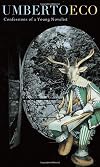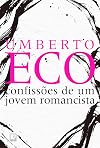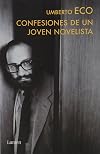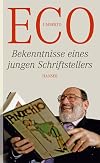
Confessions of a Young Novelist
by Umberto Eco
On This Page
Description
Umberto Eco, author of "The Name of the Rose," looks back on his long career as a theorist and his more recent work as a novelist, and explores their fruitful conjunction.Tags
Recommendations



Member Reviews
This is brief, illuminating and generally interesting to read. For me, the last part was unnecessary, as it was a regurgitation of his "An Infinity of Lists" without the, for me, saving grace of the examples from art history. But the book is worth reading for the first three chapters.
A short collection of essays/lectures by Eco.
"Writing from Left to Right" describes Eco's decision to write novels, and his writing process.
"Author, Text and Interpreters" talks about intentionality and the difficulties inherent in translation, as well as the tendency to find meanings in a text that were not put there by the author, and when/if these meanings are valid.
"Some Remarks on Fictional Characters" discusses how fictitious individuals can become part of our culture, and how they affect us emotionally.
"My Lists" enumerates the ways in which writers use the literary device of a list of connected (or random) items, and shows that device's effectiveness. (Well done, because usually I find such lists tedious, but this had me almost show more convinced.)
Eco is a witty and entertaining writer, no matter what topic he is discussing, and therefore this was an interesting read. I'd recommend it for people who have already read his novels.
His comments are occasionally, however, snobbish and condescending. I haven't quite decided if the fact that he is probably completely justified in this attitude makes it better or worse. (Yes, he is more erudite, and likely smarter than me or you.) show less
"Writing from Left to Right" describes Eco's decision to write novels, and his writing process.
"Author, Text and Interpreters" talks about intentionality and the difficulties inherent in translation, as well as the tendency to find meanings in a text that were not put there by the author, and when/if these meanings are valid.
"Some Remarks on Fictional Characters" discusses how fictitious individuals can become part of our culture, and how they affect us emotionally.
"My Lists" enumerates the ways in which writers use the literary device of a list of connected (or random) items, and shows that device's effectiveness. (Well done, because usually I find such lists tedious, but this had me almost show more convinced.)
Eco is a witty and entertaining writer, no matter what topic he is discussing, and therefore this was an interesting read. I'd recommend it for people who have already read his novels.
His comments are occasionally, however, snobbish and condescending. I haven't quite decided if the fact that he is probably completely justified in this attitude makes it better or worse. (Yes, he is more erudite, and likely smarter than me or you.) show less
Delivered as the 2008 Richard Ellmann Lectures in Modern Literature at Emory University, the four essays in Umberto Eco's Confessions of a Young Novelist (HUP, 2011) offer a peek inside Eco's creative writing process, his views on a "model reader" and on perceptions of creative writing and fictional characters generally, and on his love of lists (as expanded upon in The Infinity of Lists).
Each of the essays here had something going for it: the lists one I enjoyed simply because I also happen to be a fan of lists and find them fascinating to read and create. The musings on fictional characters and their "life" as characters, while sometimes veering a bit too far into the lit-crit-jargon territory for me, were in the end instructive. The show more second essay, "Author, Text, and Interpreters," in which Eco discussed relationships between authors, translators, different types of readers, as well as the first (on particular inspirations, challenges and techniques he's used in crafting his own novels) were the best of the quartet.
There may be better introductions to Eco's work, but if you have some familiarity with his novels, these essays will likely be of interest to you.
http://philobiblos.blogspot.com/2011/06/book-review-confessions-of-young.html show less
Each of the essays here had something going for it: the lists one I enjoyed simply because I also happen to be a fan of lists and find them fascinating to read and create. The musings on fictional characters and their "life" as characters, while sometimes veering a bit too far into the lit-crit-jargon territory for me, were in the end instructive. The show more second essay, "Author, Text, and Interpreters," in which Eco discussed relationships between authors, translators, different types of readers, as well as the first (on particular inspirations, challenges and techniques he's used in crafting his own novels) were the best of the quartet.
There may be better introductions to Eco's work, but if you have some familiarity with his novels, these essays will likely be of interest to you.
http://philobiblos.blogspot.com/2011/06/book-review-confessions-of-young.html show less
Got most of the way through this, then remembered why I don't like Eco-pretentious and overblown; too consumed with the importance of his own voice. That's the vibe I get from his writing, in any case. I dislike literary snobbery, and dismissing readers as unsophisticated (I'm paraphrasing here-I don't remember exactly what he said) raises my hackles.
A mere twenty-eight years after publishing his first novel this great author comments in these lectures on his literary experiences and more. An entertaining blend of personal memoir and literary criticism that is enjoyable from beginning to end.
I honestly can’t understand why this doesn’t have across-the-board stellar reviews, I found it life-changing
Didn't read ' My Lists ' ( but overall very interesting )
Members
- Recently Added By
Lists

Authors from Italy
13 works; 1 member
Author Information

503+ Works 115,259 Members
Umberto Eco was born in Alessandria, Italy on January 5, 1932. He received a doctorate of philosophy from the University of Turin in 1954. His first book, Il Problema Estetico in San Tommaso, was an extension of his doctoral thesis on St. Thomas Aquinas and was published in 1956. His first novel, The Name of the Rose, was published in 1980 and won show more the Premio Strega and the Premio Anghiar awards in 1981. In 1986, it was adapted into a movie starring Sean Connery. His other works include Foucault's Pendulum, The Island of the Day Before, Baudolino, The Prague Cemetery, and Numero Zero. He also wrote children's books and more than 20 nonfiction books including Serendipities: Language and Lunacy. He taught philosophy and then semiotics at the University of Bologna. He also wrote weekly columns on popular culture and politics for L'Espresso. He died from cancer on February 19, 2016 at the age of 84. (Bowker Author Biography) show less
Series
Belongs to Publisher Series
Common Knowledge
- Canonical title
- Confessions of a Young Novelist
- Original title
- Confessions of a Young Novelist
- Original publication date
- 2011
- People/Characters
- Umberto Eco
- First words
- The lectures are entitled Confessions of a Young Novelist - and one might ask why, since I am marching toward my seventy-seventh year.
- Last words
- (Click to show. Warning: May contain spoilers.)These are the confessions of a young writer.
Classifications
- Genres
- Literature Studies and Criticism, Fiction and Literature, Nonfiction
- DDC/MDS
- 853.914 — Literature & rhetoric Italian, Romanian & related literatures Italian fiction 1900- 20th Century 1945-1999
- LCC
- PQ4865 .C6 .Z46 — Language and Literature French, Italian, Spanish and Portuguese literatures Italian literature Individual authors, 1961-2000
- BISAC
Statistics
- Members
- 353
- Popularity
- 89,171
- Reviews
- 13
- Rating
- (3.53)
- Languages
- 14 — Chinese, Czech, Dutch, English, Estonian, French, German, Greek, Italian, Polish, Portuguese (Portugal), Russian, Spanish, Turkish
- Media
- Paper, Ebook
- ISBNs
- 29
- ASINs
- 4