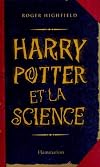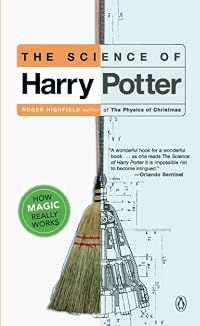
The Science of Harry Potter: How Magic Really Works
by Roger Highfield
On This Page
Description
A look at the scientific principles underpinning the magic of Harry Potter reveals some of the true magic behind science.Tags
Recommendations

Member Reviews
“Animated by Highfield's enthusiasm for the extraordinary, The Science of Harry Potter is an enjoyably indirect survey of modern science.”
This book starts off slowly talking a lot of science and mathematics and you wonder, is this what it's going to be like throughout. But wait. It does get better. The writer eventually discusses the unique animals in Harry's world
This book starts off slowly talking a lot of science and mathematics and you wonder, is this what it's going to be like throughout. But wait. It does get better. The writer eventually discusses the unique animals in Harry's world - Fluffy, hippogriffs, nifflers, - inferring that with the coming of gene manipulation such animals may one day exist. Potions are merely herbs, plants, and such that are used in their natural state while medicines are many times refinements of these same plants. Then there's Skele-Gro - that amazing elixir that will grow bones back. There is a Professor in NY who believes he understands how it works with special cells being activated... well you see what I mean. This book is full of "possible" explanations for show more the magical world of Harry Potter. show less
An exceptionally well-written book...if you forget the fact that it's about Harry Potter. The book deals only vary conservatively with Harry Potter.
However, once you leave that behind, the book is wonderful. It is concise enough that you can read short bursts of it and use it as a bathroom book, detailed enough that you can use it strictly for reference, and yet eloquent enough that it can be read all the way through without feeling like you're stuck in a high school chemistry lecture.
I truly wish that aside from his Harry Potter glossary he had included a more in-depth science glossary (let's face it, most of us aren't chemistry majors). But he did a fine job of thoroughly explaining most concepts and notable people...I really wish show more he would have explained what a meme was though, I had to look it up on-line. show less
However, once you leave that behind, the book is wonderful. It is concise enough that you can read short bursts of it and use it as a bathroom book, detailed enough that you can use it strictly for reference, and yet eloquent enough that it can be read all the way through without feeling like you're stuck in a high school chemistry lecture.
I truly wish that aside from his Harry Potter glossary he had included a more in-depth science glossary (let's face it, most of us aren't chemistry majors). But he did a fine job of thoroughly explaining most concepts and notable people...I really wish show more he would have explained what a meme was though, I had to look it up on-line. show less
Who doesn't like Harry Potter? I suppose there must be some such person, but it is hard to criticize a book series that has youngsters eager to gobble up 700 pages, even if they were not as creative and entertaining as they are. If you have read some or all of the books, I'm sure that you noticed all the science they contain. No? Me neither. These are not science books - in fact, they are about as nonscientific as you can get. Yet Roger Highfield claims to have written his own 300 plus pages on the subject. Mr. Highfield is trying (successfully, I might add - I contributed my own fourteen bucks) to cash in on Pottermania. The relationship between his book and the original is extremely tenuous, and I found his excursions to be show more interesting but not very relevant to his promise to tell "how magic really works". The magic of Harry Potter does not require scientific explanation. show less
2.5 stars honestly. The idea behind the book is cool and some of the info is interesting, but to me it reads almost like a textbook. Considering who the target audience is for Harry Potter, you would think this book might be a little easier to read or more enjoyable. Towards the middle I had to start skimming. Simply put, it was boring, and this is coming from someone who enjoys reading about science.
Roger Highfield does a good job at taking the science behind the Harry Potter series and putting up against real-world scientific theories.
Members
- Recently Added By
Author Information

14+ Works 2,597 Members
Roger Highfield is science editor of The Daily Telegraph and a regular broadcaster on the BBC. He lives in London.
Awards and Honors
Notable Lists
Common Knowledge
- Original publication date
- 2002
- People/Characters
- Harry James Potter; Hermione Jean Granger; Ronald Bilius "Ron" Weasley; Douglas Noël Adams; Miguel Alcubierre; Eric Altschuler (show all 31); Robert Axelrod; John Balaban; Bonnie Bassler; Charles Bennett; Michael Berry; Friedrich Bessel; Colin Blakemore; Yoram Bonneh; Robert Bowles; Robert Boyle; Bertie Bott; Samuel L. Braunstein (as Samuel Braunstein); Robin Briggs; Thomas Browne; Linda Buck; Edmund Burke; John Burn; David Colbert; Dudley Dursley; Albert Einstein; Stephen Hawking; Isaac Newton; J. K. Rowling; Newt Scamander; Kennilworthy Whisp
- Dedication
- To the three witches who enchant me: Julia, Holly and Doris
- First words
- I love the Harry Potter books, but maybe not for all the same reasons that you do.
- Quotations
- If Newton had not, as Wordsworth put it, voyaged through strange seas of thought alone, someone else would have. If Marie Curie had not lived, we would still have discovered the radioactive elements polonium and radium. But i... (show all)f J.K. Rowling had not been born, we would never have known about Harry Potter. That is why Master Potter means so much to me. Science may be special but Harry, as a work of art, is more so. Harry Potter is unique.
- Last words
- (Click to show. Warning: May contain spoilers.)Harry Potter is unique.
Classifications
Statistics
- Members
- 932
- Popularity
- 28,807
- Reviews
- 12
- Rating
- (3.27)
- Languages
- 6 — Czech, Dutch, English, French, Italian, Portuguese
- Media
- Paper, Ebook
- ISBNs
- 16
- ASINs
- 4