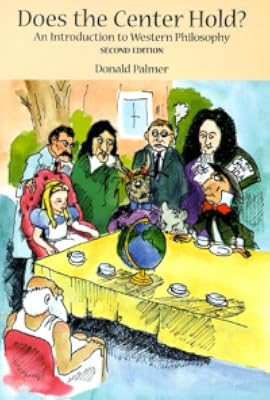
Does the Center Hold? An Introduction to Western Philosophy
by Donald Palmer
On This Page
Description
Does the Center Hold? is an entertaining, topically-organized introductory program with more than 500 original illustrations. The ideas and issues typically covered in introductory philosophy courses are presented here in a remarkably accessible and enjoyable manner. Donald Palmer demonstrates that serious philosophical inquiry may be perplexing, but is ultimately liberating, and students will come away from the book with a comprehensive, and often delighted, understanding of philosophy. The show more Connect course for this offering includes SmartBook, an adaptive reading and study experience which guides students to master, recall, and apply key concepts while providing automatically-graded assessments. McGraw-Hill Connect® is a subscription-based learning service accessible online through your personal computer or tablet. Choose this option if your instructor will require Connect to be used in the course. Your subscription to Connect includes the following: * SmartBook® - an adaptive digital version of the course textbook that personalizes your reading experience based on how well you are learning the content. * Access to your instructor's homework assignments, quizzes, syllabus, notes, reminders, and other important files for the course. * Progress dashboards that quickly show how you are performing on your assignments and tips for improvement. * The option to purchase (for a small fee) a print version of the book. This binder-ready, loose-leaf version includes free shipping. Complete system requirements to use Connect can be found here: http://www.mheducation.com/highered/platforms/connect/training-support-students.html show lessTags
Recommendations
















Member Reviews
Humor and drawings make this survey of Western philosophy less of a slog than it would otherwise be. The book is intended as a college textbook. As a result, it covers a lot of material, but not very deeply.
If I were going to teach an introduction to philosophy, this would be the text I'd use. It's exceedingly accessible and designed in a fashion that would interest even many who were required to take a class they did not want. Don't be fooled by the goofy illustrations and the cartoonish font; the content here is much more serious and the scope broader than would first appear. Key terms are not avoided, but there is no stuffy tone and complex sentence structure needed more for academic prestige than for explanation. This is a textbook with fairly good introductions to various concepts and figures, but it contains no excerpts. For this, there are many ways to get at the works themselves, and Palmer gives the instructor leeway to choose the show more works most appropriate for a particular class. Each chapter is followed by topics for consideration, suggestions for further reading, and notes pointing to the original sources. The glossary and index are sufficient but not overly thorough. Chapters are arranged by divisions within philosophy (e.g ontology, ethics, aesthetics) rather than chronologically. Overall, I very much recommend this book. show less
One of the best "Introductions", with accessible but challenging summaries of the people and the conventional themes taught in Western Philosophy classes. The themes are kept alive throughout the calligraphic text with cartoons, explicit connections to the arts and sciences, and by the personal eccentric and Jamesian positions of the author. With Glossary and Index.
Chapter 1 - PHILOSOPHY. Origins and contemporary branches. Socrates.
Chapter 2 - EPISTEMOLOGY. The difference between opinion and knowledge. Rationalism, Plato and Descartes.
Chapter 3 EMPIRICISM. [WUCUG what you see you get]. John Locke, Berkeley, phenomenalism. Hume - without god.
Chapter 4 - ONTOLOGY. Materialism, Behaviorism (Skinner vs Chomsky), Pluralism (the alternative show more to dualism and materialistic monism). Aristotle -- "substances", Wittgenstein.
Chapter 5 - RELIGION. Theism - proof from ontology, cosmology. Teleology (design) - Summa Theologica (Aquinas).
Criticism: Hume (Causality 193). Darwin - the purposed relation between the world and a designer fails empirically. Feuerbach (b. 1804) - religion is the result of confusion and prevents solutions to serious problems. Marx - "opiate" addresses real pain. Marcuse - the transfiguring content of religion cannot be liberated by surrender to science.[211] Freud - the mind preserves its earlier stages, onto- and phylogenetically.[212] [Making "scientific religious art"! 215]. Pragmatism ["ugly enough to be safe from kidnappers"] William James (b. 1842) -- passional argument -- only meaningful sentences can be true.
Existentialsm - Kierkegaard - interpretation of Abraham's acceptance of the murder assignment, in which the individual is responsible, is the beginning.[230]
Chapter 6 - Freedom. Determinism - Skinner, Freud. Libertarianism. Heisenberg indeterminism. Sartre (b.1905) "facticity". Dostoyevsky's Notes from Under the Floorboards" -- perverse freedom [270], resentment against prudence and reason, an Arab's "whim".
Chapter 7 - Ethics. Justice/ Morality, City / Soul. Greeks, Utilitarians, Kant - duty-oriented morality.
Chapter 8 - Morality. Naturalism, Positivism, Relativism.
Chapter 9 - Political Philosophy: the legitimacy of Government. Plato, Hobbes (and Freud) the selfish atom, Locke (and Marx) cooperative nature, Rousseau, Mill. Why do we put up with "rules" enforced by a threat of force? Colin Turnbull's work with the Ik, and the BaMbuti. [ 403].
Chapter 10 - Justice: The key concept of social philosophy. Fairness in the distribution of goods and services, allocating resources. (1) statist communism, (2) minimal-state anarchism, (3) liberalism.
(1) Statist : Hegel (b. 1770) - idealist organicism. Marx (b. 1818) - materialist evolutionary.
(2) Non-statist: Nozick "historical patterns" and agencies in anarchy [421]. Holdings have absolute rights - upon just acquisition, then to transfer, rectify, defend, punish. Critics (MacIntryre, Brown) note that in the absence of a just acquisition of anything, the theory is utopian and irrelevant to any actual choices.
(3) The Liberal State. John Rawls "A Theory of Justice" (1971, 1999). A social contract guides conduct, and it is negotiated behind a "veil of ignorance". State regulations to foster low inflation and high employment, protecting the free market, capital, and resources. The right to fair treatment is as basic as Nozick's right to property.
Chapter 11 - Art. Plato and Freud, Aristotle. Marx, Marcuse, Existentialism, Wittgenstein "open concepts". Nietzsche (redeeming), Rilke -- "du musst dein Leben andern!". show less
Chapter 1 - PHILOSOPHY. Origins and contemporary branches. Socrates.
Chapter 2 - EPISTEMOLOGY. The difference between opinion and knowledge. Rationalism, Plato and Descartes.
Chapter 3 EMPIRICISM. [WUCUG what you see you get]. John Locke, Berkeley, phenomenalism. Hume - without god.
Chapter 4 - ONTOLOGY. Materialism, Behaviorism (Skinner vs Chomsky), Pluralism (the alternative show more to dualism and materialistic monism). Aristotle -- "substances", Wittgenstein.
Chapter 5 - RELIGION. Theism - proof from ontology, cosmology. Teleology (design) - Summa Theologica (Aquinas).
Criticism: Hume (Causality 193). Darwin - the purposed relation between the world and a designer fails empirically. Feuerbach (b. 1804) - religion is the result of confusion and prevents solutions to serious problems. Marx - "opiate" addresses real pain. Marcuse - the transfiguring content of religion cannot be liberated by surrender to science.[211] Freud - the mind preserves its earlier stages, onto- and phylogenetically.[212] [Making "scientific religious art"! 215]. Pragmatism ["ugly enough to be safe from kidnappers"] William James (b. 1842) -- passional argument -- only meaningful sentences can be true.
Existentialsm - Kierkegaard - interpretation of Abraham's acceptance of the murder assignment, in which the individual is responsible, is the beginning.[230]
Chapter 6 - Freedom. Determinism - Skinner, Freud. Libertarianism. Heisenberg indeterminism. Sartre (b.1905) "facticity". Dostoyevsky's Notes from Under the Floorboards" -- perverse freedom [270], resentment against prudence and reason, an Arab's "whim".
Chapter 7 - Ethics. Justice/ Morality, City / Soul. Greeks, Utilitarians, Kant - duty-oriented morality.
Chapter 8 - Morality. Naturalism, Positivism, Relativism.
Chapter 9 - Political Philosophy: the legitimacy of Government. Plato, Hobbes (and Freud) the selfish atom, Locke (and Marx) cooperative nature, Rousseau, Mill. Why do we put up with "rules" enforced by a threat of force? Colin Turnbull's work with the Ik, and the BaMbuti. [ 403].
Chapter 10 - Justice: The key concept of social philosophy. Fairness in the distribution of goods and services, allocating resources. (1) statist communism, (2) minimal-state anarchism, (3) liberalism.
(1) Statist : Hegel (b. 1770) - idealist organicism. Marx (b. 1818) - materialist evolutionary.
(2) Non-statist: Nozick "historical patterns" and agencies in anarchy [421]. Holdings have absolute rights - upon just acquisition, then to transfer, rectify, defend, punish. Critics (MacIntryre, Brown) note that in the absence of a just acquisition of anything, the theory is utopian and irrelevant to any actual choices.
(3) The Liberal State. John Rawls "A Theory of Justice" (1971, 1999). A social contract guides conduct, and it is negotiated behind a "veil of ignorance". State regulations to foster low inflation and high employment, protecting the free market, capital, and resources. The right to fair treatment is as basic as Nozick's right to property.
Chapter 11 - Art. Plato and Freud, Aristotle. Marx, Marcuse, Existentialism, Wittgenstein "open concepts". Nietzsche (redeeming), Rilke -- "du musst dein Leben andern!". show less
Ratings
Members
- Recently Added By
Author Information

15 Works 1,691 Members
Common Knowledge
- Canonical title
- Does the Center Hold? An Introduction to Western Philosophy
- Original publication date
- 1991
- First words
- There are very few academic courses in which a big part of the class time is spent agonizing over what the subject matter of the course is and over whether the discipline to be studied even exists. Yet such is the case in phi... (show all)losophy.
- Quotations
- The book's title, "Does the Center Hold?" asks whether a scrutiny of human experience reveals some kind of unity, or does it plunge us into chaos?
Meno and Socrates are strolling in a garden, and they come across the gardener, an untutored slave boy. Socrates asks him to solve a fairly complicated geometrical problem -- that of doubling the square. The boy objects that ... (show all)he hasn't studied mathematics, but Socrates, undeterred, begins to ask him a series of questions...the un-schooled slave boy was able to answer a difficult mathematical question without being given any information he did not already possess. [56-57]
[The story of Abraham and Isaac and a ram in a thicket] provokes a state of deep perplexity in [Soren Kierkegaard] Johannes de Silentio, the pseudonymous author of "Fear and Trembling". First of all, Johannes is perplexed bec... (show all)ause he cannot understand the story; second, he is perplexed because everyone else seems to understand the story perfectly well...without being the least bit affected by the story. [ 225] - Last words
- (Click to show. Warning: May contain spoilers.)So if art offers the possibility of madness and degradation, it also offers the possibility of insight, joy, progress, sophistication, and redemption. Once again, in this respect, it is like the human mind itself.
- Publisher's editor
- Bull, James (Sponsoring editor); Toy, Linda (Managing editor); Glider, Sondra (Production editor); Wright, Sylvia Stein (Manuscript editor)
Classifications
Statistics
- Members
- 359
- Popularity
- 88,147
- Reviews
- 4
- Rating
- (3.85)
- Languages
- Dutch, English
- Media
- Paper, Ebook
- ISBNs
- 11
- ASINs
- 4