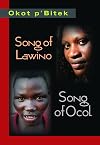
Song of Lawino / Song of Ocol
by Okot P'Bitek
On This Page
Description
Song of Lawino and Song of Ocol are among the most successful African literary works. Song of Lawino is an African womans lamentation over the cultural death of her western educated husband - Ocol. In Song of Ocel the husband tries to justify his cultural apostasy. These songs were translated from Acholi by the author. They evince a fascinating flavour of the African rhythmical idiom.Tags
Recommendations


















Member Reviews
"Woman, Shut up! Pack your things, Go!" with such harsh words begins the Song of Ocol. Ocol is the westernized husband of Lawino and he responds to her lament with unabashed cruelty. Okot p'Bitek's Song of Lawino is an African book for Africans. It is also a book for those of us who come from former colonies, a protest against the blind rejection of old beliefs and customs, an argument for faith over western empiricism. Lawino's speech is emotional and complex. She does not make her case constrained by an analytical framework. Rather, she lashes out at her husband's wholesale rejection of his people and their mores. In some places she resorts to logic and in others she snickers with innuendo.
Ocol's faith in the white man's religion is show more as irrational, or depending on your perspective, rational, as Lawino's beliefs in the ways of her people, the Acoli. She argues that Ocol has lost his individuality, he has become a dog of the white man, an obedient servant of no consequence. Ocol's sins are many but they amount to the same thing, a disdainful rejection of his community. He has fallen for another woman, who dresses and behaves like white women. He does not like the food he grew up eating, he hates the wailing of his children and he gives them bastardized western names.
Lawino's song has references to African culture and the introduction provides important context. There are many things to appreciate in Lawino's lament and there are things that you just cannot agree with. Her rejection of western medicine and of books for example.
Ocol's response to Lawino is interesting in several ways. First, it isn't really a different perspective, it is Okot p'Bitek pointing out the inherent absurdity in the philosophy of people like Ocol, through the Song of Ocol. Second, though Lawino's song is focused on Ocol, his response addresses the society and not her concerns. Of her, he is dismissive. If he had his way, Ocol would wipe the slate clean of African culture and start off with the "founders of modern Africa" Leopold II of Belgium, Bismarck, David Livingstone and the like. p'Bitek highlights Ocol's cognitive dissonance, who, while praising Bismarck and Livingstone, rejects communism by arguing that Karl Marx and Lenin were not from Africa. Ocol's ambition of building a new Africa on the ashes of his people's ancient systems seems blindly foolish and that's the message p'Bitek seems to want to convey.
I was recommended the book by an immigrant from Sierra Leone and I found in it many parallels with my own experiences. Recommended. show less
Ocol's faith in the white man's religion is show more as irrational, or depending on your perspective, rational, as Lawino's beliefs in the ways of her people, the Acoli. She argues that Ocol has lost his individuality, he has become a dog of the white man, an obedient servant of no consequence. Ocol's sins are many but they amount to the same thing, a disdainful rejection of his community. He has fallen for another woman, who dresses and behaves like white women. He does not like the food he grew up eating, he hates the wailing of his children and he gives them bastardized western names.
Lawino's song has references to African culture and the introduction provides important context. There are many things to appreciate in Lawino's lament and there are things that you just cannot agree with. Her rejection of western medicine and of books for example.
Ocol's response to Lawino is interesting in several ways. First, it isn't really a different perspective, it is Okot p'Bitek pointing out the inherent absurdity in the philosophy of people like Ocol, through the Song of Ocol. Second, though Lawino's song is focused on Ocol, his response addresses the society and not her concerns. Of her, he is dismissive. If he had his way, Ocol would wipe the slate clean of African culture and start off with the "founders of modern Africa" Leopold II of Belgium, Bismarck, David Livingstone and the like. p'Bitek highlights Ocol's cognitive dissonance, who, while praising Bismarck and Livingstone, rejects communism by arguing that Karl Marx and Lenin were not from Africa. Ocol's ambition of building a new Africa on the ashes of his people's ancient systems seems blindly foolish and that's the message p'Bitek seems to want to convey.
I was recommended the book by an immigrant from Sierra Leone and I found in it many parallels with my own experiences. Recommended. show less
Ratings
Members
- Recently Added By
Lists

Books Read in 2017
4,249 works; 130 members

Uganda
17 works; 1 member
Author Information
17+ Works 281 Members
One of the most eloquent crusaders for the decolonization of the African mind through confrontations with all manifestations of colonial mentality in African manners, fashion, spiritual values, and use of language, Okot p'Bitek wrote his only novel, Lak Tar Miyo Kinyero We Lobo (Are Your Teeth White, If So, Laugh) (1953), and his long satirical show more and humorous poems or "poetic novels" - Song of Lawino (1966), Song of Ocol (1970), The Song of a Prisoner (1971), and The Revelations of a Prostitute in his native Luo. He then produced English translations of the songs in order to be able to reach a wider audience. Born in Gulu, northern Uganda, Okot was educated at Gulu High School and King's College in Budo, Uganda, before proceeding to England in the mid-1950s, where he earned degrees from Bristol University, the University of Wales at Aberystwyth, and Oxford University. Before his premature death in 1980, Okot served as the director of the Uganda National Theatre, professor at the Makerere University at Kampala, writer-in-residence at the University of Iowa, and visiting professor at the University of Ife (now the Obafemi Awolowo University) at Ile-Ife, Nigeria. (Bowker Author Biography) show less
Series
Belongs to Publisher Series
Work Relationships
Contains
Common Knowledge
- Canonical title
- Song of Lawino / Song of Ocol
- Original publication date
- 1966
- Original language
- Acholi (Song of Lawino) (Song of Lawino); English (Son of Ocol) (Son of Ocol)
Classifications
- Genres
- Poetry, Fiction and Literature
- DDC/MDS
- 896 — Literature & rhetoric Literatures of other languages African literatures
- LCC
- PL8041.9 .B5 — Language and Literature Languages and literatures of Eastern Asia, Africa, Oceania Languages of Eastern Asia, Africa, Oceania African languages and literature Special languages (alphabetically)
- BISAC
Statistics
- Members
- 162
- Popularity
- 202,284
- Reviews
- 1
- Rating
- (4.06)
- Languages
- Dutch, English, Indonesian
- Media
- Paper, Ebook
- ISBNs
- 6
- ASINs
- 5