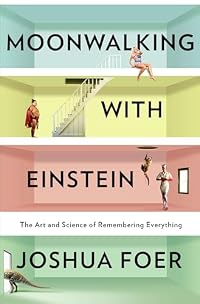
Moonwalking with Einstein: The Art and Science of Remembering Everything
by Joshua Foer
Van der Leeuw-lezing (2011)
On This Page
Description
Having achieved the seemingly unachievable-- becoming a U.S. Memory Champion-- Foer shows how anyone with enough training and determination can achieve mastery of their memory.Tags
Recommendations





Member Recommendations
Member Reviews
Memory is an elusive concept. It seems like something that comes and goes with age, and it is often assumed that some people have a better one than others. In reality it’s an art, an ability that you can exercise and improve just like anything else. The first half of the book focuses much more on the history of memorization and its benefits. The second half takes a drastic shift as the author himself gets pulled into the world of memory competitions. He decides to train and compete and he brings the reader along for the ride as he learns the tricks of the trade.
The concept of memory palaces was one I've heard of before but it was interesting to hear it described in more detail. To remember a long list you visualize each item in a show more specific location in a specific home. For example, if you have a grocery list you can place that in your childhood home. Say a jar of mayonnaise goes at the end of the driveway, a carton of eggs goes at the front door, etc. Then you “walk” through the house in your mind you see each of the items you visualized in the specific spot.
I never realized how critical memory was before the printing presses existed. People who had access to books could only refer back to what they’d memorized. Books were rare, as was the ability to read. Sharing stories through oral tradition was much more common that reading actual books.
“Creating new memories stretches out psychological time and lengthens our perception of our lives.”
There’s one section where Foer discusses the danger of routine making our lives literally seem shorter. When we are constantly creating new memories our life becomes more memorable. Going on a big trip, learning something new, having dinner with friends, each of those things becomes a specific moment in time that we remember. Whereas going home from work, watching TV every night and eating almost the same thing makes a whole week blend together. I loved this section because I try to constantly do new things in my life. I travel often, try new restaurants, see plays and visit museum exhibits, even being a tourist in my own city and spending time with friends fits in this category. To me, it seems like time still goes by quickly, but it’s packed to the brim! I can think of what happened last week in specific memories instead of seeing it blur together. I thought it was fascinating that actual studies have been done on this. And the conclusion was, you can live the healthiest life in the world, but if it’s only full of repetitive routines than it will still seem short.
BOTTOM LINE: I was fascinated by the whole book. Foer’s writing style is perfectly suited to make nonfiction content feel like a page-turner. I look forward to whatever he writes next.
“Monotony collapses time, novelty unfolds it.”
“Of all the things one could be obsessive about collecting, memories of one’s own life don’t seem like the most unreasonable. There’s something even strangely rational about it.
Side note: I will say it was a bit ironic to read this one while having “pregnancy brain”. At no point in my life have I had a harder time remembering small things! show less
The concept of memory palaces was one I've heard of before but it was interesting to hear it described in more detail. To remember a long list you visualize each item in a show more specific location in a specific home. For example, if you have a grocery list you can place that in your childhood home. Say a jar of mayonnaise goes at the end of the driveway, a carton of eggs goes at the front door, etc. Then you “walk” through the house in your mind you see each of the items you visualized in the specific spot.
I never realized how critical memory was before the printing presses existed. People who had access to books could only refer back to what they’d memorized. Books were rare, as was the ability to read. Sharing stories through oral tradition was much more common that reading actual books.
“Creating new memories stretches out psychological time and lengthens our perception of our lives.”
There’s one section where Foer discusses the danger of routine making our lives literally seem shorter. When we are constantly creating new memories our life becomes more memorable. Going on a big trip, learning something new, having dinner with friends, each of those things becomes a specific moment in time that we remember. Whereas going home from work, watching TV every night and eating almost the same thing makes a whole week blend together. I loved this section because I try to constantly do new things in my life. I travel often, try new restaurants, see plays and visit museum exhibits, even being a tourist in my own city and spending time with friends fits in this category. To me, it seems like time still goes by quickly, but it’s packed to the brim! I can think of what happened last week in specific memories instead of seeing it blur together. I thought it was fascinating that actual studies have been done on this. And the conclusion was, you can live the healthiest life in the world, but if it’s only full of repetitive routines than it will still seem short.
BOTTOM LINE: I was fascinated by the whole book. Foer’s writing style is perfectly suited to make nonfiction content feel like a page-turner. I look forward to whatever he writes next.
“Monotony collapses time, novelty unfolds it.”
“Of all the things one could be obsessive about collecting, memories of one’s own life don’t seem like the most unreasonable. There’s something even strangely rational about it.
Side note: I will say it was a bit ironic to read this one while having “pregnancy brain”. At no point in my life have I had a harder time remembering small things! show less
After journalist Josha Foer covered the United States Memory Championship for a magazine story, he became fascinated by the feats of memory and the mental athletes who perform them. He decided to train for the competition himself, and we get to go along for the ride. He shares some of the techniques that memory athletes use, findings from scientific research on memory, and interesting profiles of some of the quirky individuals who compete in memory contests.
This is non-fiction at its best. Foer weaves interesting facts in with the story of his training. I was fascinated to learn about the techniques that memory athletes use to memorize strings of numbers or decks of cards. I may even use some of the techniques myself. Some semesters, I show more meet 100+ students on the first day of class, and I struggle to remember their names. Foer has convinced me that I can overcome this lack of natural memory. However, even Foer admits that good memory requires concentration and practice. After all of his training, he admits that he took the subway home one night after meeting friends for dinner, completely forgetting that he had driven to the restaurant and left his car in the parking lot.
I also enjoyed Foer's reflection on whether it is worth it to develop memory skills. After all, can't we just store everything we need to know in our smartphones or Google the facts that have slipped our minds? In the end, Foer decides that memory is still an important talent, concluding, "How we perceive the world and how we act in it are products of how and what we remember. . . Our ability to find humor in the world, to make connections between previously unconnected notions, to create new ideas, to share in a common culture: All these essentially human acts depend on memory." show less
This is non-fiction at its best. Foer weaves interesting facts in with the story of his training. I was fascinated to learn about the techniques that memory athletes use to memorize strings of numbers or decks of cards. I may even use some of the techniques myself. Some semesters, I show more meet 100+ students on the first day of class, and I struggle to remember their names. Foer has convinced me that I can overcome this lack of natural memory. However, even Foer admits that good memory requires concentration and practice. After all of his training, he admits that he took the subway home one night after meeting friends for dinner, completely forgetting that he had driven to the restaurant and left his car in the parking lot.
I also enjoyed Foer's reflection on whether it is worth it to develop memory skills. After all, can't we just store everything we need to know in our smartphones or Google the facts that have slipped our minds? In the end, Foer decides that memory is still an important talent, concluding, "How we perceive the world and how we act in it are products of how and what we remember. . . Our ability to find humor in the world, to make connections between previously unconnected notions, to create new ideas, to share in a common culture: All these essentially human acts depend on memory." show less
Foer chronicles his foray into the world of memory in this intelligent and fun book. The perfect combination of the personal and the academic, Moonwalking with Einstein had me completely hooked. Intelligent. Fun. Insightful. Funny. Inventive. Fabulous. And a host of other adjectives that start with I and F.
My first brush with the study of memory occurred in my Classical Rhetoric course while in the Masters program at DePaul. We read the Rhetorica ad Herennium, a text mentioned often in Foer's work, and while I freely admit that this wasn't exactly the highlight of my reading life, this text and other works by Cicero gave the class a foundation for memory studies. In particular, the works discussed the use of a memory palace to solidify show more lists in our minds. Tricks like this sprinkle the text which I really enjoyed (and am trying to use in my daily life). At one point, Foer has the reader play along with him, using a memory palace to remember a to-do list. Three days after reading that section, I still remember the freaking list.
This, in my opinion, is narrative nonfiction at its best: personal, informative, and entertaining. The perfect combination of inquiry and experience, the book used personal experience to really dig into an academic topic. show less
My first brush with the study of memory occurred in my Classical Rhetoric course while in the Masters program at DePaul. We read the Rhetorica ad Herennium, a text mentioned often in Foer's work, and while I freely admit that this wasn't exactly the highlight of my reading life, this text and other works by Cicero gave the class a foundation for memory studies. In particular, the works discussed the use of a memory palace to solidify show more lists in our minds. Tricks like this sprinkle the text which I really enjoyed (and am trying to use in my daily life). At one point, Foer has the reader play along with him, using a memory palace to remember a to-do list. Three days after reading that section, I still remember the freaking list.
This, in my opinion, is narrative nonfiction at its best: personal, informative, and entertaining. The perfect combination of inquiry and experience, the book used personal experience to really dig into an academic topic. show less
Because the title of this book has apparently confused some people: this is not about Einstein. The title is referring to the memorization technique Foer learned, which involves populating a "memory palace" with bizarre and therefore memorable imagery that one has in some way linked to the less memorable information one wants to memorize.
I listened to the audiobook, so apologies if I have some of the details wrong. If I remember right, this book begins with Foer sitting in on a memory competition for an article he was writing. After the event, he spoke to one of the participants, who told him that, with enough training in the right techniques, anyone could become a memory champion. Foer was initially unconvinced but willing to give it a show more shot.
This book's overall framework is Foer's own memory journey from "regular guy" to competitor in the finals of the U.S. Memory Championship, but along the way he writes about the history of memorization techniques, the science of memory and learning, the world of memory championship competitors, why supposedly photographic memories don't exist, and more.
Although this was often a fascinating book, it also had some incredibly annoying and misogynistic sections. For example, Foer's mentor was part of the KL7, a "secret" society of memorizers who came across like pickup artists and stereotypical frat brothers. I forget the exact details, but joining the KL7 involved a combination of beer drinking, successful card memorization, and kissing a nearby woman. Several of the members of KL7 seemed to have learned memorization techniques primarily so they could impress women who might otherwise be put off by their behavior, lack of jobs, etc. Even Foer admitted that he got a little weird during his memory improvement journey, essentially living in his parents' basement as he practiced memorization techniques for hours and wore blinders while staring at cards and random numbers.
Foer spent so much time writing about the KL7 members and similar guys that, for a while there, it sounded like the world of memory championships was composed entirely of men. Even the techniques they employed seemed very oriented towards men - the secret of the "memory palace" memorization method, for example, involved making one's mental images as funny and/or raunchy as possible (be prepared for a heavy amount of male-gaze aspects in Foer's descriptions of his own mental imagery and the imagery he suggests readers picture when trying out the technique themselves). The few times Foer wrote about female memory championship competitors, my brain latched onto them like a traveler in the desert who's just come across on oasis.
Unfortunately, those might as well have been mirages, because Foer never spent much time on them, even when the tantalizing bits of information he included seemed to contradict what he'd written about the KL7 members' memorization techniques. For example, rather than linking the poetry she needed to memorize to particularly memorable imagery, one female memory championship competitor told Foer that her technique involved deeply understanding the poem and feeling its emotions. I really wish Foer had explored that a bit more.
I found many of the topics the book covered to be interesting, which somewhat made up for the company Foer kept while he was researching and studying memory. It also helped that I listened to the audiobook version, so there were times I could just tune out or speed through the parts that irked me so that I could get back to the more interesting stuff.
(Original review posted on A Library Girl's Familiar Diversions.) show less
I listened to the audiobook, so apologies if I have some of the details wrong. If I remember right, this book begins with Foer sitting in on a memory competition for an article he was writing. After the event, he spoke to one of the participants, who told him that, with enough training in the right techniques, anyone could become a memory champion. Foer was initially unconvinced but willing to give it a show more shot.
This book's overall framework is Foer's own memory journey from "regular guy" to competitor in the finals of the U.S. Memory Championship, but along the way he writes about the history of memorization techniques, the science of memory and learning, the world of memory championship competitors, why supposedly photographic memories don't exist, and more.
Although this was often a fascinating book, it also had some incredibly annoying and misogynistic sections. For example, Foer's mentor was part of the KL7, a "secret" society of memorizers who came across like pickup artists and stereotypical frat brothers. I forget the exact details, but joining the KL7 involved a combination of beer drinking, successful card memorization, and kissing a nearby woman. Several of the members of KL7 seemed to have learned memorization techniques primarily so they could impress women who might otherwise be put off by their behavior, lack of jobs, etc. Even Foer admitted that he got a little weird during his memory improvement journey, essentially living in his parents' basement as he practiced memorization techniques for hours and wore blinders while staring at cards and random numbers.
Foer spent so much time writing about the KL7 members and similar guys that, for a while there, it sounded like the world of memory championships was composed entirely of men. Even the techniques they employed seemed very oriented towards men - the secret of the "memory palace" memorization method, for example, involved making one's mental images as funny and/or raunchy as possible (be prepared for a heavy amount of male-gaze aspects in Foer's descriptions of his own mental imagery and the imagery he suggests readers picture when trying out the technique themselves). The few times Foer wrote about female memory championship competitors, my brain latched onto them like a traveler in the desert who's just come across on oasis.
Unfortunately, those might as well have been mirages, because Foer never spent much time on them, even when the tantalizing bits of information he included seemed to contradict what he'd written about the KL7 members' memorization techniques. For example, rather than linking the poetry she needed to memorize to particularly memorable imagery, one female memory championship competitor told Foer that her technique involved deeply understanding the poem and feeling its emotions. I really wish Foer had explored that a bit more.
I found many of the topics the book covered to be interesting, which somewhat made up for the company Foer kept while he was researching and studying memory. It also helped that I listened to the audiobook version, so there were times I could just tune out or speed through the parts that irked me so that I could get back to the more interesting stuff.
(Original review posted on A Library Girl's Familiar Diversions.) show less
This was a weird read. Foer sets off to write a book that is part autobiographical, part about the mnemonist community (competitive memorizers) and part about the science of memory. The third part is by far the weakest -- if you've read any other pop science about memory, you've read everything here. The first part is also not that strong: it's mostly Foer hanging around a bunch of mnemonists. And as I quickly learned, mnemonists are not the sort of people I would want to hang out with: self-absorbed, quick to turn things into a lewd reference, under-employed and drunken. But none of that matters, I imagine people mostly come for the act of competitive memorizing.
Foer starts out the book by declaring that people like me don't exist, show more which was kind of a surreal book start. By people like me, I mean people with naturally strong memories. I've had an unusually strong memory my whole life: when the waiter doubles back to say an ordered dish is out of stock, I can recite the menu verbatim for my dining companions, barely having glanced at it; I work a field that requires memorizing hundreds of rare diseases (many of which I've never actually seen) and the associated features; I spent most of high school memorizing long swathes of poetry for fun (including the entirety of the Wasteland).
Foer's central argument is that everyone has the same memory and that any exceptions are synesthetes who can encode information visually. And that's where I really fell off the rails with him: I'm not a visual processor at all. I remember words. Which, of course, Foer states as impossible. He argues words have to be transformed into visual features to be memorized. For a while, I thought that maybe literally decades of chanting torah and memorizing each vowel sound and trope pattern explained the difference between how my memory works and how he claims the universal memory works, but then I remembered that my father memorizing a thousand digits of pi by remembering the aural patterns. So then I thought maybe as Jews, we've been selected for this by memorizing talmud and torah as a culture, but Foer is also Jewish (and does talk about Torah chanting for his Bar Mitzvah), so who knows.
Why does it matter that this book is aggressively not about me? Because I think it takes something that a small group of mnemonists do and makes it into a universal rule for memorizing: memories have to be visual and obscene. Memorizing a poem or a deck of cards isn't visual or obscene? First memorize an incredibly complex system of how to encode this information as lewd visuals, and then quickly transform one to the other and Bob's your uncle. This seems absurd to me, why not just memorize a poem by...memorizing it? But then I started to think about what I knew about the study of memory, and I know from the educational literature that people remember information that they've needed to transform or encode. I realized it doesn't matter if you transform the deck of cards into lewd visual images, or a rhyming scheme or a patter song, it's engaging with and transforming the content that makes it memorable. Foer considers, but dismisses this, but it's actually a fascinating central point because it's much more universalizable: most people with jobs are not going to spend hours first memorizing schemes that involve pop stars and specific sex acts just in case they need to memorize something else later, but a more flexible, lower upfront cost schema for memorizing is useful. Foer himself talks about how being a mnemonist isn't actually useful in any way -- the mnemonists he encounters (and Foer himself) rudely forget people's names, miss appointments and all of the general scourges of daily memory
Two things that I will operationalize from the book: I am convinced that the idea of a spatial memory is useful. I'd read about memory palaces before but never found them useful. Foer's specific guidance to have multiple, each real life places that you have a strong spatial sense of, and to use them to order information by following a path around the space is very useful. The other is the major rule for memorizing numbers, encoding each digit into a phoneme so that a short number, like a credit card number or a phone number, (or a medical record number!) can become a distinctive word. show less
Foer starts out the book by declaring that people like me don't exist, show more which was kind of a surreal book start. By people like me, I mean people with naturally strong memories. I've had an unusually strong memory my whole life: when the waiter doubles back to say an ordered dish is out of stock, I can recite the menu verbatim for my dining companions, barely having glanced at it; I work a field that requires memorizing hundreds of rare diseases (many of which I've never actually seen) and the associated features; I spent most of high school memorizing long swathes of poetry for fun (including the entirety of the Wasteland).
Foer's central argument is that everyone has the same memory and that any exceptions are synesthetes who can encode information visually. And that's where I really fell off the rails with him: I'm not a visual processor at all. I remember words. Which, of course, Foer states as impossible. He argues words have to be transformed into visual features to be memorized. For a while, I thought that maybe literally decades of chanting torah and memorizing each vowel sound and trope pattern explained the difference between how my memory works and how he claims the universal memory works, but then I remembered that my father memorizing a thousand digits of pi by remembering the aural patterns. So then I thought maybe as Jews, we've been selected for this by memorizing talmud and torah as a culture, but Foer is also Jewish (and does talk about Torah chanting for his Bar Mitzvah), so who knows.
Why does it matter that this book is aggressively not about me? Because I think it takes something that a small group of mnemonists do and makes it into a universal rule for memorizing: memories have to be visual and obscene. Memorizing a poem or a deck of cards isn't visual or obscene? First memorize an incredibly complex system of how to encode this information as lewd visuals, and then quickly transform one to the other and Bob's your uncle. This seems absurd to me, why not just memorize a poem by...memorizing it? But then I started to think about what I knew about the study of memory, and I know from the educational literature that people remember information that they've needed to transform or encode. I realized it doesn't matter if you transform the deck of cards into lewd visual images, or a rhyming scheme or a patter song, it's engaging with and transforming the content that makes it memorable. Foer considers, but dismisses this, but it's actually a fascinating central point because it's much more universalizable: most people with jobs are not going to spend hours first memorizing schemes that involve pop stars and specific sex acts just in case they need to memorize something else later, but a more flexible, lower upfront cost schema for memorizing is useful. Foer himself talks about how being a mnemonist isn't actually useful in any way -- the mnemonists he encounters (and Foer himself) rudely forget people's names, miss appointments and all of the general scourges of daily memory
Two things that I will operationalize from the book: I am convinced that the idea of a spatial memory is useful. I'd read about memory palaces before but never found them useful. Foer's specific guidance to have multiple, each real life places that you have a strong spatial sense of, and to use them to order information by following a path around the space is very useful. The other is the major rule for memorizing numbers, encoding each digit into a phoneme so that a short number, like a credit card number or a phone number, (or a medical record number!) can become a distinctive word. show less
A funny and thought-provoking look at the world of memory training. If, like me, you often find yourself unable to remember embarrassingly fundamental details of your daily life, you'll be intrigued by Foer's account of how he, an average dude with an average memory, got involved with the memory training subculture, started using their techniques, and briefly became a US memory champion. Along the way, he interviews people with strong memories, both trained and savant-like, reviews historical treatises on the art of memory, and talks about the ways that memory training both is and isn't helpful.
The official US Memory Championship involves events where you memorize four different types of items: a collection of names and faces, a group show more of random numbers, the order of a deck of cards, and a poem written specifically for the occasion. Each is just a concentrated and amplified version of techniques that all of us use unconsciously countless times in our daily lives, but everyone has had the sensation of having forgotten the name of someone they met at a party, or where they left their keys, or had some other trivial yet head-slappingly bone-headed instance of forgetfulness. Foer discusses how this much more aware we are of these memory failures in the modern era, where we're surrounded by technology whose job is to correct for our lapses yet engenders a nagging sense of learned helplessness in us - it's certainly reasonable to wonder if the ability to store numbers in a phone means that our ability to remember those numbers unaided is atrophying somehow. Could we train ourselves to remember things better and not have to rely on technology as much?
The answer to that question is complicated. Is memory a skill that can be practiced, or is it an unchangeable innate endowment? Is it more like a muscle or more like a bone? Foer relates some of the techniques he learns - chunk items together, associate items with something else you've already remembered, relate abstract things like numbers to concrete things like images and actions, try to build connections with things that provoke emotional responses - and how eventually he was able to work his way up to master-level. That's why the contrast he draws between "normal" people who have practiced memory techniques and the abilities of people with genuinely exceptional memories is so thought-provoking. Synaesthesia and Asperger's syndrome seem to be closely related to whatever it is that causes extremely good memory, but while synaesthesia is a fairly "harmless" condition, Asperger's is not, and judging by the general weirdness of the memory savants Foer profiles (or Borges' famous protagonist in his story "Funes the Memorious"), it does seem that to some extent you're either born with the ability to memorize thousands of digits of pi or you're not, and even if you put in the days and weeks it takes to mimic that talent, you'll never have the same sort of effortless skill with it that the savants do.
To that end, there's one analogy in the book that will stick with me, from when Foer is trying to answer the nature-nurture question of memory skill:
"When people first learn to use a keyboard, they improve very quickly from sloppy single-finger pecking to careful two-handed typing, until eventually the fingers move so effortlessly across the keys that the whole process becomes unconscious and the fingers seem to take on a mind of their own. At this point, most people's typing skills stop progressing. They reach a plateau. If you think about it, it's a strange phenomenon. After all, we've always been told that practice makes perfect, and many people sit behind a keyboard for at least several hours a day in essence practicing their typing. Why don't they just keep getting better and better?"
I myself am a fairly fast typist, but I've never learned to touch-type and it looks like I've stuck at my current plateau forever. Foer's explanation for why I'm stuck there is that research has shown that learning comes in three general stages: the cognitive stage is when you're learning the very basic strategies for accomplishing your task, the associative stage is when you'e got your strategies down and you're just working out the kinks, and the autonomous stage is when you've internalized the strategies to the extent that you don't even think about them anymore (this bears directly on Malcolm Gladwell's "10,000 hours" theory of expertise). The way to avoid plateauing is to deliberately de-autonomize your techniques by practicing in ways that prevent you from going naturally into autopilot. This is hard: in my case, I would have to unlearn my own idiosyncratic crab-handed style by being willing to spend weeks reprogramming myself and typing like an elementary schoolchild in the meantime. The kind of memory you use when remembering names a parties isn't quite the same as the muscle memory you use when typing, but the point still stands that to improve, sometimes you have to accept temporary regressions. In Foer's words:
"The best way to get out of the autonomous stage and off the OK plateau, Ericsson has found, is to actually practice failing. One way to do that is to put yourself in the mind of someone far more competent at the task you’re trying to master, and try to figure out how that person works through problems. Benjamin Franklin was apparently an early practitioner of this technique. In his autobiography, he describes how he used to read essays by the great thinkers and try to reconstruct the author's arguments according to Franklin's own logic. He'd then open up the essay and compare his reconstruction to the original words to see how his own chain of thinking stacked up against the master's. The best chess players follow a similar strategy. They will often spend several hours a day replaying the games of grand masters one move at a time, trying to understand the expert's thinking at each step. Indeed, the single best predictor of an individual’s chess skill is not the amount of chess he's played against opponents, but rather the amount of time he's spent sitting alone working through old games."
That sounds right to me. Ultimately, after a bunch of practice Foer is able to compete with people who've been practicing for years at the US Memory Championship and becomes the American champion (interestingly, Americans are looked at as memory chumps by foreigners, who regularly destroy us in international competitions). Amusingly, even after becoming a memory champion he was still prone to the same thoughtless forgetfulness he was before - he relates a story of driving out to have dinner with friends and taking the subway home, having completely forgotten that he had driven! He closes by noting that even if memory training hadn't perfected his memory, it was was still a worthwhile thing to do, as it was about "nurturing something profoundly and essentially human". Either way, it was still an entertaining read. The bibliography also has plenty of good and slightly more rigorous material to track down afterwards too. show less
The official US Memory Championship involves events where you memorize four different types of items: a collection of names and faces, a group show more of random numbers, the order of a deck of cards, and a poem written specifically for the occasion. Each is just a concentrated and amplified version of techniques that all of us use unconsciously countless times in our daily lives, but everyone has had the sensation of having forgotten the name of someone they met at a party, or where they left their keys, or had some other trivial yet head-slappingly bone-headed instance of forgetfulness. Foer discusses how this much more aware we are of these memory failures in the modern era, where we're surrounded by technology whose job is to correct for our lapses yet engenders a nagging sense of learned helplessness in us - it's certainly reasonable to wonder if the ability to store numbers in a phone means that our ability to remember those numbers unaided is atrophying somehow. Could we train ourselves to remember things better and not have to rely on technology as much?
The answer to that question is complicated. Is memory a skill that can be practiced, or is it an unchangeable innate endowment? Is it more like a muscle or more like a bone? Foer relates some of the techniques he learns - chunk items together, associate items with something else you've already remembered, relate abstract things like numbers to concrete things like images and actions, try to build connections with things that provoke emotional responses - and how eventually he was able to work his way up to master-level. That's why the contrast he draws between "normal" people who have practiced memory techniques and the abilities of people with genuinely exceptional memories is so thought-provoking. Synaesthesia and Asperger's syndrome seem to be closely related to whatever it is that causes extremely good memory, but while synaesthesia is a fairly "harmless" condition, Asperger's is not, and judging by the general weirdness of the memory savants Foer profiles (or Borges' famous protagonist in his story "Funes the Memorious"), it does seem that to some extent you're either born with the ability to memorize thousands of digits of pi or you're not, and even if you put in the days and weeks it takes to mimic that talent, you'll never have the same sort of effortless skill with it that the savants do.
To that end, there's one analogy in the book that will stick with me, from when Foer is trying to answer the nature-nurture question of memory skill:
"When people first learn to use a keyboard, they improve very quickly from sloppy single-finger pecking to careful two-handed typing, until eventually the fingers move so effortlessly across the keys that the whole process becomes unconscious and the fingers seem to take on a mind of their own. At this point, most people's typing skills stop progressing. They reach a plateau. If you think about it, it's a strange phenomenon. After all, we've always been told that practice makes perfect, and many people sit behind a keyboard for at least several hours a day in essence practicing their typing. Why don't they just keep getting better and better?"
I myself am a fairly fast typist, but I've never learned to touch-type and it looks like I've stuck at my current plateau forever. Foer's explanation for why I'm stuck there is that research has shown that learning comes in three general stages: the cognitive stage is when you're learning the very basic strategies for accomplishing your task, the associative stage is when you'e got your strategies down and you're just working out the kinks, and the autonomous stage is when you've internalized the strategies to the extent that you don't even think about them anymore (this bears directly on Malcolm Gladwell's "10,000 hours" theory of expertise). The way to avoid plateauing is to deliberately de-autonomize your techniques by practicing in ways that prevent you from going naturally into autopilot. This is hard: in my case, I would have to unlearn my own idiosyncratic crab-handed style by being willing to spend weeks reprogramming myself and typing like an elementary schoolchild in the meantime. The kind of memory you use when remembering names a parties isn't quite the same as the muscle memory you use when typing, but the point still stands that to improve, sometimes you have to accept temporary regressions. In Foer's words:
"The best way to get out of the autonomous stage and off the OK plateau, Ericsson has found, is to actually practice failing. One way to do that is to put yourself in the mind of someone far more competent at the task you’re trying to master, and try to figure out how that person works through problems. Benjamin Franklin was apparently an early practitioner of this technique. In his autobiography, he describes how he used to read essays by the great thinkers and try to reconstruct the author's arguments according to Franklin's own logic. He'd then open up the essay and compare his reconstruction to the original words to see how his own chain of thinking stacked up against the master's. The best chess players follow a similar strategy. They will often spend several hours a day replaying the games of grand masters one move at a time, trying to understand the expert's thinking at each step. Indeed, the single best predictor of an individual’s chess skill is not the amount of chess he's played against opponents, but rather the amount of time he's spent sitting alone working through old games."
That sounds right to me. Ultimately, after a bunch of practice Foer is able to compete with people who've been practicing for years at the US Memory Championship and becomes the American champion (interestingly, Americans are looked at as memory chumps by foreigners, who regularly destroy us in international competitions). Amusingly, even after becoming a memory champion he was still prone to the same thoughtless forgetfulness he was before - he relates a story of driving out to have dinner with friends and taking the subway home, having completely forgotten that he had driven! He closes by noting that even if memory training hadn't perfected his memory, it was was still a worthwhile thing to do, as it was about "nurturing something profoundly and essentially human". Either way, it was still an entertaining read. The bibliography also has plenty of good and slightly more rigorous material to track down afterwards too. show less
I picked up this book after seeing Foer speak at the National Book Festival, and enjoyed it enough that I wanted to write a review immediately. Foer is a journalist who goes to cover the National Memory Championships, and is intrigued by the claims that anyone can learn the memory techniques and excel at the competition. So he decides to devote a year to training his own memory and then competing in the Championships himself, as a fun piece of experimental journalism. In the resulting book, he discusses both his own experiences and all sorts of interesting memory-related issues. He comes across as honest and open when talking about himself, knowledgeable about the various topics that he's researched (coming from a Classics background, I show more couldn't find fault with his discussion of Homeric composition), and often funny. Possibly my favourite quote from the book: "I decided to make memorizing a part of my daily routine. Like flossing. Except I was actually going to do it." (110)
Some particular things that I want to take away from this reading:
Memory Palaces. The basic concept behind a lot of memorization is to visualize things as ridiculous situations happening in a familiar place. As you walk mentally from room to room, you may see, for example, Bill Clinton copulating with a basketball, which represents the king of diamonds, four of hearts, and seven of clubs. I don't personally plan to come up with complex card-memorizing schemes, but the idea of the memory palace should be useful just for remembering more basic lists of objects or actions.
Expertise. In order to become an expert, you need to get beyond the "okay plateau" by deliberately focusing on improvement: challenging yourself to go beyond "good enough" by figuring out areas of difficulty and actively addressing them. If you're acting on autopilot, you're not going to improve; deliberate challenge, with prompt feedback, is key.
Daniel Tammet. I read Tammet's memoir Born on a Blue Day several years ago, and found it interesting to hear about the thought processes of a savant. Foer, though, thinks that Tammet actually uses more standard memory-type techniques for some of his feats (specifically, multiplying and dividing large numbers in his head, or identifying all the prime numbers up to 10,000), instead of just knowing the answers through some sort of synesthetic process. I don't have a stake in it either way, but I have to admire Foer for taking a difficult position, especially since he could easily have excluded Tammet altogether without having much impact on the overall narrative--and he does say that he "agonized over whether to include Daniel in this book." I found the discussion fascinating.
Basically, Moonwalking with Einstein manages to be entertaining, informative, and thought-provoking all at the same time. It goes beyond the initial question of training for a memory competition and touches on all sorts of interesting related issues. I'd definitely recommend it, and I'll look forward to seeing what Foer writes next. show less
Some particular things that I want to take away from this reading:
Memory Palaces. The basic concept behind a lot of memorization is to visualize things as ridiculous situations happening in a familiar place. As you walk mentally from room to room, you may see, for example, Bill Clinton copulating with a basketball, which represents the king of diamonds, four of hearts, and seven of clubs. I don't personally plan to come up with complex card-memorizing schemes, but the idea of the memory palace should be useful just for remembering more basic lists of objects or actions.
Expertise. In order to become an expert, you need to get beyond the "okay plateau" by deliberately focusing on improvement: challenging yourself to go beyond "good enough" by figuring out areas of difficulty and actively addressing them. If you're acting on autopilot, you're not going to improve; deliberate challenge, with prompt feedback, is key.
Daniel Tammet. I read Tammet's memoir Born on a Blue Day several years ago, and found it interesting to hear about the thought processes of a savant. Foer, though, thinks that Tammet actually uses more standard memory-type techniques for some of his feats (specifically, multiplying and dividing large numbers in his head, or identifying all the prime numbers up to 10,000), instead of just knowing the answers through some sort of synesthetic process. I don't have a stake in it either way, but I have to admire Foer for taking a difficult position, especially since he could easily have excluded Tammet altogether without having much impact on the overall narrative--and he does say that he "agonized over whether to include Daniel in this book." I found the discussion fascinating.
Basically, Moonwalking with Einstein manages to be entertaining, informative, and thought-provoking all at the same time. It goes beyond the initial question of training for a memory competition and touches on all sorts of interesting related issues. I'd definitely recommend it, and I'll look forward to seeing what Foer writes next. show less
Members
- Recently Added By
Lists

Really Good Narrative Non-Fiction
65 works; 24 members

Top Five Books of 2013
1,562 works; 721 members

To Read - Non Fiction
46 works; 4 members

Non-Fiction Worth Reading
1,015 works; 256 members

Make it Stick's Suggested Books Reading
19 works; 2 members

Perspectives Book Club Picks
49 works; 3 members

Best books read in 2011
200 works; 51 members

Best Books Read for TIOLI
49 works; 14 members

TED 2013 Summer Reading List
190 works; 13 members

Books Read in 2011
684 works; 20 members

10 books Bill Gates wants you to read 2020
12 works; 1 member

The Great Courses: The Learning Brain
61 works; 1 member

Tom's Bookstore
346 works; 2 members

Books Read in 2021
5,361 works; 114 members

Books & Films Referenced by Cal Newport's Deep Work
43 works; 1 member
Author Information

8+ Works 7,758 Members
Some Editions
Awards and Honors
Awards
Distinctions
Series

Belongs to Publisher Series
Work Relationships
Is abridged in
Is a reply to
Common Knowledge
- Canonical title*
- Het geheugenpaleis; Het geheugen na de zondvloed
- Original title
- Moonwalking with Einstein: The Art and Science of Remembering Everything
- Original publication date
- 2011
- People/Characters
- Tony Buzan; Simonides of Ceos; Solomon Veniaminovich Shereshevsky; Ed Cooke; Daniel Tammet; Kim Peek (show all 7); Cicero, Marcus Tullius, 106-43 BC
- Dedication
- For Dinah: Everything
- First words
- There were no other survivors.
- Last words
- (Click to show. Warning: May contain spoilers.)I'd forgotten to take it off.
- Blurbers
- Roach, Mary; Ariely, Dan; Lehrer, Jonah; Fatsis, Stefan
- Original language
- English
- Canonical DDC/MDS
- 153.14
*Some information comes from Common Knowledge in other languages. Click "Edit" for more information.
Classifications
- Genres
- General Nonfiction, Science & Nature, Nonfiction, Biography & Memoir
- DDC/MDS
- 153.14 — Philosophy & psychology Psychology Conscious mental processes and intelligence Learning, Memory, And Motivation Memory Improvement
- LCC
- BF385 .F64 — Philosophy, Psychology and Religion Psychology Psychology Consciousness. Cognition
- BISAC
Statistics
- Members
- 4,944
- Popularity
- 2,826
- Reviews
- 147
- Rating
- (3.84)
- Languages
- 19 — Chinese, Czech, Danish, Dutch, English, Estonian, Finnish, French, German, Hungarian, Italian, Norwegian (Bokmål), Polish, Portuguese, Romanian, Spanish, Swedish, Turkish, Vietnamese
- Media
- Paper, Audiobook, Ebook
- ISBNs
- 51
- UPCs
- 2
- ASINs
- 21