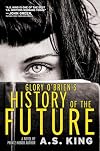
Glory O'Brien's History of the Future
by A. S. King 
On This Page
Description
Science Fiction. Young Adult Fiction. HTML:In this masterpiece about freedom, feminism, and destiny, Printz Honor author A.S. King tells the epic story of a girl coping with devastating loss at long last—a girl who has no idea that the future needs her, and that the present needs her even more.Graduating from high school is a time of limitless possibilities—but not for Glory, who has no plan for what's next. Her mother committed suicide when Glory was only four years old, and she's show more never stopped wondering if she will eventually go the same way...until a transformative night when she begins to experience an astonishing new power to see a person's infinite past and future. From ancient ancestors to many generations forward, Glory is bombarded with visions—and what she sees ahead of her is terrifying: A tyrannical new leader raises an army. Women's rights disappear. A violent second civil war breaks out. And young girls vanish daily, sold off or interned in camps. Glory makes it her mission to record everything she sees, hoping her notes will somehow make a difference. She may not see a future for herself, but she'll do anything to make sure this one doesn't come to pass.
. show less
Tags
Recommendations
















Member Reviews
Right before her high school graduation, Glory and her friend Ellie Heffner drink the remains of a dead bat, and they begin to have visions: transmissions of the past or future of whoever they look at. In the future, Glory sees a Second Civil War, and she begins to write down what she learns in her History of the Future.
Apart from the transmissions, Glory is dealing with other things as well. Her mother, Darla, committed suicide when Glory was four, and she's never understood why, and always worried if she, too, would become suicidal. Glory finally convinces her father to let her use her mother's darkroom in the basement, and she finds Darla's notebooks and sketchbooks there, which lead her to ask her dad questions about their show more relationship to their neighbors the Heffners.
Readers will learn a fair amount about film photography, and about feminism: Glory's vision of the future includes a New America that finds a loophole in the Fair Pay Act and forbids women from working at all.
An element of magical realism is a given in A.S. King's work (Ask the Passengers, Everybody Sees the Ants, Reality Boy), but what Glory sees is only part of her story; the other part consists of her efforts to understand her parents and her friendship with Ellie, and figure out what to do in her own immediate future - questions many people face as high school ends.
Quotes
It would seem that I was popular, and with my camera, I was. (19)
I was interested in death the way Ellie was interested in sex. The less adults talked to us about things, the more we wanted to know, I guess. (19)
"Why be happy something is over when there's nothing to go to next?" (Ellie to Glory, 29)
Jasmine Blue didn't allow magazines in her house, but Ellie knew what all girls knew - we were here to be whatever men wanted us to be.
I tried to think of one single message that said the opposite, but I couldn't think of one. Everywhere I'd looked for seventeen years said, under the slick imagery, "You are here to look pretty, keep quiet, and touch [penises]." (43)
I wished I could take her to the library and hand her over to the librarians. Please teach her about everything, I'd say. (44)
There is a moment in every photograph's life when it has been exposed but not developed. The light from the enlarger has shone through the negative and made its impression on the paper, but without the magic of developer, the paper will stay white and no one will ever see what that impression is. (93)
I felt like that piece of paper. Exposed but not developed. Potential beneath the surface. Blank.
...I realized that most everyone is just like me - exposed but not developed. Secretive. Scared. (94)
[At graduation] We were fed onto the stage like machine parts. We were a conveyor belt of future. We were an assembly line of tomorrow. (98)
Free yourself. Have the courage. (repeated)
"I take pictures because sometimes I can't find the words to say what I want to say." (118)
Suicide isn't something people do to hurt other people. It''s something people do to release themselves from pain. (149)
That's what a picture was, wasn't it? A point of view? ....Everything we see is based on where we're standing when we see it. (151)
Why do people take pictures?
To make things real.
...
To have memories of things they lost.
To remember - even though sometimes they want to forget. (195)
Past doesn't always have to be the present. Present doesn't always have to be the future. (239)
That's how suicide goes. No one has all the answers except the person you can't ask anymore. (266) show less
Apart from the transmissions, Glory is dealing with other things as well. Her mother, Darla, committed suicide when Glory was four, and she's never understood why, and always worried if she, too, would become suicidal. Glory finally convinces her father to let her use her mother's darkroom in the basement, and she finds Darla's notebooks and sketchbooks there, which lead her to ask her dad questions about their show more relationship to their neighbors the Heffners.
Readers will learn a fair amount about film photography, and about feminism: Glory's vision of the future includes a New America that finds a loophole in the Fair Pay Act and forbids women from working at all.
An element of magical realism is a given in A.S. King's work (Ask the Passengers, Everybody Sees the Ants, Reality Boy), but what Glory sees is only part of her story; the other part consists of her efforts to understand her parents and her friendship with Ellie, and figure out what to do in her own immediate future - questions many people face as high school ends.
Quotes
It would seem that I was popular, and with my camera, I was. (19)
I was interested in death the way Ellie was interested in sex. The less adults talked to us about things, the more we wanted to know, I guess. (19)
"Why be happy something is over when there's nothing to go to next?" (Ellie to Glory, 29)
Jasmine Blue didn't allow magazines in her house, but Ellie knew what all girls knew - we were here to be whatever men wanted us to be.
I tried to think of one single message that said the opposite, but I couldn't think of one. Everywhere I'd looked for seventeen years said, under the slick imagery, "You are here to look pretty, keep quiet, and touch [penises]." (43)
I wished I could take her to the library and hand her over to the librarians. Please teach her about everything, I'd say. (44)
There is a moment in every photograph's life when it has been exposed but not developed. The light from the enlarger has shone through the negative and made its impression on the paper, but without the magic of developer, the paper will stay white and no one will ever see what that impression is. (93)
I felt like that piece of paper. Exposed but not developed. Potential beneath the surface. Blank.
...I realized that most everyone is just like me - exposed but not developed. Secretive. Scared. (94)
[At graduation] We were fed onto the stage like machine parts. We were a conveyor belt of future. We were an assembly line of tomorrow. (98)
Free yourself. Have the courage. (repeated)
"I take pictures because sometimes I can't find the words to say what I want to say." (118)
Suicide isn't something people do to hurt other people. It''s something people do to release themselves from pain. (149)
That's what a picture was, wasn't it? A point of view? ....Everything we see is based on where we're standing when we see it. (151)
Why do people take pictures?
To make things real.
...
To have memories of things they lost.
To remember - even though sometimes they want to forget. (195)
Past doesn't always have to be the present. Present doesn't always have to be the future. (239)
That's how suicide goes. No one has all the answers except the person you can't ask anymore. (266) show less
Terrific book about a girl who doesn't want to think about the future as she graduates from high school; she and her father have put off thinking about the future when her mother committed suicide, leaving her daughter a camera. With a friend, Glory drinks a concoction made from dried bat (trust me, it works even if it sounds twee and silly) and both of them can suddenly see people's past and future. The differences in their visions deepens the fragility of their friendship and Glory realizes that, while the future will have some terrible moments (thanks to a civil war), she is capable of much. I loved the feminism involved, the humanity, the way a dystopian future is hinted at in a way that provokes thought but doesn't revel in the show more usual forms of YA dystopian misery and youth-led self-discovery-driven rebellion, and the excellent narrative voice. Incredibly impressive on all levels. show less
I am a big AS King fan and there are a couple books of King’s I haven’t read...this was one of them. I ended up really really loving this AS King book; I think it is my favorite AS King book so far. I love the protagonist's snarky attitude and thought the ability she gained was really interesting.
Imagine if you could look at a person and see, not only the past and the past of their ancestors, but also the future and the future of their descendants? What would you do if you found out that one of the descendants is going to change life as we know it and not for the better? How would you make people believe you?
This was a crazily creative book that I found both highly entertaining and a bit scary and creepy. The future portrayed here show more was scarily possible and absolutely terrifying.
I could not put this book down and ended up devouring this whole book in one night. I immediately gave it to my husband and told him to read it and I really think everyone should read it both to be entertained and as a cautionary tale of what the future could be come.
There is so much in here aside from Glory’s strange ability. She is dealing with her mother’s suicide, issues at school, a cult, and her own self worth. There is so much packed into this book that makes you really think and stretches your imagination.
This is actually one of A.S King’s more approachable books in my opinion; it’s not quite as abstract and ambiguous as some of King’s other works.
Overall I absolutely adored this book to pieces. I would recommend everyone read it. It was absolutely amazing. So creative and so hard to put down. show less
Imagine if you could look at a person and see, not only the past and the past of their ancestors, but also the future and the future of their descendants? What would you do if you found out that one of the descendants is going to change life as we know it and not for the better? How would you make people believe you?
This was a crazily creative book that I found both highly entertaining and a bit scary and creepy. The future portrayed here show more was scarily possible and absolutely terrifying.
I could not put this book down and ended up devouring this whole book in one night. I immediately gave it to my husband and told him to read it and I really think everyone should read it both to be entertained and as a cautionary tale of what the future could be come.
There is so much in here aside from Glory’s strange ability. She is dealing with her mother’s suicide, issues at school, a cult, and her own self worth. There is so much packed into this book that makes you really think and stretches your imagination.
This is actually one of A.S King’s more approachable books in my opinion; it’s not quite as abstract and ambiguous as some of King’s other works.
Overall I absolutely adored this book to pieces. I would recommend everyone read it. It was absolutely amazing. So creative and so hard to put down. show less
As Glory is about to graduate from high school, a strange thing happens to her and her best friend, Ellie. In a jar, they've kept a petrified bat that has turned to bat-dust, then one night when they settle on a blanket at their favorite spot near a pond with a six-pack that Ellie has snuck from home, the girls first mix, and afterwards drink a cocktail of bat-dust and beer. This not only makes them light-headed, but they also discover the next morning that it's now possible for them to see other people's future and distant pasts--ancestors and all.
Glory uses this supernatural power and records these visions in a book (Glory O'Brien's History of the Future) that provides a framed story within Glory's own story. She has real issues to show more work out too, for her mother (a photographer) had long-ago committed suicide by means of a gas oven. Like her mother, Glory is a photographer, and she has taken the pics for her high school year book. It's Glory's camera interests that have kept her sane, but she worries for how much longer because, even with her new powers, Glory can't see her own future. She lives with her dad, who, like everyone else, has avoided talking to Glory about her mom's suicide. When Glory finally get the courage to ask her dad for the key to her mother's locked basement darkroom, he surprisingly doesn't resist and hands over the key. After entering, Glory finds her mother's notebooks and some old photos, bringing on even more questions that Glory wants to find the answers to.
Glory O'Brien, like A. S. King's characters from other YA novels, you just can't help caring about. There's humor interspersed with a serious side in this one as Glory grapples with visualizing her own future. show less
Glory uses this supernatural power and records these visions in a book (Glory O'Brien's History of the Future) that provides a framed story within Glory's own story. She has real issues to show more work out too, for her mother (a photographer) had long-ago committed suicide by means of a gas oven. Like her mother, Glory is a photographer, and she has taken the pics for her high school year book. It's Glory's camera interests that have kept her sane, but she worries for how much longer because, even with her new powers, Glory can't see her own future. She lives with her dad, who, like everyone else, has avoided talking to Glory about her mom's suicide. When Glory finally get the courage to ask her dad for the key to her mother's locked basement darkroom, he surprisingly doesn't resist and hands over the key. After entering, Glory finds her mother's notebooks and some old photos, bringing on even more questions that Glory wants to find the answers to.
Glory O'Brien, like A. S. King's characters from other YA novels, you just can't help caring about. There's humor interspersed with a serious side in this one as Glory grapples with visualizing her own future. show less
I have not devoured a book as hungrily as I devoured Glory O’Brien’s History of the Future in a LONG time. Especially a hardcopy book.
There are a couple kinds of book reviews – ones that break down the mechanics of a book and offer a stiff, analytical perspective… and ones that unapologetically gush over a book because the story was just that good. I love the latter, and that’s what this review is going to be. I unabashedly loved Glory O’Brien’s History of the Future and I’m not sorry.
First, a note: this book is a bit odd. I mean, it starts off with two seventeen-year-olds ingesting a mummified bat, so… you know, life choices. I absolutely adore books with characters who are not the type of people you would normally show more pluck off the street in a Disney movie, so Glory’s tragic past and Ellie’s uncomfortable present appealed to me immensely. Glory’s a sort of no-nonsense kind of girl. While she’s bitter and jaded, she’s not cookie-cutter sarcastic-broken-contemporary-protagonist. The supernatural elements were great. Subtle, but great. They made the story, but also didn’t get in the way of the story. And the girls handled things in such a realistic way. No dramatic reactions, no over-the-top superhero antics. I loved the realism in it, all the while acknowledging that this was not your typical situation and not your typical cast of characters.
There were so many raw moments and quotes I jotted down because they were honest and relatable.
I rooted for the subtle but rewarding, slow burning, slightly unresolved love story. Relationships progressed naturally, and for once, it felt like a healthy YA relationship. Glory’s, not Ellie’s. Ellie’s love life was a heap of burning garbage.
I liked the messy, confusing friendship. Friendships, especially long-standing ones, are complicated and not always pretty. Ellie and Glory’s back-and-forth made so much sense to me. Friendship isn’t always bubbles and mani-pedis. A lot of them are complicated and the power shifts all the time and you can love one of your friends but discover you don’t really like them.
Themes and messages woven into Glory O’Brien’s History of the Future were so fantastically good. Feminism, politics, human interactions, moral dilemmas, empowerment… all were interesting and nothing felt preachy. I was a thing that was happening and that was that and at no time did I feel like this book existed to drive action. At the end of the day, it was a novel that gave a nudge at a little more awareness, a gentle reminder not to be a crappy human.
Also. I love a protagonist who is a photographer, I really do.
I’m blabbering and rambling. I really, really enjoyed this book. Because of the bit of oddity to it, it reminds me of books like Special Topics in Calamity Physics and because of that, I know that Glory O’Brien’s History of the Future will not be for everyone. I loved it. I loved it so much. But it’s not your typical YA and is best for readers who like low-key slow burn stories with intellectual puzzles, untraditional characters, and strange elements. The writing was really good, but the topics and their presentation would probably turn off readers who have gotten used to the sort of style most YA comes in these days. It just felt so much more earthy and raw than most of what I read and what I see. I repeat: there’s nothing wrong with it. It’s really good. But it is so different that it stands out.
Good for fans of John Green and Marisha Pessl. Maybe. I don’t know. I really liked it. Try it if you are feeling brave or want something a little different. It’s a little dark and gritty, it has the edge of an incoming dystopia. It’s so good. But I can’t promise you’ll like it as much as I did. show less
There are a couple kinds of book reviews – ones that break down the mechanics of a book and offer a stiff, analytical perspective… and ones that unapologetically gush over a book because the story was just that good. I love the latter, and that’s what this review is going to be. I unabashedly loved Glory O’Brien’s History of the Future and I’m not sorry.
First, a note: this book is a bit odd. I mean, it starts off with two seventeen-year-olds ingesting a mummified bat, so… you know, life choices. I absolutely adore books with characters who are not the type of people you would normally show more pluck off the street in a Disney movie, so Glory’s tragic past and Ellie’s uncomfortable present appealed to me immensely. Glory’s a sort of no-nonsense kind of girl. While she’s bitter and jaded, she’s not cookie-cutter sarcastic-broken-contemporary-protagonist. The supernatural elements were great. Subtle, but great. They made the story, but also didn’t get in the way of the story. And the girls handled things in such a realistic way. No dramatic reactions, no over-the-top superhero antics. I loved the realism in it, all the while acknowledging that this was not your typical situation and not your typical cast of characters.
There were so many raw moments and quotes I jotted down because they were honest and relatable.
I rooted for the subtle but rewarding, slow burning, slightly unresolved love story. Relationships progressed naturally, and for once, it felt like a healthy YA relationship. Glory’s, not Ellie’s. Ellie’s love life was a heap of burning garbage.
I liked the messy, confusing friendship. Friendships, especially long-standing ones, are complicated and not always pretty. Ellie and Glory’s back-and-forth made so much sense to me. Friendship isn’t always bubbles and mani-pedis. A lot of them are complicated and the power shifts all the time and you can love one of your friends but discover you don’t really like them.
Themes and messages woven into Glory O’Brien’s History of the Future were so fantastically good. Feminism, politics, human interactions, moral dilemmas, empowerment… all were interesting and nothing felt preachy. I was a thing that was happening and that was that and at no time did I feel like this book existed to drive action. At the end of the day, it was a novel that gave a nudge at a little more awareness, a gentle reminder not to be a crappy human.
Also. I love a protagonist who is a photographer, I really do.
I’m blabbering and rambling. I really, really enjoyed this book. Because of the bit of oddity to it, it reminds me of books like Special Topics in Calamity Physics and because of that, I know that Glory O’Brien’s History of the Future will not be for everyone. I loved it. I loved it so much. But it’s not your typical YA and is best for readers who like low-key slow burn stories with intellectual puzzles, untraditional characters, and strange elements. The writing was really good, but the topics and their presentation would probably turn off readers who have gotten used to the sort of style most YA comes in these days. It just felt so much more earthy and raw than most of what I read and what I see. I repeat: there’s nothing wrong with it. It’s really good. But it is so different that it stands out.
Good for fans of John Green and Marisha Pessl. Maybe. I don’t know. I really liked it. Try it if you are feeling brave or want something a little different. It’s a little dark and gritty, it has the edge of an incoming dystopia. It’s so good. But I can’t promise you’ll like it as much as I did. show less
GLORY O’BRIEN’S HISTORY OF THE FUTURE by A.S. King is a thought provoking young adult novel with a fantasy twist.
A touch of magical realism turns this starkly realistic coming-of-age story into a provocative exploration of the past and future. Glory is a fascinating and intelligent narrator with a wonderful streak of dark humor. Focusing attention on a wide range of issues including suicide, feminism, and activism, King does an outstanding job balancing Glory’s everyday struggles with a compelling exploration of a troubled future. From Glory’s tormented father to her long-time friend, King is a master at developing authentic characters.
Little things can make a big difference in YA literature. King’s use of very short show more chapters with brilliant titles, alternating chapters building the backstory of the future, and engaging, humorous dialogue reflect the exceptional skills of this popular author.
Readers who enjoy King’s new book should be reminded to revisit her other outstanding works including REALITY BOY, ASK THE PASSENGERS, EVERYBODY SEES THE ANTS, and PLEASE IGNORE VERA DIETZ.
This one is going on my Printz short list.
To learn more about the author, go to http://www.as-king.com/. Discussion guides are also available at King’s website. show less
A touch of magical realism turns this starkly realistic coming-of-age story into a provocative exploration of the past and future. Glory is a fascinating and intelligent narrator with a wonderful streak of dark humor. Focusing attention on a wide range of issues including suicide, feminism, and activism, King does an outstanding job balancing Glory’s everyday struggles with a compelling exploration of a troubled future. From Glory’s tormented father to her long-time friend, King is a master at developing authentic characters.
Little things can make a big difference in YA literature. King’s use of very short show more chapters with brilliant titles, alternating chapters building the backstory of the future, and engaging, humorous dialogue reflect the exceptional skills of this popular author.
Readers who enjoy King’s new book should be reminded to revisit her other outstanding works including REALITY BOY, ASK THE PASSENGERS, EVERYBODY SEES THE ANTS, and PLEASE IGNORE VERA DIETZ.
This one is going on my Printz short list.
To learn more about the author, go to http://www.as-king.com/. Discussion guides are also available at King’s website. show less
As a YA book, I'd probably rate it 4 stars (but 3 stars just putting it in amongst all the books I routinely read, especially since I don't routinely read YA books). I like some of the overall messages in the book. It has a peep into a future dystopia (where women basically become non-entities) & a drive/desire to make sure that is not the future that happens, while simultaneously addressing normal teenage angst & confusion, family & friend ties, etc....
Members
- Recently Added By
Lists

Bibliotherapy: Family and Personal Social Issues
174 works; 5 members

Books recommended by Calgary Public Library staff
1,588 works; 4 members
Author Information

14+ Works 6,305 Members
Some Editions
Awards and Honors
Awards
Distinctions
Notable Lists
Common Knowledge
- Original publication date
- 2014-10
- People/Characters
- Gloria "Glory" O'Brien; Ellie Heffner; Darla O'Brien (deceased); Jasmine Blue Heffner; Amy (aunt); Roy O'Brien (show all 10); Richard "Rick"; Peter; Ed Heffner; Richard of the USS Pledge
- Epigraph
- The future is no more uncertain than the present.
---Walt Whitman - Dedication
- For my girls
- First words
- So we drank it--the two of us.
- Last words
- (Click to show. Warning: May contain spoilers.)Can you?
- Publisher's editor
- Andrea Spooner
- Blurbers
- Green, John; Quick, Matthew; Hopkins, Ellen; Trueman, Terry; Smith, Andrew; Brewer, Heather
Classifications
Statistics
- Members
- 515
- Popularity
- 57,961
- Reviews
- 44
- Rating
- (3.89)
- Languages
- English, Portuguese, Spanish
- Media
- Paper, Audiobook, Ebook
- ISBNs
- 14
- ASINs
- 5