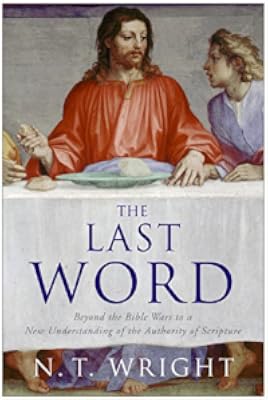
Scripture and the Authority of God: How to Read the Bible Today
by N. T. Wright
On This Page
Description
In this revised and expanded edition of The Last Word, Wright, Bishop of Durham, one of the preeminent Bible scholars of our day and author of such beloved works as After You Believe and Simply Christian, gives new life to the old, tattered doctrine of the authority of Scripture, delivering a fresh, helpful, and concise statement on the current battles for the Bible; and restoring Scripture as a place to find God's voice. Removing the baggage that the last hundred years of controversy and show more confusion have placed on this doctrine, he renews readers; confidence in the Bible, and shows that the Bible can still be a guide for their lives. This updated version includes two new case studies, taking a closer look at what it means to keep the Sabbath holy, and also how Christians can defend marital monogamy in modern society. show lessTags
Recommendations






Member Reviews
I started and finished reading this having begun Dale Martin’s *Sex and the Single Savior,* which takes an anti-foundationalist approach to reading Scripture. Martin provides some great critique to Wright’s focus on historical criticism, especially that at some level Wright’s emphasis is so strong that it raises the question of how anyone read the Bible well and faithfully in the past, before the historical-critical method existed.
Wright indeed gives disappointingly scant attention to both premodern and postmodern readings of Scripture in this book. He also doesn’t address theological readings which are not his own model (Creation Fall Israel Jesus Church). Part of this has to do with the relatively narrow and non-exhaustive show more scope of Wright’s book, but I still wish he had treated those subjects more thoroughly.
What still brings this up to a 4-5 star book after those critiques is 1) that Wright is writing as a pastor to the Church, and this pastoral emphasis shapes every page and 2) the conversation about sources of authority in the church through the framework readers of Hooker and Wesley have given them (Scripture, Tradition, Reason, Experience).
As a United Methodist pastor turning to Wright while United Methodism appears to be flying toward schism, his writing about how these sources of authority interact is just terrific. He is especially helpful in speaking about how for Hooker and Wesley (and most of the Christian Tradition) reason is a particular kind of reason—not just the ability to think rationally, but reasoning within the Church, with its Scripture. Reason is thus a traditioned form of theological reasoning with the Scriptures. Experience, meanwhile, insists Wright, is no source of authority at all but rather the end of authority, if we take “experience” to mean that my individual experience determines my theology, rather than that experience is an important shaper and affirmer of our theology from other sources of primary authority.
Five stars not because it’s perfect but because it helps me think and understand and speak better of Scripture, theology, and God to the people of God. show less
Wright indeed gives disappointingly scant attention to both premodern and postmodern readings of Scripture in this book. He also doesn’t address theological readings which are not his own model (Creation Fall Israel Jesus Church). Part of this has to do with the relatively narrow and non-exhaustive show more scope of Wright’s book, but I still wish he had treated those subjects more thoroughly.
What still brings this up to a 4-5 star book after those critiques is 1) that Wright is writing as a pastor to the Church, and this pastoral emphasis shapes every page and 2) the conversation about sources of authority in the church through the framework readers of Hooker and Wesley have given them (Scripture, Tradition, Reason, Experience).
As a United Methodist pastor turning to Wright while United Methodism appears to be flying toward schism, his writing about how these sources of authority interact is just terrific. He is especially helpful in speaking about how for Hooker and Wesley (and most of the Christian Tradition) reason is a particular kind of reason—not just the ability to think rationally, but reasoning within the Church, with its Scripture. Reason is thus a traditioned form of theological reasoning with the Scriptures. Experience, meanwhile, insists Wright, is no source of authority at all but rather the end of authority, if we take “experience” to mean that my individual experience determines my theology, rather than that experience is an important shaper and affirmer of our theology from other sources of primary authority.
Five stars not because it’s perfect but because it helps me think and understand and speak better of Scripture, theology, and God to the people of God. show less
Beautifully and cogently written -- a timely reminder of how well-meaning Christians can mis-represent and mis-use the Bible when they pull 'proof texts' out of context and then conveniently ignore other, inconvenient passages. The book is an easy read, but addresses some weighty issues. I'll need to read it again at least once.
A fascinating breakdown of what "authority of God" truly means, and how Scripture relates to it. Like most things N.T. Wright, full of many nuggets of truth that will challenge you and take some time to digest. Edition-specific: the added case studies really helped illustrate the concepts laid out in the original chapters.
Highly recommended for all interested in Christianity, how to read the Bible, and practical application of Scripture and doctrine.
Highly recommended for all interested in Christianity, how to read the Bible, and practical application of Scripture and doctrine.
A well-written and well-presented discussion of the disputations regarding the role of the Bible in Christian life and practice.
Wright goes through the history of how the Bible was used and interpreted in order to explain how we have reached the current moment. He demonstrates well why there must be a delineation between the Old and the New Testaments, and is as critical toward proof-texting conservatism as he is toward free-wheeling liberalism with the text.
Wright re-emphasizes how the Scriptures are, at heart, a story-- the story of God's work of salvation as expressed through the creation, fall, Abraham, Patriarchs, Israelites, and Jesus the Messiah, and a foretaste of the ultimate demonstration of God's rule in His Kingdom for show more eternity. He indicates how we are in "act 5" of this story, and how we should use Scripture as our guide for faith and practice to live the Christian message in the 21st century.
Recognition that the Scriptures are authoritative because they are the message of the God who has all authority and His Son to whom He gave all authority is expressed and is quite important. It must never be forgotten that the Bible is designed to point to God's truth and is no substitute for God Himself as the authority.
Wright sensibly handles the different roles of tradition, reason, "experience," and scholarship in helping to define, describe, and illuminate our attempts to understand Scripture.
A book very worthy of consideration. show less
Wright goes through the history of how the Bible was used and interpreted in order to explain how we have reached the current moment. He demonstrates well why there must be a delineation between the Old and the New Testaments, and is as critical toward proof-texting conservatism as he is toward free-wheeling liberalism with the text.
Wright re-emphasizes how the Scriptures are, at heart, a story-- the story of God's work of salvation as expressed through the creation, fall, Abraham, Patriarchs, Israelites, and Jesus the Messiah, and a foretaste of the ultimate demonstration of God's rule in His Kingdom for show more eternity. He indicates how we are in "act 5" of this story, and how we should use Scripture as our guide for faith and practice to live the Christian message in the 21st century.
Recognition that the Scriptures are authoritative because they are the message of the God who has all authority and His Son to whom He gave all authority is expressed and is quite important. It must never be forgotten that the Bible is designed to point to God's truth and is no substitute for God Himself as the authority.
Wright sensibly handles the different roles of tradition, reason, "experience," and scholarship in helping to define, describe, and illuminate our attempts to understand Scripture.
A book very worthy of consideration. show less
This is an excellent, very accessible (non-academic) book which guides the reader away from shallow readings of Scripture and replaces that with a thoughtful method centered on the authority of God as exercised through Scripture. Wright does a good job of avoiding external priorities overlaid on Scripture by various camps and includes two intriguing case studies.
Not as good (read fresh, insightful, well-argued) as Wright's other books, but a solid overview of his approach to the authority of Scripture. If you're familiar with Wright's other works and textbook hermeneutics then you can pass on this.
What a great little gem of a book. A lot of ground is covered within this, but Wright makes every point quite cohesively and in a manner that really brings about thought. I really appreciate the thoughts he put in this and it is a very interesting subject. It is probably something that should be discuseed more often, openly, and with respect to each other.
Members
- Recently Added By
Author Information

291+ Works 56,582 Members
N. T. Wright serves as Senior Research Fellow at Wycliffe Hall, Oxford University, as well professor emeritus of New Testament and Early Christianity at the School of Divinity at the University of St. Andrews. He is the award-winning author of many books, including Broken Signposts, Paul: A Biography, Surprised by Hope, and many more.
Some Editions
Common Knowledge
- Alternate titles
- The Last Word; Scripture and the Authority of God
- Original publication date
- 2005-11-22
- Disambiguation notice
- US title: The Last Word; UK title: Scripture & the Authority of God.
Classifications
Statistics
- Members
- 1,577
- Popularity
- 14,500
- Reviews
- 14
- Rating
- (3.97)
- Languages
- English, Portuguese (Portugal)
- Media
- Paper, Audiobook, Ebook
- ISBNs
- 13
- UPCs
- 1
- ASINs
- 5