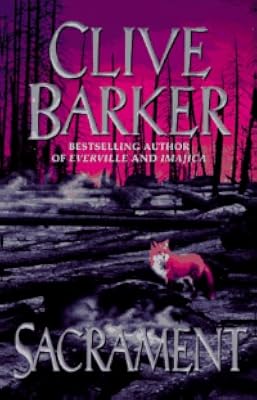
Sacrament
by Clive Barker
On This Page
Description
A gay photographer of endangered species recalls a childhood meeting with two agents of Death. They told him they were seeking the extinction of species. Suddenly, he has an intuitive flash. Aids! Is that their work too, the extinction of his kind? He embarks on a quest for an answer.Tags
Recommendations









Member Reviews
This was an absolutely fabulous read! Yet again, Barker astounds me with his use of language, weaving plot-lines, and adept and revealing characterizations of people who you actually are interested in and want to know about. This was a passionate, jarring, and emotional novel that throws off the shackles than contemporary fiction sometimes places on itself and instead goes for the heart and the mind at the same time. Any reader should view this as an astounding piece of art- for that is what it is. I was blown away by this and I intend to keep working on Barker's oeuvre.
4.5 stars- and very well deserved!
4.5 stars- and very well deserved!
Like many of my generation, I went through a Clive Barker phase when I was a teenager. The Hellraiser movies, Nightbreed, Candyman; his novels, The Great and Secret Show and Imajica. He defined dark and edgy for me, and he was much cooler than Stephen King.
Sacrament was the first new-to-me Clive Barker novel I’d read in over two decades. It wasn't what I expected.
Because of his early work, Mr. Barker is too easily dismissed as a horror writer, albeit one who incorporates a greater portion of magic and fantasy than most. This has never been entirely fair—his best novels have always been more than just horror, as fantastical as they are horrible, works of unfettered imagination.
Sacrament casts off any chains previously tying Mr. show more Barker to the horror genre. There's darkness in it, and danger, but it's definitively not a horror novel.
To be honest, I'm not entirely sure what sort of novel this is. I'm not even sure that's the right question to ask. Perhaps magical realism comes closest.
Like much of his work, Sacrament is fascinated by the relationship between reality and illusion, between the mind and dreams, between perception and meaning. Ultimately, it's obsessed with the relationships people have with each other, and the power these relationships have to define our world.
However, compared to his earlier work, Sacrament is more explicitly grounded in real, present day issues (present day for 1996, when it was released). Mr. Barker is concerned here with environmentalism and gay culture. He clearly wants to make a statement about our responsibility to the planet and to each other.
This book is overtly spiritual—it's a clearer expression of his Christian faith than his previous work.
Mr. Barker's writing style tends to be rather florid. As I get older, I find I have less patience for over-written stories. Too often, authors resort to overwrought language in an attempt to present their work as more significant than it really is.
I was pleasantly surprised to find that Mr. Barker's writing style didn't bother me. Indeed, his floridness is somehow perfectly appropriate to the story. His vision is so complete, so clear, so compelling, it needs no help to achieve significance. His language comes across not as a crutch, but as an honest attempt to describe that vision as accurately as possible.
Ultimately, though, Sacrament isn't his best work. It won't sit on the shelf next to Imajica or The Great and Secret Show when people assess Mr. Barker's literary legacy. Which is too bad, because I get the feeling that Sacrament may be one of his most personal books. I think he wanted this one to really mean something. show less
Sacrament was the first new-to-me Clive Barker novel I’d read in over two decades. It wasn't what I expected.
Because of his early work, Mr. Barker is too easily dismissed as a horror writer, albeit one who incorporates a greater portion of magic and fantasy than most. This has never been entirely fair—his best novels have always been more than just horror, as fantastical as they are horrible, works of unfettered imagination.
Sacrament casts off any chains previously tying Mr. show more Barker to the horror genre. There's darkness in it, and danger, but it's definitively not a horror novel.
To be honest, I'm not entirely sure what sort of novel this is. I'm not even sure that's the right question to ask. Perhaps magical realism comes closest.
Like much of his work, Sacrament is fascinated by the relationship between reality and illusion, between the mind and dreams, between perception and meaning. Ultimately, it's obsessed with the relationships people have with each other, and the power these relationships have to define our world.
However, compared to his earlier work, Sacrament is more explicitly grounded in real, present day issues (present day for 1996, when it was released). Mr. Barker is concerned here with environmentalism and gay culture. He clearly wants to make a statement about our responsibility to the planet and to each other.
This book is overtly spiritual—it's a clearer expression of his Christian faith than his previous work.
Mr. Barker's writing style tends to be rather florid. As I get older, I find I have less patience for over-written stories. Too often, authors resort to overwrought language in an attempt to present their work as more significant than it really is.
I was pleasantly surprised to find that Mr. Barker's writing style didn't bother me. Indeed, his floridness is somehow perfectly appropriate to the story. His vision is so complete, so clear, so compelling, it needs no help to achieve significance. His language comes across not as a crutch, but as an honest attempt to describe that vision as accurately as possible.
Ultimately, though, Sacrament isn't his best work. It won't sit on the shelf next to Imajica or The Great and Secret Show when people assess Mr. Barker's literary legacy. Which is too bad, because I get the feeling that Sacrament may be one of his most personal books. I think he wanted this one to really mean something. show less
Clive Barker's Sacrament is a puzzle box, a mystery that begs to be solved. This novel stands apart in Barker's arsenal. It exudes a personal, contemplative aura. It cannot truly be considered horror or even fantasy. It might more accurately be regarded as something akin to magical realism. Those less-than-hardy readers who avoid books that contain blood and gore can read this book without fear of getting wet.
Sacrament is a thinking person's novel. It is a novel that examines the past and foretells the future.
Every aspect of this book shivers in the light like reflections in a house of mirrors. Characters mirror each other to the point that one cannot be sure of who is real and who is the shadow- double of another. One cannot even come show more to a definitive analysis of the plot line. Is it a non-linear frame story, or is it a linear progression documenting the unconscious adventures of a man in a coma? One cannot even say whether the man ever wakes, or if he continues in a dream state.
Mr. Barker weaves a tale of a man on a quest initiated by a pivotal childhood meeting. The narrative opens in a frozen town called Balthazar. Snow and ice give rise to a sterile whiteout, a tabula rasa that insists on annotation. The borealis ripples across the night sky, its wavering image foreshadowing magical things to come. The protagonist, Will Rabjons, is a photographer. He filters his view of the world through the lens of a camera, effectively distancing himself from the truth. His passion is documenting extinctions. Why? He regularly risks his life to capture a picture that commemorates the passing of the last of a species, even if that animal is dangerous. It appears he is taunting death, daring the grim reaper to take him. The last animal he photographs is a giant polar bear that turns out to be blind—blind like a photographer who hides from the truth. Will survives this test, but later meets his match when an angry polar bear, another soon-to-be last thing, mauls him.
It is extremely interesting that, in the midst of this crucial photo shoot, Will is focused on arranging a meeting with a mysterious hermit. A reader would most likely predict that this meeting must have something to do with Will's profession, but when he finally gets to meet Guthrie, the narrative reveals that it is knowledge Will seeks. All he wants is to ask about "Jacob and Rosa." The true mystery begins. Soon thereafter, Will is so severely injured by a polar bear that that he falls into a coma. Here, the story appears to drop into a frame to return to Will's past—or is Will simply dreaming?
The reader then meets Will as a boy, a boy unloved by his parents. Will believes that a "perfect" brother forced him into this position. After his brother's death, Will's parents become distant, preferring the memory of a perfect, dead child to the presence of a living, unique son. Since Will is gay, one might wonder if there ever really was a corporeal, perfect brother, or if the perfect, deceased brother was actually Will himself, the perfect Will who fell tragically from favor when his parents discovered his true nature and decided he no longer deserved their love. Will's mother constantly mourns, and his father hovers in his library, judging the living and the dead in his philosophical writings.
Supposedly, to ease the grief of Will's mother, the family moves away and settles in a country town, Burnt Yarly. Again, a reader might wonder if the move was truly spurred by a shameful attempt to escape a truth Will's parents cannot accept. At the same time, Will is glad his brother is dead, just as he might be glad to have left a counterfeit persona behind in the past so he so he can honor his true self. As expected, Will suffers from an abject lack of love, a situation that sends many young people careening toward disaster.
Desperate to escape his pain, Will sneaks out of the house and becomes lost in overgrown fields. There he stumbles upon, or is perhaps lured to an abandoned building. It turns out to be the skeleton of a "court house" built by an eccentric man whose goal was to judge people based on the way they treated animals. Once inside, Will finds a starving sheep lost in the labyrinthine courthouse. He leads the sheep to freedom and unconsciously offers himself up for sacrifice in its place. There he meets Jacob, the killer of last things, who keeps a diary in which he documents all the last of things he annihilates, just as Will publishes photo collections that artistically document the deaths of last things. In addition, Will meets Jacob's partner, Rosa, a defiler of young men. Jacob draws Will into his web by building a fire stoked with the dusty wings of fluttering moths. When Jacob convinces Will to add moths to the fire, he is hooked. He will never be the same. With the innocence of childhood, Will believes he has found the love and acceptance he craves.
Back in the present, Will supposedly wakes from his coma. He returns to his home in California, but he no longer feels at home. He feels strangely distanced from his old haunts, from old friends and lovers. It is as if he walks in a dream. When he is lured back to England to see about his seriously injured father, Will leaves his camera out of the picture; guided by his totem fox, he is ready to face a truth unaltered by the lens of a camera. He knows he must see through his own naked eyes and flayed soul. Thus begins Will's quest.
So many mysteries beg to be dragged out into the light. Is Jacob a discrete individual, or is he actually Will's Jungian shadow fighting to preserve its existence by refusing to join with its other half in order to avoid an individuation that would leave behind only one, new, complete individual? Why are Will's mother and Rosa both portrayed as women haunted by the loss of children who have met violent ends? Even Frannie loses her brother/son to violence, forming a female triad. Why the triad of secluded, judgmental, controlling men? The father in his library, Jacob in his courthouse, and Rukenau in his kingdom built of excrement. Actually, it could be said that all three men live in kingdoms of excrement.
It could be said that the operative questions raised by this novel include us all. Are we all drawn to the flame of knowledge? Are we nothing more than moths, kindling for the fire? Since each human is unique, is each a last thing? Will anyone be there to document each individual passing? Are are we killers of last things when we support child labor in order to purchase a fine rug? Are we killers of last things when we wear real fur?
Given the title Sacrament, and the word's association with inner grace and purification, perhaps this novel is actually a glorious metaphor for the coming to terms with pain and the finding of one's self and the hunger for love and acceptance that can never truly be found in another?
Dear readers, if you decide to join Will on his journey through this extremely ambiguous text, take care, you just might solve the puzzle box and be forced to gaze upon your own wavering reflections in a house of mirrors. Keep your wings tightly tucked, and stay away from the flame.
As Jacob says, "Living and dying, we feed the fire." show less
Sacrament is a thinking person's novel. It is a novel that examines the past and foretells the future.
Every aspect of this book shivers in the light like reflections in a house of mirrors. Characters mirror each other to the point that one cannot be sure of who is real and who is the shadow- double of another. One cannot even come show more to a definitive analysis of the plot line. Is it a non-linear frame story, or is it a linear progression documenting the unconscious adventures of a man in a coma? One cannot even say whether the man ever wakes, or if he continues in a dream state.
Mr. Barker weaves a tale of a man on a quest initiated by a pivotal childhood meeting. The narrative opens in a frozen town called Balthazar. Snow and ice give rise to a sterile whiteout, a tabula rasa that insists on annotation. The borealis ripples across the night sky, its wavering image foreshadowing magical things to come. The protagonist, Will Rabjons, is a photographer. He filters his view of the world through the lens of a camera, effectively distancing himself from the truth. His passion is documenting extinctions. Why? He regularly risks his life to capture a picture that commemorates the passing of the last of a species, even if that animal is dangerous. It appears he is taunting death, daring the grim reaper to take him. The last animal he photographs is a giant polar bear that turns out to be blind—blind like a photographer who hides from the truth. Will survives this test, but later meets his match when an angry polar bear, another soon-to-be last thing, mauls him.
It is extremely interesting that, in the midst of this crucial photo shoot, Will is focused on arranging a meeting with a mysterious hermit. A reader would most likely predict that this meeting must have something to do with Will's profession, but when he finally gets to meet Guthrie, the narrative reveals that it is knowledge Will seeks. All he wants is to ask about "Jacob and Rosa." The true mystery begins. Soon thereafter, Will is so severely injured by a polar bear that that he falls into a coma. Here, the story appears to drop into a frame to return to Will's past—or is Will simply dreaming?
The reader then meets Will as a boy, a boy unloved by his parents. Will believes that a "perfect" brother forced him into this position. After his brother's death, Will's parents become distant, preferring the memory of a perfect, dead child to the presence of a living, unique son. Since Will is gay, one might wonder if there ever really was a corporeal, perfect brother, or if the perfect, deceased brother was actually Will himself, the perfect Will who fell tragically from favor when his parents discovered his true nature and decided he no longer deserved their love. Will's mother constantly mourns, and his father hovers in his library, judging the living and the dead in his philosophical writings.
Supposedly, to ease the grief of Will's mother, the family moves away and settles in a country town, Burnt Yarly. Again, a reader might wonder if the move was truly spurred by a shameful attempt to escape a truth Will's parents cannot accept. At the same time, Will is glad his brother is dead, just as he might be glad to have left a counterfeit persona behind in the past so he so he can honor his true self. As expected, Will suffers from an abject lack of love, a situation that sends many young people careening toward disaster.
Desperate to escape his pain, Will sneaks out of the house and becomes lost in overgrown fields. There he stumbles upon, or is perhaps lured to an abandoned building. It turns out to be the skeleton of a "court house" built by an eccentric man whose goal was to judge people based on the way they treated animals. Once inside, Will finds a starving sheep lost in the labyrinthine courthouse. He leads the sheep to freedom and unconsciously offers himself up for sacrifice in its place. There he meets Jacob, the killer of last things, who keeps a diary in which he documents all the last of things he annihilates, just as Will publishes photo collections that artistically document the deaths of last things. In addition, Will meets Jacob's partner, Rosa, a defiler of young men. Jacob draws Will into his web by building a fire stoked with the dusty wings of fluttering moths. When Jacob convinces Will to add moths to the fire, he is hooked. He will never be the same. With the innocence of childhood, Will believes he has found the love and acceptance he craves.
Back in the present, Will supposedly wakes from his coma. He returns to his home in California, but he no longer feels at home. He feels strangely distanced from his old haunts, from old friends and lovers. It is as if he walks in a dream. When he is lured back to England to see about his seriously injured father, Will leaves his camera out of the picture; guided by his totem fox, he is ready to face a truth unaltered by the lens of a camera. He knows he must see through his own naked eyes and flayed soul. Thus begins Will's quest.
So many mysteries beg to be dragged out into the light. Is Jacob a discrete individual, or is he actually Will's Jungian shadow fighting to preserve its existence by refusing to join with its other half in order to avoid an individuation that would leave behind only one, new, complete individual? Why are Will's mother and Rosa both portrayed as women haunted by the loss of children who have met violent ends? Even Frannie loses her brother/son to violence, forming a female triad. Why the triad of secluded, judgmental, controlling men? The father in his library, Jacob in his courthouse, and Rukenau in his kingdom built of excrement. Actually, it could be said that all three men live in kingdoms of excrement.
It could be said that the operative questions raised by this novel include us all. Are we all drawn to the flame of knowledge? Are we nothing more than moths, kindling for the fire? Since each human is unique, is each a last thing? Will anyone be there to document each individual passing? Are are we killers of last things when we support child labor in order to purchase a fine rug? Are we killers of last things when we wear real fur?
Given the title Sacrament, and the word's association with inner grace and purification, perhaps this novel is actually a glorious metaphor for the coming to terms with pain and the finding of one's self and the hunger for love and acceptance that can never truly be found in another?
Dear readers, if you decide to join Will on his journey through this extremely ambiguous text, take care, you just might solve the puzzle box and be forced to gaze upon your own wavering reflections in a house of mirrors. Keep your wings tightly tucked, and stay away from the flame.
As Jacob says, "Living and dying, we feed the fire." show less
Sacrament might be favorite novel yet by Clive Barker. I am not sure how personal this was to Clive (I have yet to read his blog and interviews for background on "Sacrament"), but it comes across as an intensely personal novel. Wil Rabjohns is an incredibly talented homosexual who has an eye for photography, for capturing species at the verge of extinction.
Like Dan Simmon's The Terror, Sacrament is a dark fantasy or supernatural horror that deals with the relationships between men and the world we live in. Wil Rabjohn's story, the story of Jacob & Rosa, and memory of Lord Fox all intertwine as Rabjohns later wonders "am I the dreamer or the dreamed?"
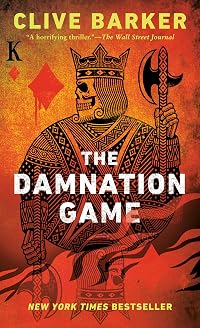
Sacrament is very different from The Hellbound Heart or The Damnation Game. Even show more compared to Galilee, Imajica, Great & Secret Show, the pacing and story of Sacrament is much more sedate, much more a personal journey than a dramatic one. I can see reviewers and readers being caught up on Rabjohns' sexuality or the pacing, and missing the story because of it. I wouldn't recommend Sacrament to some fans, but I would to most.
I loved Sacrament. This was my second reading, and I'm sure I'd read it again. I'd love to have a Lord Fox in my head, but I'd settle for trying to make the world better for dogs amidst their "meat and flowers." show less
Like Dan Simmon's The Terror, Sacrament is a dark fantasy or supernatural horror that deals with the relationships between men and the world we live in. Wil Rabjohn's story, the story of Jacob & Rosa, and memory of Lord Fox all intertwine as Rabjohns later wonders "am I the dreamer or the dreamed?"
Sacrament is very different from The Hellbound Heart or The Damnation Game. Even show more compared to Galilee, Imajica, Great & Secret Show, the pacing and story of Sacrament is much more sedate, much more a personal journey than a dramatic one. I can see reviewers and readers being caught up on Rabjohns' sexuality or the pacing, and missing the story because of it. I wouldn't recommend Sacrament to some fans, but I would to most.
I loved Sacrament. This was my second reading, and I'm sure I'd read it again. I'd love to have a Lord Fox in my head, but I'd settle for trying to make the world better for dogs amidst their "meat and flowers." show less
Having had Barker’s ‘Sacrament’ on my ‘to read’ list for quite a while I was not disappointed. Touted as an alternative to Stephen King, and having ‘O.D.ed’ on Mr King by the early 1990’s, it was a disturbing pleasure to re-enter the horror genre with Barker’s macabre images of death and animals, and with the raunchiest sex scene I have read in quite a while this was certainly a reading pleasure. I was very pleased to find a gay main character whose sexuality was important but not overplayed, and his sojourn back to San Francisco afforded me the opportunity to re-visit one of my favourite cities. Other reviews appear to indicate this is not one of Barker’s best novels, so I’m looking forward to exploring this show more author’s work. show less
Really fantastic read. Barker proves once again how effortlessly he handles urban fantasy. I'm a big fan of his work and writing style and the types of characters he writes, and I felt like this book fully delivered on everything a fan would expect of him. I'm actually shocked now when I think of how little I'd heard about this book. That's one of the reasons I picked it up, because it seems to be the one Barker novel that no one talks about. But it's just as good, if not better, than the ones that seem to get all the attention. It's hard for me to narrow down why I loved it so much. Partly the risks he took here, partly the mysterious nature of what made the plot supernatural. But suffice to say I loved it.
This book would certainly not be for everyone. It's a book that will make you think however about how you fit into the world. The book is longer than it needed to be and I did skim a little here and there, but that was because I wanted to get to the end to see how the story resolved itself. A decent Barker tale that remains true to the type of story he likes to tell. If you enjoy Barker's works and haven't read this, it's only a matter of time.
Members
- Recently Added By
Author Information

381+ Works 57,041 Members
Critics of the horror story have frequently called Clive Barker the "British Stephen King". Born in Liverpool in 1952, Barker attended the University of Liverpool but moved to London in 1977, where he worked as a commercial artist and became involved with the avant-garde theatrical community. Primarily a playwright during this period, he also show more produced short fiction that he would eventually publish as part of his six-volume collection titled Books of Blood (1984-85). More than any other author of contemporary horror fiction, Barker has had a major impact on the direction of the genre. He has introduced strong elements of sex and graphic violence into his fiction, but these elements are employed with an artistic objective. Barker underscores his work with complex subtextual metaphors and artistic allusions. Preoccupied with the craft of writing and with its effect on the reader, Barker is an innovator of formula and genre, often parodying the former in order to change the philosophical contour of the latter. Barker has achieved commercial success not only with his short fiction but also with his novels, which tend to be epic in scope and to blend elements of horror with those of high fantasy. Barker is one of the more influential voices in horror cinema, having written and directed a number of films. His printed works include The Candle in the Cloud, Absolute Midnight, The Scarlet Gospels, and Black is the Devil's Rainbow: Tales of a Journeyman. His films include Dread, Tortured Souls: Animae Damanatae, and Hellraiser. (Bowker Author Biography) Clive Barker was born in October, 1952, in Liverpool, England, and graduated from Liverpool University. While a student, the resourceful Barker formed a theater company as an outlet for his career as a budding playwright. After minor success with several plays such as "Frankenstein in Love," Barker vaulted onto the horror fiction scene with the publication of his short stories, "The Books of Blood." Later books such as "The Damnation Game," "Imajica," and "Everville" have further established his reputation as a Master of Horror. Barker gained further popularity with several motion picture projects. Unhappy with previous film versions of his works, he chose to direct the successful movie "Hellraiser," which generated a string of sequels. In addition to writing and directing, Barker has produced several of the movies in both the "Hellraiser" and "Candyman" series. Besides his writing and film activities, the multitalented Barker is an actor and illustrator, with several published volumes of his artwork. Barker is a recipient of British Fantasy awards and a World Fantasy award, and resides in Los Angeles. (Bowker Author Biography) show less
Awards and Honors
Awards
Notable Lists
Series
Belongs to Publisher Series
Heyne Allgemeine Reihe (10626)
Common Knowledge
- Canonical title*
- Das Sakrament
- Original title
- Sacrament
- Original publication date
- 1996
- People/Characters
- Will Rabjohns
- Epigraph
- I am a man, and men are animals who tell stories.
This is a gift from God, who spoke our species into being,
but left the end of our story untold.
That mystery is troubling to us. How could it be otherwise?
Wi... (show all)thout the final part, we think, how are we to make sense
of all that went before: which is to say, our lives?
So we make stories of our own,
in fevered and envious imitation of our Maker,
hoping that we'll tell. by chance, what God left untold.
And finishing our tale,
come to understand why we were born. - Dedication
- For Malcolm
- First words
- To every hour, its mystery.
- Last words
- (Click to show. Warning: May contain spoilers.)Turning from the deserted village, and from the church, and the house, he walked down to the river and, following the track that wound beside it, began his journey back to his only true and certain home, the world.
- Original language*
- Englisch
- Canonical DDC/MDS
- 823.914
- Canonical LCC
- PR6052.A6475
*Some information comes from Common Knowledge in other languages. Click "Edit" for more information.
Classifications
Statistics
- Members
- 1,505
- Popularity
- 15,386
- Reviews
- 17
- Rating
- (3.58)
- Languages
- 9 — Czech, Dutch, English, French, German, Greek, Italian, Polish, Turkish
- Media
- Paper, Audiobook, Ebook
- ISBNs
- 31
- ASINs
- 15