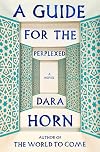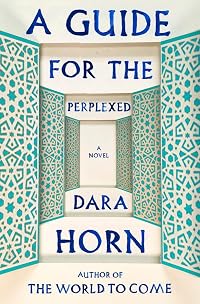
A Guide for the Perplexed
by Dara Horn 
On This Page
Description
While consulting at an Egyptian library, software prodigy Josie Ashkenazi is kidnapped and her talent for preserving memories becomes her only means of escape as the power of her ingenious work is revealed, while jealous sister Judith takes over Josie's life at home.Tags
Recommendations


















Member Reviews
Like other novels by the talented Dara Horn, this book has layers upon layers that challenge the reader intellectually without pulling you away from the story.
This book is, on one level, a retelling of the Biblical story of Joseph, who was sold into bondage in Egypt by his jealous brothers. If you haven’t read that story in a while, I won’t mention many more parallels, lest it be spoilery. But in a nice twist, rather than Joseph, we have a story about Josephine (or “Josie”), and her envious sister Judith. At Judith's encouragement, Josie leaves her husband and young daughter behind to travel to Egypt, and there she is kidnapped by revolutionaries.
It is also a story about memory and the gates of perception. What becomes our show more sharpest memories about ourselves and others, and how does that choice or phenomenon affect our interaction with the present and the future?
Tying these two themes together are two other themes. (Horn is always complex, making the title of this book sort of a double entendre!). One theme is a fictional retelling of the historical discovery of the Genizah in Cairo. A Genizah is a repository of memories: in the Jewish religion, any object inscribed with the name of God cannot be destroyed, so synagogues designate rooms as repositories for marred, worn, or otherwise damaged documents they could no longer use. This storeroom is known as a Genizah, or “hiding place.”
Josie has created a computer program to store memories which she calls Genizah. It has been wildly successful. It takes any input - including documents, notes, pictures, and videos - and categorizes them, putting them behind visual “doors”. The more labels or categories one adds to the data, the better the program can sort and retrieve any memories or ideas. Then it can generate patterns so you can see persistent behaviors and themes and perhaps even predict future outcomes. And if we can save the past, and “recreate” people from these memories, haven’t we in some senses “resurrected” them from the dead? And what about the converse: is Hell just oblivion? Is that what we all really fear?
All of this is echoed in the fourth theme, the great 12th Century work of philosophy by the Jewish scholar Maimonides, Guide for the Perplexed. Because of his adaptation of Aristotelian thought to Biblical faith, Maimonides influenced a number of scholars who came after him, including the noted Christian theologian Saint Thomas Aquinas.
In the [original] Guide for the Perplexed, a copy of which was [actually] discovered in the Cairo Genizah, Maimonides considers the reconciliation of ideas about God's omniscience, omnipotence, and benevolence with (a) the problem of evil in the world, and (b) whether or not this could mean that mankind has free will. As Judith Plaskow (Professor of Religious Studies at Manhattan College) once wrote, the most salient existential dilemma is not how a supposedly good and omnipotent God would permit evil in the world, because we cannot know the answer. Rather, she suggests, a better question is how, given the reality of evil, we deal with it. And how then do we justify faith or lack of faith? What stories do we tell ourselves? These issues become critically important to Josie after she is kidnapped in Cairo, and because she has with her a copy of the Maimonides work, it helps her understand her fate.
Evaluation: I told you there are four basic themes, but actually there are others as well. There are contemporary (or perhaps, more accurately, timeless) ideas explored about marriage and parenting and sibling rivalry, for example. Horn incorporates so many clever layers into this story that it would take a book of my own to explicate them all. If you like intelligent fiction; fiction that makes you think about religious, philosophical, political, technical, and personal issues and how they intersect, Dara Horn is one of the best authors I know who makes this happen. In addition, the story itself, without any layers or higher meaning at all, is a good one; one that is thought-provoking enough on its own to provide endless conversation for a book club or with a reading partner. show less
This book is, on one level, a retelling of the Biblical story of Joseph, who was sold into bondage in Egypt by his jealous brothers. If you haven’t read that story in a while, I won’t mention many more parallels, lest it be spoilery. But in a nice twist, rather than Joseph, we have a story about Josephine (or “Josie”), and her envious sister Judith. At Judith's encouragement, Josie leaves her husband and young daughter behind to travel to Egypt, and there she is kidnapped by revolutionaries.
It is also a story about memory and the gates of perception. What becomes our show more sharpest memories about ourselves and others, and how does that choice or phenomenon affect our interaction with the present and the future?
Tying these two themes together are two other themes. (Horn is always complex, making the title of this book sort of a double entendre!). One theme is a fictional retelling of the historical discovery of the Genizah in Cairo. A Genizah is a repository of memories: in the Jewish religion, any object inscribed with the name of God cannot be destroyed, so synagogues designate rooms as repositories for marred, worn, or otherwise damaged documents they could no longer use. This storeroom is known as a Genizah, or “hiding place.”
Josie has created a computer program to store memories which she calls Genizah. It has been wildly successful. It takes any input - including documents, notes, pictures, and videos - and categorizes them, putting them behind visual “doors”. The more labels or categories one adds to the data, the better the program can sort and retrieve any memories or ideas. Then it can generate patterns so you can see persistent behaviors and themes and perhaps even predict future outcomes. And if we can save the past, and “recreate” people from these memories, haven’t we in some senses “resurrected” them from the dead? And what about the converse: is Hell just oblivion? Is that what we all really fear?
All of this is echoed in the fourth theme, the great 12th Century work of philosophy by the Jewish scholar Maimonides, Guide for the Perplexed. Because of his adaptation of Aristotelian thought to Biblical faith, Maimonides influenced a number of scholars who came after him, including the noted Christian theologian Saint Thomas Aquinas.
In the [original] Guide for the Perplexed, a copy of which was [actually] discovered in the Cairo Genizah, Maimonides considers the reconciliation of ideas about God's omniscience, omnipotence, and benevolence with (a) the problem of evil in the world, and (b) whether or not this could mean that mankind has free will. As Judith Plaskow (Professor of Religious Studies at Manhattan College) once wrote, the most salient existential dilemma is not how a supposedly good and omnipotent God would permit evil in the world, because we cannot know the answer. Rather, she suggests, a better question is how, given the reality of evil, we deal with it. And how then do we justify faith or lack of faith? What stories do we tell ourselves? These issues become critically important to Josie after she is kidnapped in Cairo, and because she has with her a copy of the Maimonides work, it helps her understand her fate.
Evaluation: I told you there are four basic themes, but actually there are others as well. There are contemporary (or perhaps, more accurately, timeless) ideas explored about marriage and parenting and sibling rivalry, for example. Horn incorporates so many clever layers into this story that it would take a book of my own to explicate them all. If you like intelligent fiction; fiction that makes you think about religious, philosophical, political, technical, and personal issues and how they intersect, Dara Horn is one of the best authors I know who makes this happen. In addition, the story itself, without any layers or higher meaning at all, is a good one; one that is thought-provoking enough on its own to provide endless conversation for a book club or with a reading partner. show less
Beautiful book set in three time periods- the main story, in the present day, is about Josie, a brilliant and beautiful high achieving American woman and her older sister Judith, a relative failure, always in Josie's shadow. A second thread follows Solomon Shechter in around 1900 as he learns of and takes into position a trove of ancient documents in a "genizah" in Cairo. Among those documents are some written by Maimonides, the great Jewish scholar of 12th century Egypt, and the book also devotes a few chapters to an imagined life of Maimonides and his brother David, a merchant.
Josie's story is fiction, while the other two are mostly accurate historically. Josie is kidnapped in Egypt while working there, and Judith struggles with her show more own complicated feelings about her sister. While being held, Josie reads a copy of Maimonides' Guide for the Perplexed, and muses about the role of God in the world.
The story is really about sibling pairs- Josie and Judith. Solomon Shechter and his twin brother in Israel. Maimonides and his brother David. And one more sister pair revealed late in the book that I won't spoil. In the Afterward the author talks about how this was really her version of the biblical story of Joseph- I see how that fits, in that Joseph was hated and envied by his brothers, as Josie is hated and envied by her sister.
Beautifully written, a compelling read. show less
Josie's story is fiction, while the other two are mostly accurate historically. Josie is kidnapped in Egypt while working there, and Judith struggles with her show more own complicated feelings about her sister. While being held, Josie reads a copy of Maimonides' Guide for the Perplexed, and muses about the role of God in the world.
The story is really about sibling pairs- Josie and Judith. Solomon Shechter and his twin brother in Israel. Maimonides and his brother David. And one more sister pair revealed late in the book that I won't spoil. In the Afterward the author talks about how this was really her version of the biblical story of Joseph- I see how that fits, in that Joseph was hated and envied by his brothers, as Josie is hated and envied by her sister.
Beautifully written, a compelling read. show less
Very nicely split between three different time periods, yet all well-connected, after a bit, and excellent women's points of view without being overtly feminist. Very very nice example of female solidarity across religious and maybe even class lines.
I love her veiled critique of our modern social media which creates a tendency to wipe out 'real' memory, that is, to wipe out our own personal memory of events or people after 'posting' memories or photos to the internet. Very good effective arguments in favor and against the possible uses of any given technology, and excellent reversals of the roles of the older/younger siblings, echoing the classic sibling rivalries throughout the Jewish Bible. And most chilling ending, after the amazing show more sacrifice near the end. Very well done. show less
I love her veiled critique of our modern social media which creates a tendency to wipe out 'real' memory, that is, to wipe out our own personal memory of events or people after 'posting' memories or photos to the internet. Very good effective arguments in favor and against the possible uses of any given technology, and excellent reversals of the roles of the older/younger siblings, echoing the classic sibling rivalries throughout the Jewish Bible. And most chilling ending, after the amazing show more sacrifice near the end. Very well done. show less
A brilliant and thoughtful interleaving of Maimonides, Solomon Schechter and the Cairo Genizah, and a modern retelling of the Biblical story of Joseph. Themes of jealousy, siblings, memory, and free will pervade all three narratives. The characters all felt relatable, and the parallels between the timelines really brought them to life. There were a few sections that felt a bit contrived as events were shoehorned into the framework, but overall the flow was natural and the transitions between subplots smooth.
Slight SPOILER: While the rest of the book was interesting, what I found most important was the very end: In many stories and in real life, we often want to paint a false, pretty picture of a person and his or her relationships with others, not realizing the negative consequences of doing so. To not spoil everything in this story, let me give an example from another one: A man meets the woman who had an affair with his father when he was a child. She tells the son that they broke up because the father loved his family too much to stay with her. Actually, she broke off the relationship. The problem is that the son had grown up feeling unloved and rejected (as he should have) and now was being told that his view of the world was wrong.
Reading Dara Horn's "A Guide for the Perplexed" has left me sufficiently perplexed. I'm glad I read the book but I'm also glad I didn't have to read this in school and satisfy the teacher somehow that I knew what the "theme" of the book was. On one hand, novels (like this one) that use interwoven stories across centuries as a device always interest me, because I'm always interested in connections, and parallels. But I had believed, based on the book's description, that technology would play a greater role in the story. Instead, technology was more than counterbalanced by a focus on people, their relationships, why they love and why they hate and why they envy and why sometimes the universe just doesn't make sense to them. How is it that show more good fortune comes to some but not others? I can say I certainly didn't anticipate the twist of fortunes that bring the novel to a close.
Philosophy plays a key role in this book, underlying all the interrelated timelines of events. And because I had a hard time grasping more than a surface-level understanding of the philosophy, I can't help but wonder what I might have missed that was important. And did I miss what I did because of my own ignorance, or because the author didn't make things sufficiently clear? If I'm left perplexed, whose fault is that?
Perhaps a Cliff Notes booklet analyzing this book could be a guide for the perplexed who have read "A Guide for the Perplexed." show less
Philosophy plays a key role in this book, underlying all the interrelated timelines of events. And because I had a hard time grasping more than a surface-level understanding of the philosophy, I can't help but wonder what I might have missed that was important. And did I miss what I did because of my own ignorance, or because the author didn't make things sufficiently clear? If I'm left perplexed, whose fault is that?
Perhaps a Cliff Notes booklet analyzing this book could be a guide for the perplexed who have read "A Guide for the Perplexed." show less
Very nicely split between three different time periods, yet all well-connected, after a bit, and excellent women's points of view without being overtly feminist. Very very nice example of female solidarity across religious and maybe even class lines.
I love her veiled critique of our modern social media which creates a tendency to wipe out 'real' memory, that is, to wipe out our own personal memory of events or people after 'posting' memories or photos to the internet. Very good effective arguments in favor and against the possible uses of any given technology, and excellent reversals of the roles of the older/younger siblings, echoing the classic sibling rivalries throughout the Jewish Bible. And most chilling ending, after the amazing show more sacrifice near the end. Very well done. show less
I love her veiled critique of our modern social media which creates a tendency to wipe out 'real' memory, that is, to wipe out our own personal memory of events or people after 'posting' memories or photos to the internet. Very good effective arguments in favor and against the possible uses of any given technology, and excellent reversals of the roles of the older/younger siblings, echoing the classic sibling rivalries throughout the Jewish Bible. And most chilling ending, after the amazing show more sacrifice near the end. Very well done. show less
Members
- Recently Added By
Published Reviews
ThingScore 75
“A Guide for the Perplexed” has three overlapping narratives. The first is a retelling of the biblical story of Joseph and his brothers, as seen through the lives of the present-day sisters Josie and Judith Ashkenazi.
The Genizah...leads to the book’s two other narrative threads, both inspired by real-life people: the 12th-century Jewish philosopher and physician Moses Maimonides, whose show more “Guide for the Perplexed” explores the relationship between faith and reason, and the 19th-century Cambridge professor Solomon Schechter, who (before he became a leader in the American Jewish community) gained academic fame for his 1896 discovery in Cairo of the world’s best-known genizah: a synagogue’s storage room for documents that, for religious reasons, can’t be thrown away. show less
The Genizah...leads to the book’s two other narrative threads, both inspired by real-life people: the 12th-century Jewish philosopher and physician Moses Maimonides, whose show more “Guide for the Perplexed” explores the relationship between faith and reason, and the 19th-century Cambridge professor Solomon Schechter, who (before he became a leader in the American Jewish community) gained academic fame for his 1896 discovery in Cairo of the world’s best-known genizah: a synagogue’s storage room for documents that, for religious reasons, can’t be thrown away. show less
added by LiteraryFiction
Lists

Books reviewed in Nature
11 works; 1 member
Author Information

14+ Works 3,458 Members
Dara Horn is a LibraryThing Author, an author who lists their personal library on LibraryThing.
Awards and Honors
Awards
Distinctions
Work Relationships
Has the (non-series) prequel
Common Knowledge
- Canonical title
- A Guide for the Perplexed
- Original publication date
- 2013
- People/Characters
- Josephine Ashkenazi; Solomon Schechter; Nasreen Jumay; Itamar Mizrahi; Tali Mizrahi; Judith Ashkenazi (show all 7); Maimonides (Moses ben Maimon or Rambam, 1135-1204)
- Important places
- Cambridge, Massachusetts, USA; Cairo, Egypt; Alexandria, Egypt
- Dedication
- For Maya, Ari, Eli, and Ronen-who will forget what I remember, and who will remember what I forget
- First words
- What happens to days that disappear?
- Quotations
- Seek not what is hidden from you...You have no business with the secret things.
There are some that have left a name, so that men declare their praise. And there are some who have no name, who have perished as though they had not lived. - Last words
- (Click to show. Warning: May contain spoilers.)All of the worlds before it might as well never have existed.
- Blurbers
- Jami Attenberg; Saul Austerlitz; Andrew Furman; Geraldine Brooks; Elif Batuman; Wendy Smith (show all 15); Barbara Kiser; Karl Wolff; Jenn Northington; Sidney Offit; Hannah Sheldon-Dean; Nicole Levy; Michael Winegrad; Judith Basya; Kelly Roark
Classifications
Statistics
- Members
- 381
- Popularity
- 82,596
- Reviews
- 20
- Rating
- (3.65)
- Languages
- English
- Media
- Paper, Audiobook, Ebook
- ISBNs
- 11
- ASINs
- 2