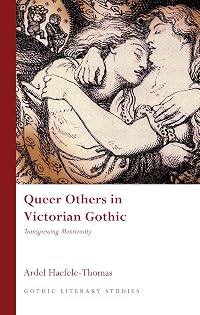
Queer Others in Victorian Gothic: Transgressing Monstrosity (Gothic Literary Studies)
by Ardel Haefele-Thomas
Gothic Literary Studies
17 Members (3.00)
On This Page
Description
Queer Others in Victorian Gothic: Transgressing Monstrosity explores the intersections of Gothic, cultural, gender, queer, socio-economic and postcolonial theories in nineteenth-century British representations of sexuality, gender, class and race. From mid-century authors like Wilkie Collins and Elizabeth Gaskell to fin-de-sie cle writers such as J. Sheridan Le Fanu, Florence Marryat and Vernon Lee, this study examines the ways that these Victorian writers utilized gothic horror as a show more proverbial 'safe space' in which to grapple with taboo social and cultural issues. This work simultaneously expl show lessTags
Member Reviews
Members
- Recently Added By
Lists

Academic Books
28 works; 1 member
Author Information
2+ Works 30 Members
Ardel Haefele-Thomas is a Victorian and Queer Studies scholar who currently holds the position of Chair of Lesbian, Gay, Bisexual and Transgender Studies at City College of Sin Francisco.
Series

Common Knowledge
- First words
- A missing Indian diamond. A scaffold in New England. A map of the African interior written on a potsherd. A Jamaican vampire bat. A portrait of an Italian castrato. These are some of the props I have chosen to analyse in Q... (show all)ueer Others in Victorian Gothic: Transgressing Monstrosity. The props themselves are only pieces of a larger tropology where queer sexuality, transgender bodies, racial otherness and Gothic horror intersect. Each item signifies a site of crisis as well as a site of transgression in Victorian culture. The Western authorities who search for the unusual Indian diamond cannot find it; rather, it is the biracial, genderqueer 'anti-authority' figure who solves the mystery of the stolen yellow jewel. The New England scaffold becomes a murder site where an American Indian woman and an English woman, clinging to one another as they are conducted out of their dank prison cell, are hung as witches by the power hungry Puritan authorities. The map on the potsherd sends three Britons to the heart of Africa where they discover a 'savage' monarch who appears hauntingly similar to Queen Victoria. The vampire bat represents a conflation of racist and imperialist stereotypes about the Jamaican spiritual practice of obeah, fin-de-siecle worries about hereditary taint and the possibility of queer contagion. And the portrait of the genderqueer, beautiful and 'wicked' Italian castrato seduces and then haunts men and women until they wither and die for want of hearing his decadent voice sing yet another song. In some cases, these props signal the author's use of Gothic to interrogate and subvert Victorian hegemonic ideals regarding sexuality, gender identity, race, empire and nation. In some other instances, the props signify the author's deep ambivalence about how to read the multiple and changing faces of the monstrous 'Other' in the nineteenth century. -1 Introduction, the intersections of queer, postcolonial and Gothic theories
Wilkie Collins's The Woman in White was first published in serial form between November 1859 and August 1860 in Charles Dickens's All The Year Round. The action of the novel takes place in and around 1848 leadin... (show all)g up to 1851. Eight years later, Collins once again employed his extremely popular split narrative form for The Moonstone, serialized from January-August 1868. Here, as well, Collins places the action of the novel in a previous time: 1799 and 1848-9. The stories take place within two years of one another, but they are haunted by two particular events that occurred in the 1850s - the decade following the action in each novel: the 1851 Great Exhibition at the Crystal Palace in London and the 1857 Indian Mutiny in Meerut, India. -2 The Spinster and the Hijra: How Queers Save Heterosexual Marriage in Wilkie Collins's The Woman in White and The Moonstone - Canonical DDC/MDS
- 823.809352664
- Canonical LCC
- PR830.T3 H34
Classifications
Statistics
- Members
- 17
- Popularity
- 1,453,106
- Rating
- (3.00)
- Languages
- English
- Media
- Paper, Ebook
- ISBNs
- 6
- ASINs
- 1