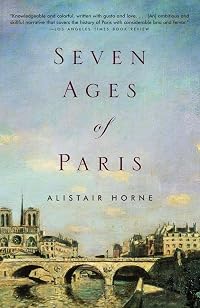
Seven Ages of Paris
by Alistair Horne
On This Page
Description
In this luminous portrait of Paris, the celebrated historian gives us the history, culture, disasters, and triumphs of one of the world's truly great cities. While Paris may be many things, it is never boring. From the rise of Philippe Auguste through the reigns of Henry IV and Louis XIV (who abandoned Paris for Versailles); Napoleon's rise and fall; Baron Haussmann's rebuilding of Paris (at the cost of much of the medieval city); the Belle Epoque and the Great War that brought it to an end; show more the Nazi Occupation, the Liberation, and the postwar period dominated by de Gaulle-Horne brings the city's highs and lows, savagery and sophistication, and heroes and villains splendidly to life. With a keen eye for the telling anecdote and pivotal moment, he portrays an array of vivid incidents to show us how Paris endures through each age, is altered but always emerges more brilliant and beautiful than ever. The Seven Ages of Paris is a great historian's tribute to a city he loves and has spent a lifetime learning to know. show lessTags
Recommendations
































Member Reviews
This shouldn’t be the first book you read about the history of Paris. Horne name-checks so many people and places that it helps to know your way around already. Instead, the best use for this book is as an enjoyable, anecdotal refresher.
It’s a challenge to pack two thousand years of history between the covers of one book, even at 477 pages, and one that at times overwhelms Horne’s narrative skill. There is no doubt of his masterful erudition, but repetitions and nonsequiturs abound. Nor is Horne skillful in constructing paragraphs. Many are chunks of information without the shaping that helps the reader sense which are the main ideas and which the subordinate clauses.
As for his writing style: those of his metaphors that were not show more cliché were confusing. Sometimes both a once. In recounting the “events” of May 1968, Horne writes: “The strike spread like a brushfire in a heat-wave summer.” This caused me to stop and try to recall whether there had been extreme heat in 1968.
On the whole, Horne views history as the chronicle of the deeds of great men. Five of his seven ages have their respective sections named after a ruler (Philippe Auguste, Henri IV, Louis XIV, Napoléon, de Gaulle). In addition, he shares the “Parisian fallacy”: the history of France is the history of Paris and vice versa. This combination results, in the early chapters, in a focus on successive Capetian kings, not all of whom were particularly interested in Paris or spent much time there. It’s as if nothing of importance happened in Paris in those years.
In addition to kings (and their mistresses), the text offers a cavalcade of other personalities, famous and infamous: great ministers Sully, Richelieu, Mazarin, and Colbert; dramatists Corneille, Racine, and Molière; novelists Balzac, Hugo and Flaubert. Other evocative names are Manon Lescaut, Ninon de Lenclos, Scaramouche, and Cartouche. Unfortunately, some are little more than name-checked.
A partial balance to Horne’s predilection for “great man history,” is his sensitivity to the condition of those below: the numerous poor crammed into squalid unhygienic slums at the periphery. Many upheavals of French history, 1789 and 1870, for example, erupted when their suffering and resentment boiled over. Horne then notes how, when the society returned to normal, it was the upper bourgeoisie that profited, not the proletariat.
My first impression of Horne’s lyrical conclusion, which lists Parisian women down through the ages from Héloïse to Piaf, was that it was in the same vein as his concern for the plight of the proletariat. But when he subsumes them as successive embodiments of Marianne, the iconic symbol of Paris, this seems to correspond with his “great man” view of history. Paris is the ever-lasting female these heroes wooed and for whose love they risked their great deeds.
Understandably, a city with such a hold on the imagination of many inspires such fanciful flights. Instead of a woman, my image of Paris is that it is the world’s largest open-air museum, which repays the time spent there with ever-changing perceptions. Just as I never tire of visiting it, I never tire of reading about it. Despite the book’s drawbacks, overall I enjoyed this vast compendium of Parisian lore. show less
It’s a challenge to pack two thousand years of history between the covers of one book, even at 477 pages, and one that at times overwhelms Horne’s narrative skill. There is no doubt of his masterful erudition, but repetitions and nonsequiturs abound. Nor is Horne skillful in constructing paragraphs. Many are chunks of information without the shaping that helps the reader sense which are the main ideas and which the subordinate clauses.
As for his writing style: those of his metaphors that were not show more cliché were confusing. Sometimes both a once. In recounting the “events” of May 1968, Horne writes: “The strike spread like a brushfire in a heat-wave summer.” This caused me to stop and try to recall whether there had been extreme heat in 1968.
On the whole, Horne views history as the chronicle of the deeds of great men. Five of his seven ages have their respective sections named after a ruler (Philippe Auguste, Henri IV, Louis XIV, Napoléon, de Gaulle). In addition, he shares the “Parisian fallacy”: the history of France is the history of Paris and vice versa. This combination results, in the early chapters, in a focus on successive Capetian kings, not all of whom were particularly interested in Paris or spent much time there. It’s as if nothing of importance happened in Paris in those years.
In addition to kings (and their mistresses), the text offers a cavalcade of other personalities, famous and infamous: great ministers Sully, Richelieu, Mazarin, and Colbert; dramatists Corneille, Racine, and Molière; novelists Balzac, Hugo and Flaubert. Other evocative names are Manon Lescaut, Ninon de Lenclos, Scaramouche, and Cartouche. Unfortunately, some are little more than name-checked.
A partial balance to Horne’s predilection for “great man history,” is his sensitivity to the condition of those below: the numerous poor crammed into squalid unhygienic slums at the periphery. Many upheavals of French history, 1789 and 1870, for example, erupted when their suffering and resentment boiled over. Horne then notes how, when the society returned to normal, it was the upper bourgeoisie that profited, not the proletariat.
My first impression of Horne’s lyrical conclusion, which lists Parisian women down through the ages from Héloïse to Piaf, was that it was in the same vein as his concern for the plight of the proletariat. But when he subsumes them as successive embodiments of Marianne, the iconic symbol of Paris, this seems to correspond with his “great man” view of history. Paris is the ever-lasting female these heroes wooed and for whose love they risked their great deeds.
Understandably, a city with such a hold on the imagination of many inspires such fanciful flights. Instead of a woman, my image of Paris is that it is the world’s largest open-air museum, which repays the time spent there with ever-changing perceptions. Just as I never tire of visiting it, I never tire of reading about it. Despite the book’s drawbacks, overall I enjoyed this vast compendium of Parisian lore. show less
Overall, a book with a lot of great information that wasn't unenjoyable. But Horne is a stuffy writer at times, and maybe even a bit of a stuffy historian. In the onslaught of historical facts, there doesn't seem to be any moment to stop and reflect or parse through the information more deeply. Granted, that may not have been within the scope of the book for him, and that's fine. As a reader, I prefer history with more spring in its interpretations.
The final chapters felt like something of a slog, and, as the book's focus comes closer to modern times, a bias becomes clear with his telling of history. For example, it's clear that de Gaulle represents greatness in all ways to Horne. It's also clear that France's occupation of Algeria was show more only an annoying "burden" (447) to France—conspicuously avoiding the horrors of colonialism and the massacres carried out by the French colonizers themselves. There's nothing wrong with Horne having an opinion about de Gaulle and French Algeria, but the book was too slanted by the end. show less
The final chapters felt like something of a slog, and, as the book's focus comes closer to modern times, a bias becomes clear with his telling of history. For example, it's clear that de Gaulle represents greatness in all ways to Horne. It's also clear that France's occupation of Algeria was show more only an annoying "burden" (447) to France—conspicuously avoiding the horrors of colonialism and the massacres carried out by the French colonizers themselves. There's nothing wrong with Horne having an opinion about de Gaulle and French Algeria, but the book was too slanted by the end. show less
Seven Ages of Paris is a great introduction to the history of Paris as well as to the wider context of the history of France and the individuals who have played a major role in its history. Alistair Horne takes no knowledge for granted and therefore provides fulsome background including, for example, introducing Napoleon, Louis XIV and other historic leaders of the country. Many readers will probably find some of this context unnecessary, but few will find it useless. It helps fill in the gaps in discussing the history of the city over a 2000-year period and provides a fuller and more readable history of Paris itself.
For each "age," Horne seeks to highlight the political, institutional, religious, cultural, legal and architectural show more developments, if any. Rather than try to provide a continuous history of all of these trends (which most likely would turn the book into very dry reading as well as lengthening it significantly), Horne zeros in on the interesting highlights. However, Horne does not neglect the intervening periods but provides information on transitional developments. He also includes anecdotes and events that in the grand scheme of things may not be significant but that a reader may appreciate knowing for their intrinsic interest. show less
For each "age," Horne seeks to highlight the political, institutional, religious, cultural, legal and architectural show more developments, if any. Rather than try to provide a continuous history of all of these trends (which most likely would turn the book into very dry reading as well as lengthening it significantly), Horne zeros in on the interesting highlights. However, Horne does not neglect the intervening periods but provides information on transitional developments. He also includes anecdotes and events that in the grand scheme of things may not be significant but that a reader may appreciate knowing for their intrinsic interest. show less
This is a wonderfully written history of Paris by a noted Francophile, one of whose previous books on the Franco Prussian war, siege and Commune I read and enjoyed several years ago. Full of colour and variety, it covers political and military history, architecture, culture and the arts, and gives a good feeling for the ebb and flow of life, at least in the latter parts. Coverage is fairly uneven, e.g. the first 1300 years occupy the same number of pages as the 20 years of the Napoleonic era; this is of course inevitable up to a point, but I would have welcomed a little more coverage of the pre-1500 period overall, and some may quibble over his choice of dates for the 7 ages (the first begins in 1180). This is a pleasure to read, but it show more could definitely have done with more detailed maps of the city at various stages and perhaps line drawings of buildings being described. show less
Themes: civilization, war, government, religion, politics, city development, art, architecture, royalty
Setting: Paris, France from before 1000 AD to 1968
The author starts by saying that every city is like a person, and Paris is definitely a woman. Like any fascinating woman, she is changeable and captivating. I'm not entirely sure this conceit works, but it's not a bad way to start off the book.
Here's what works: I could certainly feel the amount of research that must have gone into this book. I'm sure it was staggering, and it shows. The author is obviously really familiar with all the key people, places, and ideas. And I liked being able to link things together. For the first time, I really got a sense of how all those Louis's fit show more together and exactly who Cardinal Richelieu was.
What didn't work: Really, it was too much. I was overwhelmed. Some of that may have been my fault, for trying to read the book straight through, without putting it down for very long, but I was afraid I would lose my place, so to speak, if I set it down. So I pushed through and it got to be confusing.
Personal feelings: I was actually glad to see that the writer sort of skimmed through the French Revolution. It became just one of a series of revolts occuring in the capital, and rather than go into all the disgusting violence in a lot of detail, he just hit on a few things, especially how it affected the look of the city itself and the economy. I read The Lost King of France last year and that one had gory detail piled upon detail of dismemberment, torture, and so on, until I couldn't wait to put it down. This book spared me all that, and I was glad. But if you are interested in the history of France primarily during the French Revolution, this is probably not a great book for you.
My other observation is probably not the author's fault, but the publishers. This is the kind of book (or I am the kind of reader, I don't know which) where you need some more maps and illustrations and so on to figure out what's going on. Instead of having them throughout the text, there are a few pages of color pictures and a few pages of black and white pictures, and that's it. I would have liked at least a black and white picture of all the major monarchs and landmarks. He assumes that you know what Paris looks like, but I only know what I've seen in books and movies. But like I say, that may be the publisher. They seem to be very picky about how many pictures they will include.
Overall: I enjoyed this book, somewhat, but I came away with the strong impression that I am EXTREMELY glad that I do not live in Paris, especially in Paris before 1900. It sounds like a horrible place to live for most people. Yes, there were great artists, musicians, scientists, and politicians who lived there and left their marks on the city. But most of the time, it was a miserable place to be, with plagues, fires, open sewage, constant violence, and little or no civil liberties. Various groups would be rounded up for whatever reason - heresy, political unrest - and summarily executed or tortured. I know this went on in most of the world, but wow, I got really tired of reading about it page after page. I debated between 2.5 stars and 3, but I decided to round up, because I think the author did a pretty good job. It's just that I found the subject rather grimmer than I expected. show less
Setting: Paris, France from before 1000 AD to 1968
The author starts by saying that every city is like a person, and Paris is definitely a woman. Like any fascinating woman, she is changeable and captivating. I'm not entirely sure this conceit works, but it's not a bad way to start off the book.
Here's what works: I could certainly feel the amount of research that must have gone into this book. I'm sure it was staggering, and it shows. The author is obviously really familiar with all the key people, places, and ideas. And I liked being able to link things together. For the first time, I really got a sense of how all those Louis's fit show more together and exactly who Cardinal Richelieu was.
What didn't work: Really, it was too much. I was overwhelmed. Some of that may have been my fault, for trying to read the book straight through, without putting it down for very long, but I was afraid I would lose my place, so to speak, if I set it down. So I pushed through and it got to be confusing.
Personal feelings: I was actually glad to see that the writer sort of skimmed through the French Revolution. It became just one of a series of revolts occuring in the capital, and rather than go into all the disgusting violence in a lot of detail, he just hit on a few things, especially how it affected the look of the city itself and the economy. I read The Lost King of France last year and that one had gory detail piled upon detail of dismemberment, torture, and so on, until I couldn't wait to put it down. This book spared me all that, and I was glad. But if you are interested in the history of France primarily during the French Revolution, this is probably not a great book for you.
My other observation is probably not the author's fault, but the publishers. This is the kind of book (or I am the kind of reader, I don't know which) where you need some more maps and illustrations and so on to figure out what's going on. Instead of having them throughout the text, there are a few pages of color pictures and a few pages of black and white pictures, and that's it. I would have liked at least a black and white picture of all the major monarchs and landmarks. He assumes that you know what Paris looks like, but I only know what I've seen in books and movies. But like I say, that may be the publisher. They seem to be very picky about how many pictures they will include.
Overall: I enjoyed this book, somewhat, but I came away with the strong impression that I am EXTREMELY glad that I do not live in Paris, especially in Paris before 1900. It sounds like a horrible place to live for most people. Yes, there were great artists, musicians, scientists, and politicians who lived there and left their marks on the city. But most of the time, it was a miserable place to be, with plagues, fires, open sewage, constant violence, and little or no civil liberties. Various groups would be rounded up for whatever reason - heresy, political unrest - and summarily executed or tortured. I know this went on in most of the world, but wow, I got really tired of reading about it page after page. I debated between 2.5 stars and 3, but I decided to round up, because I think the author did a pretty good job. It's just that I found the subject rather grimmer than I expected. show less
This book is sick. It amounts to a history of France, but Horne stays focused on the real Paris, as it was and as it is, in a wonderful way, while providing awesome insight into the character of Parisians and of France in general. It's an awesome book.
I was reminded of fellow Goodreader F1Wild, who doesn't like military history. I don't either, so I was psyched that Horne breezes by military affairs, while giving much more shrift to art, literature. architecture, fashion, and the rest of what makes society.
And Jennifer will be pleased to hear that the epilogue focuses on Père Lachaise Cemetery, which has so many important people in it that it's basically like a history of Paris unto itself.
Totally readable, exquisitely researched, show more gossipy in a good way...this is a very, very good book. I wish I'd never visited Paris without it. show less
I was reminded of fellow Goodreader F1Wild, who doesn't like military history. I don't either, so I was psyched that Horne breezes by military affairs, while giving much more shrift to art, literature. architecture, fashion, and the rest of what makes society.
And Jennifer will be pleased to hear that the epilogue focuses on Père Lachaise Cemetery, which has so many important people in it that it's basically like a history of Paris unto itself.
Totally readable, exquisitely researched, show more gossipy in a good way...this is a very, very good book. I wish I'd never visited Paris without it. show less
I truly wish I was planning a trip to Paris sometime soon, as this is the perfect book to read before exploring that famous city. Rich in history, the author provides a compelling account of how Paris evolved over the centuries into the beautiful city of today. Going back to its ancient roots and delving to details like fashion, culture, and even its most famous cemetery, this is a great read on Paris and France as a nation.
Members
- Recently Added By
Lists

Paris, City of Lights
103 works; 17 members
Author Information

31+ Works 5,874 Members
Alistair Allan Horne was born in London, England on November 9, 1925. He enlisted in the Royal Air Force, but failed to qualify for pilot training because of poor eyesight. He later joined the Coldstream Guards, attaining the rank of captain. When the war ended, he was transferred to the Intelligence Corps and stationed in Cairo where he monitored show more Soviet activity in the Balkans. He received a master's degree in English in 1949 from Jesus College, Cambridge. Before becoming an author, he was a foreign correspondent for The Daily Telegraph and a spy for MI6, Britain's foreign intelligence service. His books included The Fall of Paris: The Siege and the Commune, 1870-71; To Lose a Battle: France 1940; Small Earthquake in Chile: A Visit to Allende's South America; The French Army and Politics, 1870-1970; Seven Ages of Paris; The Age of Napoleon; La Belle France: A Short History; and Kissinger: 1973, The Crucial Year. The Price of Glory: Verdun 1916 won the Hawthornden Prize and A Savage War of Peace: Algeria 1954-1962 won the Wolfson Prize. He wrote several memoirs including A Bundle from Britain and But What Do You Actually Do?: A Literary Vagabondage. He was knighted in 2003. He died on May 25, 2017 at the age of 91. (Bowker Author Biography) show less
Common Knowledge
- Original publication date
- 2002
- Important places
- Paris, France
- Dedication
- For Nicky
Good friend, and ally of many years; best of publishers for nearly forty
Classifications
- Genres
- History, Nonfiction, General Nonfiction, Travel
- DDC/MDS
- 944.361 — History & geography History of Europe France and Monaco Champagne; Ile de France; Lorraine Île-de-France Paris
- LCC
- DC707 .H74 — History of Europe, Asia, Africa and Oceania France – Andorra – Monaco History of France Local history and description Paris
- BISAC
Statistics
- Members
- 1,057
- Popularity
- 24,356
- Reviews
- 13
- Rating
- (3.82)
- Languages
- English
- Media
- Paper, Audiobook, Ebook
- ISBNs
- 10
- ASINs
- 6