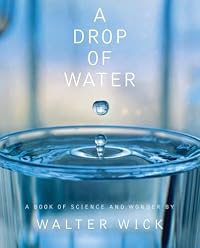
A Drop of Water: A Book of Science and Wonder
by Walter Wick
On This Page
Description
Describes the origins, characteristics, and uses of water.Tags
Recommendations









Member Reviews
I found this book extremely interesting for a few reasons. The pictures throughout this story were phenomenal, due to their clear details. I think that these illustrations really enhance the book, especially the section on bubble shapes. Readers usually think of bubbles as round spheres, but these bubbles are shown as spirals and cubes. These types of illustrations engage the reader and make them want to keep reading and possibly look deeper into the subject. I also loved the pictures in the section about snowflakes. Many readers have never seen a real snowflake up close. Readers learn that there is an “endless variety” of shapes and designs of snowflakes. I also think that it is important that the story shows a picture of a show more snowflake at its’ actual size, to display to readers how magnified the multiple pictures of snowflakes are. This book is nonfiction, and to my knowledge is accurate. I like that the book is organized into different sections about water, such as frost and dew, clouds, snowflakes, surface tension, etc. This book really caught my attention due to the beautiful pictures. The big idea of this book is to inform the readers about the different forms of water and how water looks when it meets air, is splashed, or freezes. show less
The photographic presentation of water are so interesting the photo's and author explains different types and observations as well as scientific content and experiment that can be performed by reader.
The Author Walter Wick take us on a journey of a simple drop of water with simple text inserts of explanations as to why from 1878 Arabella B Buckley. This book will entice readers to think all about a drop of water and its journey that we take for granite in our lives. Beautiful, inspiring photos that really make you think, speculate and want to try this for yourself. A light investigation and explanation of molecules and the parts they play as water transforms itself from liquid, to solid, to gas and back. Great for beginning to show more understand nature and science. show less
The Author Walter Wick take us on a journey of a simple drop of water with simple text inserts of explanations as to why from 1878 Arabella B Buckley. This book will entice readers to think all about a drop of water and its journey that we take for granite in our lives. Beautiful, inspiring photos that really make you think, speculate and want to try this for yourself. A light investigation and explanation of molecules and the parts they play as water transforms itself from liquid, to solid, to gas and back. Great for beginning to show more understand nature and science. show less
Here are a series of beautiful and fascinating photographs depicting the properties of water as it evaporates, splashes, condenses and bubbles. This book is certainly for the tween crowd, but the writing is descriptive and interesting, sneaking the facts in subtly. The glossary in the back of water related terms helps give clarity to the concepts.
Wick does an exceptional job combining an exposition of information with his incredible photographs about water. The images increase the wonder of this often taken for granted element and the reader is introduced to many concepts such as adhesion, condensation, cloud formation and the water cycle, just to name a few. Best of all, this book is a resource for possible experiments for increasing understanding of the different concepts presented. From this book, I look forward to getting jump started on some experiments on H2O!
Did you know that snowflakes are created by gas moving directly into a solid state, and that this is how they get their amazing forms? How about the fact that capillary attraction is what allows water molecules to flow up the stem of a plant, against gravity? I thought that this book was awe inspiring! I never knew, for example, that a single drop of water will eventually be distributed evenly throughout an entire receptacle. We are reminded time and time again of the magical qualities of water. The water cycle is the continuous movement of water by the sun and earth's gravitational pull, and this is what keeps life on this earth possible. Without the cycle of water life on earth would be impossible!
The best part about this book is by far the photographs in this photographic essay about water. The photographer captures water splashing, zooms in on what a snowflake looks like, shows condensation as a series, and so many other fascinating things about water. The intended audience for this book is probably older elementary children because it is very scientific. Some of the words may not be understood by younger children, but I think overall both younger and older children would appreciate the wonders presented in this book. I never really thought about water in this way. I think this book is a photographic essay because the photographs are incredible, and it explains the processes of water.
This book explains the many properties of water by explaining various phenomena involving water. The sub-topics explore the three states of matter of water, surface tension, when air meets water, soap bubbles, and snowflakes and more. The author is trying to show the wonder of these properties through his photography, then explains the science using the appropriate vocabulary in the paragraphs that accompany the photos.
Because of the use of photographs in this text, the author has created a highly interesting and engaging text for children. He has captured the wonder of children and made them want to further their understanding of what they see in the picture by reading the descriptions below. In terms of accuracy and thoroughness, the show more author does a good job of giving the child accurate vocabulary to explain what they see. It is “just enough” information to give them some understanding, but since there are no more than three paragraphs for any one topic, the author doesn’t go into too much detail about any one thing. This is nice, however, for children that may get “turned off” from a text that is too “wordy” or technical.
I can’t say that this book personally affected me in any way, really. The only way it’s related to “my own personal agenda” is that it goes with a fifth grade unit I teach about properties of water, water cycle, water conservation, etc. I read this book with fifth graders last year for the first time and loved it because of how much it motivated my kids to read and know more about the topic. I will be using it again this year when we get to that unit. show less
Because of the use of photographs in this text, the author has created a highly interesting and engaging text for children. He has captured the wonder of children and made them want to further their understanding of what they see in the picture by reading the descriptions below. In terms of accuracy and thoroughness, the show more author does a good job of giving the child accurate vocabulary to explain what they see. It is “just enough” information to give them some understanding, but since there are no more than three paragraphs for any one topic, the author doesn’t go into too much detail about any one thing. This is nice, however, for children that may get “turned off” from a text that is too “wordy” or technical.
I can’t say that this book personally affected me in any way, really. The only way it’s related to “my own personal agenda” is that it goes with a fifth grade unit I teach about properties of water, water cycle, water conservation, etc. I read this book with fifth graders last year for the first time and loved it because of how much it motivated my kids to read and know more about the topic. I will be using it again this year when we get to that unit. show less
Members
- Recently Added By
Lists

Children's Books About Science and Math
461 works; 12 members

Ambleside Y3
36 works; 1 member

House of Harvest Science
6 works; 1 member

Ambleside Year 3
47 works; 1 member
Author Information

59+ Works 8,913 Members
Walter Wick grew up in a rural part of Connecticut. His first serious interest in art began with drawings and painting in high school. He went on to study photography at Paier College of Art in Hamden, Connecticut. After graduating in 1973, he worked as a lab technician and assistant to a commercial photographer. Eventually, Wick moved to New York show more City and started his own photography studio. He stumbled upon a particular photo that led to the creation of his popular children's books, "I Spy" which are optical illusion picture books. He has also written "A Drop of Water: A Book of Science and Wonder" and "Walter Wick's Optical Tricks." (Bowker Author Biography) show less
Awards and Honors
Awards
Distinctions
Common Knowledge
- Canonical title
- A Drop of Water: A Book of Science and Wonder
Classifications
Statistics
- Members
- 1,829
- Popularity
- 11,800
- Reviews
- 59
- Rating
- (4.33)
- Languages
- English, French
- Media
- Paper
- ISBNs
- 5
- ASINs
- 4