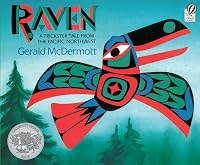
Raven: A Trickster Tale from the Pacific Northwest
by Gerald McDermott
On This Page
Description
Raven, a Pacific Coast Indian trickster, sets out to find the sun.Tags
Recommendations





Member Reviews
In this book, Gerald McDermott tells just one of the many tales of Raven, a trickster character featured in many Native American myths from the Pacific Northwest. In many traditions, Raven is both a "mischief-maker and culture hero." McDermott's book tells of Raven's ingenuity in stealing the sun to give light to all the world. With excellent illustrations and wonderfully melodic language, this book is a fantastic addition to any collection.
This book is lovely in both words and illustrations. I am a fan of trickster tales and this one gives a wonderful introduction to Raven, one of the recurring tricksters from the Pacific Northwest. The illustrations are done in traditional PNW style, and the story tells the tale of how Raven brought light to the people by becoming a child and playing on his grandfather's indulgence.
A wonderful read for kids and adults of all ages but I would love to use it in an elementary school as an example of how stories can help us think about some of the big questions in life--why is the sun in the sky? Is it hard to say no to a toddler? Did Raven do the right thing?
A wonderful read for kids and adults of all ages but I would love to use it in an elementary school as an example of how stories can help us think about some of the big questions in life--why is the sun in the sky? Is it hard to say no to a toddler? Did Raven do the right thing?
Raven is part Pourqui tale and part trickster tale as it explains how light was brought to the world and it demonstrates the sly wisdom of the raven. The world exists in darkness and Raven is sad for the people. Desiring to change this, Raven goes in search of light and finds it at the Sky Chief's lodge. Being the trickster that he is, Raven see a girl drinking water from bowl then Raven changes himself into a pine needle and positions himself to be scooped up into the bowl where the girl then drinks the Raven/pine-needle. Later on, the girl becomes pregnant and gives birth to Raven. Sky Chief is enamored with Raven and gives Raven whatever he wants, including a shining box which ends up housing the sun. Raven steals the run, turns back show more into a bird and flies into the sky where he throws the sun for all to enjoy. This origin story shares many similarities with other origin stories such as Maui, Prometheus and even Jesus Christ and the Virgin Mary. The art is simple but poignant, with vivid colors reserved for Raven while everything else is in muted colors, representing the lack of light or enlightenment. Once Raven engages with the humans, their world takes on more color and once Raven brings the sun, the world is illuminated as well. show less
First of all, the illustration immediately captures both the existing Pacific environment, and the traditional artistic images of some local Native American peoples. While the soft watercolor renderings of the evergreen forests and cloud tinged skies make the setting of the story feel authentic to the Pacific Northwest, the bold geometric patterns of Raven’s feathers and dress, and the totem-like representation of the characters’ faces capture the look of much of the traditional carvings and paintings of the Tlingit and Haida people. Even in it’s written form, the language of the story seens to capture the oral traditions from which it came. As a child Raven calls “Ga! Ga!” a cry which transitions to “Ha! Ha!” as he show more successfully outwits the Sky Chief and “Caw! Caw!” as he becomes a bird again. One can imagine how the sound of a real raven’s cry could inspire the creation of this character and his mischievous personality. show less
The art in this is a lot of fun, I especially liked the look of the Raven boy. The story is a mish-mash of a many different versions, and there is no acknowledgement of any original cultural setting other than the very vague 'Pacific Northwest in the title. The ending with its emphasis on gratitude seemed a little bit didactic for my taste.
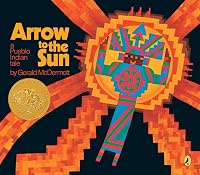
Gerald McDermott borrows from Pacific Northwest native designs as his inspiration for Raven. The text is simple but blends well with the art depicted in the story. When reading it the rhythmic cadence of it reminds me of native stories being told by elders of a tribe, yet it seems inauthentic because it isn't being told by someone who is of a northwestern tribe. They're out there and as with McDermott's previous native story 'Arrow to the Sun', one can make the argument he takes what he wants from native culture and art but does not pay homage, nor state his sources or further information on where to look up similar information. The only reason I'm giving it 3 stars is the art work is beautiful and it could be an introduction to native show more lore for a young child. show less
Raven wants to help the people of the world have light, he tricks the sky king and his daughter into giving it to him and unleashes it on the world.
This was a good read. The illustrations are beautiful, I liked how raved was flat and graphic against a more realistic style. The story was familiar and foreign at the same time. I like the idea of introducing different cultures by taking a familiar format that is slightly tweaked.
This was a good read. The illustrations are beautiful, I liked how raved was flat and graphic against a more realistic style. The story was familiar and foreign at the same time. I like the idea of introducing different cultures by taking a familiar format that is slightly tweaked.
Members
- Recently Added By
Lists

Caldecott Honor Books
296 works; 23 members

My Wishlist - Children's
185 works; 4 members

al.vick-wishlist-Children's
462 works; 3 members

Books Read in 2023
5,638 works; 147 members

Native American Books
3 works; 1 member

Children's Picture Books
188 works; 1 member
Author Information

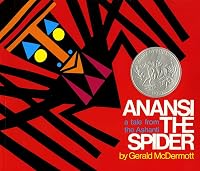
Gerald McDermott was born January 31, 1941 in Detroit, Michigan. He began studying art when he was admitted to a class at one of the nation's finest museums, the Detroit Institute of Arts, when he was just four years old. He continued pursuing his passion for art at Cass Tech, a public high school for the gifted. Upon graduation, he was awarded a show more National Scholastic scholarship to New York's Pratt Institute. He took a leave of absence during his junior year to become the first graphic designer for Channel 13, New York's educational television station, the year it went on the air. He also designed and directed his first animated film, The Stonecutter. He then toured Europe, visiting and exchanging ideas with filmmakers in England, France, and Yugoslavia. He returned to Pratt to finish his degree in 1964 and began producing and directing a series of animated films on folklore. It was then that he met Joseph Campbell, who served as the consultant on four of McDermott's films. McDermott then began to adapt his films into picture books. His first book, Anansi the Spider: A Tale from the Ashanti, was named a Caldecott Honor Book. His other books include Arrow to the Sun: A Tale from the Pueblo that won the 1975 Caldecott Medal, Raven: A Trickster Tale from the Pacific Northwest, another Caldecott Honor Book, and Musicians of the Sun. He died on December 26, 2012 at the age of 71. (Bowker Author Biography) show less
Awards and Honors
Awards
Distinctions
Common Knowledge
- Original publication date
- 1993
- People/Characters
- Raven; Sky Chief; Sky Chief's Daughter
- Dedication
- For Trevor, Erin, and Caitlin
- First words
- Raven came.
- Last words
- (Click to show. Warning: May contain spoilers.)To thank him for bringing them light.
Classifications
Statistics
- Members
- 1,887
- Popularity
- 11,406
- Reviews
- 89
- Rating
- (3.99)
- Languages
- English
- Media
- Paper, Audiobook, Ebook
- ISBNs
- 16
- ASINs
- 5