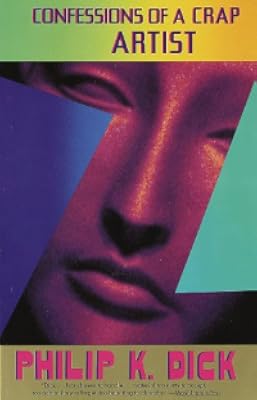
Confessions of a Crap Artist
by Philip K. Dick
On This Page
Description
Jack Isidore is a crap artist -- a collector of crackpot ideas (among other things, he believes that the earth is hollow and that sunlight has weight) and worthless objects, a man so grossly unequipped for real life that his sister and brother-in-law feel compelled to rescue him from it. But seen through Jack's murderously innocent gaze, Charlie and Juddy Hume prove to be just as sealed off from reality, in thrall to obsessions that are slightly more acceptable than Jack's, but a great deal show more uglier. show lessTags
Recommendations









Member Reviews
I forgot when I packed this for my trip that this is Dick's one non-sf novel. While it drags a bit in places, it ends up being a cutting send-up of the upper-middle-class in Northern California in the 50s. Everyone in this book is terrible -- but mostly in interesting ways. I spent most of the book swinging wildly between rooting for Jack's probably sociopathic sister Fay and rooting for her comeuppance. In some ways Jack seems the most sane of the bunch, until he falls in with an end-of-the-world group and things feel for a bit like they're on more familiar Dick territory.
I probably wouldn't have read this had it been by anyone else, but it was fascinating to see Dick's non-genre work.
I probably wouldn't have read this had it been by anyone else, but it was fascinating to see Dick's non-genre work.
Could have been edited down a lot. Dick repeats himself, takes a long time narrating irrelevant things, and I don't believe all of it is deliberate. It makes for a really boring book. And what's more is that it is just so misanthropic, without any interesting edge to it. But I don't know. Maybe this says something really insightful about middle-class families in the American 1950s, as the back of the book says? Lives boring and comfortable like those bred contempt and self-sabotaging behavior, I guess. Fair enough. But the book is just a depressing and boring drag, even if it might have some true observations. And that's only if it does.
It's also worth saying that this book is uncharacteristically misogynistic for a PKD book. In his show more other books it's clear that PKD is like pathetically in love with women, but the mechanism of this book relies so much on this nasty view of men and women. It's just a bad picture I think no matter how you look at it. show less
It's also worth saying that this book is uncharacteristically misogynistic for a PKD book. In his show more other books it's clear that PKD is like pathetically in love with women, but the mechanism of this book relies so much on this nasty view of men and women. It's just a bad picture I think no matter how you look at it. show less
The first non sci fi PKD book I have read and I enjoyed it. Very easy to read, a few characters that he regularly uses in his novels. Excellent comparison of a 'not normal' person with some so called 'normal' people. I really enjoyed the chapters that were told from the perspective of the brother, very detailed and often OCD view of the world. I much liked how he described people driving on the roads that they were familiar with.
[review 1]
pig hearts
[review 2]
I must admit I am a little perplexed. I’ve never been one for novels in which bourgeois jerks act like jerks and we’re supposed to snicker / cry. It’s an entire sub-genre of American literature I have intentionally censured on ideological grounds. So how this particular book stacks up with the rest of that is a little up in the air for me. I would take Lethem’s word that it stacks up lickity split but really I can’t believe it considering what makes Dick horrible, aka bad writing, is on display in dollops here. Dick’s low brow epistemological pipe bombs don’t quite work in a world wherein the telepathy is patently false. Diffuse the bomb, diffuse the beauty.
What I can’t get out of my head is show more notion that Jack Isidore is PKD. In the words of Charlie Hume, “haven't you ever faced the fact that you're a warped, stunted, asshole type?” Fresh off the Exegesis, I feel like Dick is confessing all that was just made up. Interesting though that Confessions was written in 1959. The events which supposedly inspired the Exegesis occurred in winter/spring 1974. Considering all the Time is Going Backwards shit in Exegesis, the pair, arguable Dick’s most mundane and far out works respectively, represent some kind of thesis and antithesis.
Perhaps what we are supposed to get from this book, and this is exactly what I took from the Exegesis, is that PKD was kind, gentle but complex (read: all mixed up) person.
His oeuvre, like any, has its own internal logic. How can it not? That oeuvre is both beautiful and strange. If it is beautiful, how can it not be true?
footnote:
The presentation of this edition is a travesty. Terribly designed cover with no relation to the text and typos on the back. Terrible. show less
pig hearts
[review 2]
I must admit I am a little perplexed. I’ve never been one for novels in which bourgeois jerks act like jerks and we’re supposed to snicker / cry. It’s an entire sub-genre of American literature I have intentionally censured on ideological grounds. So how this particular book stacks up with the rest of that is a little up in the air for me. I would take Lethem’s word that it stacks up lickity split but really I can’t believe it considering what makes Dick horrible, aka bad writing, is on display in dollops here. Dick’s low brow epistemological pipe bombs don’t quite work in a world wherein the telepathy is patently false. Diffuse the bomb, diffuse the beauty.
What I can’t get out of my head is show more notion that Jack Isidore is PKD. In the words of Charlie Hume, “haven't you ever faced the fact that you're a warped, stunted, asshole type?” Fresh off the Exegesis, I feel like Dick is confessing all that was just made up. Interesting though that Confessions was written in 1959. The events which supposedly inspired the Exegesis occurred in winter/spring 1974. Considering all the Time is Going Backwards shit in Exegesis, the pair, arguable Dick’s most mundane and far out works respectively, represent some kind of thesis and antithesis.
Perhaps what we are supposed to get from this book, and this is exactly what I took from the Exegesis, is that PKD was kind, gentle but complex (read: all mixed up) person.
His oeuvre, like any, has its own internal logic. How can it not? That oeuvre is both beautiful and strange. If it is beautiful, how can it not be true?
footnote:
The presentation of this edition is a travesty. Terribly designed cover with no relation to the text and typos on the back. Terrible. show less
This book may have ruined Philip Dick for me: from this point on I'm sure I'll find myself hypersensitive to his portrayal of women as either "harmless" types who defer to their husbands or harping shrews who drive men to beat them (and ultimately to suicide). I can't believe I finished this; perhaps I was hoping it would get better? I can say with certainty, though, that this wasn't worth it.
Jack Isidore is a "crap artist" who collects crackpot theories and lives his life as though a scientific observer instead of an active player. Fay and Charley (Jack's sister and brother-in-law) decide he is not capable of supporting himself in normal society, so take him in to live with them in their giant house in the country. Fay and Charley have problems of their own. While no single character in genuinely sympathetic, Jack's naive observations of dramatic events entertained me in a way similar to Star Trek's Data and his confusion when humans react differently than he expects.It's an initially confusing book, and takes a little while to get into its groove. It swaps point of view nearly every chapter, alternating between show more first-person Jack, first-person Fay, third-person Charley, or third-person Nat Anteil (their neighbor). (The fact that the back of the book incorrectly refers to Charley and Fay as Charlie and Judy didn't help matters either.) Once you pick up on this it's fairly easy to distinguish narrators and becomes an interesting study in different people's opinions on the same events, and the effect these differences have on the outcome. You can see the tragedy coming a mile away but still can't believe it when it actually happens, which is a feeling I hadn't encountered in a book for a long time. The ending was somewhat abrupt but generally satisfying. show less
I had not read this Dick novel previously, and found myself experiencing cognitive dissonance since much of it takes place in rural Marin county, a real place, and much of that action is surreal without being science fictional: no Mars, no radioactive dust, no androids, and yet somehow this is of a piece with novels like "Do Androids Dream of Electric Sheep?" and "Martian Time Slip". As I read and reread Dick, I am becoming persuaded that he is one of the most significant American novelists of the last century.
Members
- Recently Added By
Lists

Books that don't know they belong in a bathroom
41 works; 3 members

School Made Us Read It
380 works; 196 members

Books Read in 2025
4,128 works; 98 members
Author Information

673+ Works 147,096 Members
Phillip Kindred Dick was an American science fiction writer best known for his psychological portrayals of characters trapped in illusory environments. Born in Chicago, Illinois, on December 16, 1928, Dick worked in radio and studied briefly at the University of California at Berkeley before embarking on his writing career. His first novel, Solar show more Lottery, was published in 1955. In 1963, Dick won the Hugo Award for his novel, The Man in the High Castle. He also wrote a series of futuristic tales about artificial creatures on the loose; notable of these was Do Androids Dream of Electric Sheep?, which was later adapted into film as Blade Runner. Dick also published several collections of short stories. He died of a stroke in Santa Ana, California, in 1982. (Bowker Author Biography) show less
Some Editions
Series
Belongs to Publisher Series
PKD composition order (1959)
Common Knowledge
- Canonical title
- Confessions of a Crap Artist
- Original title
- Confessions of a Crap Artist
- Original publication date
- 1975
- People/Characters
- Jack Isidore; Fay Hume; Charlie Hume
- Original language
- English
Classifications
Statistics
- Members
- 1,358
- Popularity
- 17,616
- Reviews
- 17
- Rating
- (3.54)
- Languages
- 9 — Czech, English, French, German, Hungarian, Italian, Japanese, Polish, Spanish
- Media
- Paper, Audiobook, Ebook
- ISBNs
- 33
- ASINs
- 12