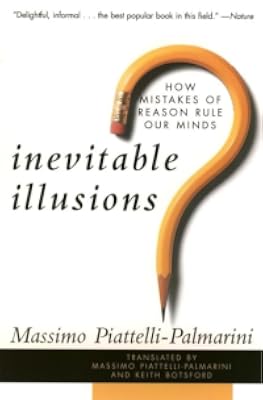
Inevitable Illusions: How Mistakes of Reason Rule Our Minds
by Massimo Piattelli-Palmarini
On This Page
Description
"Fascinating and insightful. . . . I cannot recall a book that has made me think more about the nature of thinking." -- Richard C. Lewontin Harvard University Everyone knows that optical illusions trick us because of the way we see. Now scientists have discovered that cognitive illusions, a set of biases deeply embedded in the human mind, can actually distort the way we think. In Inevitable Illusions, distinguished cognitive researcher Massimo Piattelli-Palmarini takes us on a provocative, show more challenging, and thoroughly entertaining exploration of the games our minds play. He opens the doors onto the newly charted realm of the cognitive unconscious to reveal the full range of illusions, showing how they inhibit our ability to reason--no matter what our educational background or IQ. Inevitable Illusions is stimulating, eye-opening food for thought. show lessTags
Recommendations








Member Reviews
Inevitable Illusions argues that a person using pure reason to make decisions will often arrive at non-intuitive, seemingly fallacious solutions. It explores this phenomena by examining heuristics (cognitive processes) and biases (intuitive and often incorrect presuppositions) that often lead subjects to responses that seem obvious but are less beneficial or illogical. A good example is The Death of Socrates; who has not read the account and thought Socrates was being a butt munch by insisting on execution?
The book is satisfying because it discusses several types of bias phenomena, how to recognize them in oneself and how to produce more reasoned and favorable outcomes in one’s life, work, and perceptions of the world. Once show more recognized, the reader is given the moral charge to aggressively identify and root out fallacy. Inversely, it can also be a primer on how to manipulate people or groups, even trained and specialized groups, to favor an illogical hypothesis. Reading it will profit all politicians, or anyone else interested in being a lying, thieving, despicable bastard.
Written for the interested layman, it will get you to think about thinking and rationality, and is mercifully free of mathematical formulae and jargon. It briefly touches on a great many facets of the corpus of cognitive science, which is both illuminating and, at times, frustrating. One thirsts for more information at times, but Dr. Piattelli-Palmarini encourages readers to shuffle off their mental sloth, so maybe that’s the point. (Not burdening the reader is also an excellent reason.)
There is a refreshingly snippy refutation of critics at the end of the book, and enough information given the reader to pursue further reading both pro and con.
One thing I especially liked about the book was that Dr. Piattelli-Palmarini confesses that cognitive science is in its infancy and the future will show that much of what is currently believed to be irrefutably true will, with the passage of time, prove naïve. But some will be more naïve than others. However, this will not be a gradual accretion of knowledge but a quantum or non-linear jump: The cognitive scientist of 2210 will be nothing like the cognitive scientist of 2010. New ways of thinking will have to come into play. show less
The book is satisfying because it discusses several types of bias phenomena, how to recognize them in oneself and how to produce more reasoned and favorable outcomes in one’s life, work, and perceptions of the world. Once show more recognized, the reader is given the moral charge to aggressively identify and root out fallacy. Inversely, it can also be a primer on how to manipulate people or groups, even trained and specialized groups, to favor an illogical hypothesis. Reading it will profit all politicians, or anyone else interested in being a lying, thieving, despicable bastard.
Written for the interested layman, it will get you to think about thinking and rationality, and is mercifully free of mathematical formulae and jargon. It briefly touches on a great many facets of the corpus of cognitive science, which is both illuminating and, at times, frustrating. One thirsts for more information at times, but Dr. Piattelli-Palmarini encourages readers to shuffle off their mental sloth, so maybe that’s the point. (Not burdening the reader is also an excellent reason.)
There is a refreshingly snippy refutation of critics at the end of the book, and enough information given the reader to pursue further reading both pro and con.
One thing I especially liked about the book was that Dr. Piattelli-Palmarini confesses that cognitive science is in its infancy and the future will show that much of what is currently believed to be irrefutably true will, with the passage of time, prove naïve. But some will be more naïve than others. However, this will not be a gradual accretion of knowledge but a quantum or non-linear jump: The cognitive scientist of 2210 will be nothing like the cognitive scientist of 2010. New ways of thinking will have to come into play. show less
Most people are familiar with term "optical illusion". One well-known example is the picture of two equally long lines, but one has arrow-heads at the end turned inward, while the other has arrow-heads turned outward. The arrow-heads make the lines appear to be of different lengths. They look something like this:
>-------
However, most people are NOT aware that there are similar mental illusions that affect how we make decisions. This book describes what researchers have found in this field in the last decades, and it is a very interesting read.
For example, there is an effect called framing, which means that the way a question or a problem is phrased has a large impact on how we answer it. In an experiment, doctors were told that when show more using a certain medical procedure, the probability that the patient is alive two years later is 93%.
Another group of doctors were told that with another procedure there was a 7% chance of the patient dying within two years. Both groups of doctors were asked whether they would recommend the procedure or not. Significantly more doctors would recommend the procedure as stated in the first case than in the second, even though the two cases are identical! This shows how powerful the framing effect is.
Another example: A wheel is spun, giving a number from 0 to 100. After seeing the number, people are asked to estimate the percentage of African nations that are part of the UN. If the number on the wheel was high, people give a high estimate of the percentage, if low a low estimate is given, even though people know that the number on the wheel has nothing to do with the actual percentage. This mental illusion is known as anchoring.
There are many more mental illusions discussed in the book, and there are lots of entertaining (and revealing) examples. I found the book very interesting and informative, and it has made me look out for mental illusions in my own decision making.
It is also interesting to note that it doesn't always help to be aware of a certain illusions - you can still be fooled by them. This is analogous to how the lines above still seem to be of different lengths even though we know that they are not.
My one criticism of the book is that the language is a little bit difficult and sometimes it doesn't flow as well as it could. But this is a minor problem. Also, there is a similar book that concentrates on mental illusions when it comes to money. It is called "Why Smart People Make Big Money Mistakes" by Belsky and Gilovich, and is also highly recommended, even though a lot of the material they cover is the same as in this book. show less
>-------
However, most people are NOT aware that there are similar mental illusions that affect how we make decisions. This book describes what researchers have found in this field in the last decades, and it is a very interesting read.
For example, there is an effect called framing, which means that the way a question or a problem is phrased has a large impact on how we answer it. In an experiment, doctors were told that when show more using a certain medical procedure, the probability that the patient is alive two years later is 93%.
Another group of doctors were told that with another procedure there was a 7% chance of the patient dying within two years. Both groups of doctors were asked whether they would recommend the procedure or not. Significantly more doctors would recommend the procedure as stated in the first case than in the second, even though the two cases are identical! This shows how powerful the framing effect is.
Another example: A wheel is spun, giving a number from 0 to 100. After seeing the number, people are asked to estimate the percentage of African nations that are part of the UN. If the number on the wheel was high, people give a high estimate of the percentage, if low a low estimate is given, even though people know that the number on the wheel has nothing to do with the actual percentage. This mental illusion is known as anchoring.
There are many more mental illusions discussed in the book, and there are lots of entertaining (and revealing) examples. I found the book very interesting and informative, and it has made me look out for mental illusions in my own decision making.
It is also interesting to note that it doesn't always help to be aware of a certain illusions - you can still be fooled by them. This is analogous to how the lines above still seem to be of different lengths even though we know that they are not.
My one criticism of the book is that the language is a little bit difficult and sometimes it doesn't flow as well as it could. But this is a minor problem. Also, there is a similar book that concentrates on mental illusions when it comes to money. It is called "Why Smart People Make Big Money Mistakes" by Belsky and Gilovich, and is also highly recommended, even though a lot of the material they cover is the same as in this book. show less
Turgid. May have been a translation difficulty, but this was basically a DNF book. His reasoning and arguments may have been sound, but they did not resonate with me.
Interesting look at how the mind works intuitively (and falsely) to solve certain problems.
L’ illusione di sapere è una sconcertante rassegna degli errori madornali che compiamo quando prendiamo delle decisioni. Questi tunnel sono universali, sistematici, indipendenti dallo stato emotivo del momento, del tutto inconsapevoli e influenzano le nostre scelte nei più svariati campi.
La "illusione di sapere" è un fenomeno ben documentato nella psicologia cognitiva e negli studi sulle decisioni. Ci sono diverse ragioni per cui le persone possono cadere in questa trappola cognitiva.
Uno dei fattori principali è la nostra tendenza a cercare conferme per le nostre credenze preesistenti, invece di cercare di verificare se queste credenze sono effettivamente supportate dai dati. Questo fenomeno è noto come "confermation bias" e si show more verifica quando cerchiamo informazioni che sostengono ciò che già crediamo, e ignoriamo o minimizziamo quelle che contraddicono le nostre convinzioni.
Inoltre, spesso ci sentiamo sicuri delle nostre conoscenze anche quando queste sono incomplete o basate su informazioni errate. Questo può accadere quando ci sentiamo sicuri di avere una buona comprensione di un argomento, ma in realtà abbiamo solo una conoscenza superficiale o frammentaria.
Un altro fattore che contribuisce all'illusione di sapere è la nostra tendenza a credere in narrazioni semplici e lineari, anche quando la realtà è molto più complessa. In generale, gli esseri umani tendono a cercare spiegazioni semplici e a ridurre la complessità del mondo, anche quando questa semplificazione porta a una comprensione distorta della realtà.
Per evitare l'illusione di sapere, è importante impegnarsi a cercare informazioni complete e affidabili, cercare di mantenere una mente aperta e flessibile, e sforzarsi di comprendere la complessità del mondo che ci circonda. Inoltre, è importante essere consapevoli dei nostri pregiudizi e delle nostre convinzioni preesistenti, e cercare di esaminarle in modo critico per verificarne la validità.
-------
Massimo Piattelli Palmarini (Roma, 29 aprile 1942) è un biochimico e linguista italiano. Laureatosi e perfezionatosi in fisica, si è occupato di biochimica, filosofia della scienza, scienze cognitive e linguistica. show less
La "illusione di sapere" è un fenomeno ben documentato nella psicologia cognitiva e negli studi sulle decisioni. Ci sono diverse ragioni per cui le persone possono cadere in questa trappola cognitiva.
Uno dei fattori principali è la nostra tendenza a cercare conferme per le nostre credenze preesistenti, invece di cercare di verificare se queste credenze sono effettivamente supportate dai dati. Questo fenomeno è noto come "confermation bias" e si show more verifica quando cerchiamo informazioni che sostengono ciò che già crediamo, e ignoriamo o minimizziamo quelle che contraddicono le nostre convinzioni.
Inoltre, spesso ci sentiamo sicuri delle nostre conoscenze anche quando queste sono incomplete o basate su informazioni errate. Questo può accadere quando ci sentiamo sicuri di avere una buona comprensione di un argomento, ma in realtà abbiamo solo una conoscenza superficiale o frammentaria.
Un altro fattore che contribuisce all'illusione di sapere è la nostra tendenza a credere in narrazioni semplici e lineari, anche quando la realtà è molto più complessa. In generale, gli esseri umani tendono a cercare spiegazioni semplici e a ridurre la complessità del mondo, anche quando questa semplificazione porta a una comprensione distorta della realtà.
Per evitare l'illusione di sapere, è importante impegnarsi a cercare informazioni complete e affidabili, cercare di mantenere una mente aperta e flessibile, e sforzarsi di comprendere la complessità del mondo che ci circonda. Inoltre, è importante essere consapevoli dei nostri pregiudizi e delle nostre convinzioni preesistenti, e cercare di esaminarle in modo critico per verificarne la validità.
-------
Massimo Piattelli Palmarini (Roma, 29 aprile 1942) è un biochimico e linguista italiano. Laureatosi e perfezionatosi in fisica, si è occupato di biochimica, filosofia della scienza, scienze cognitive e linguistica. show less
Apr 27, 2023Italian
Este libro es muy bueno, porque trata de dar una explicación al pensamiento del hombre frente a las diferentes etapas de la vida.
May 4, 2007Spanish
Ratings
Members
- Recently Added By
Lists

The Great Courses: Mathematical Decision Making
14 works; 1 member
Author Information

Some Editions
Series
Belongs to Publisher Series
Common Knowledge
- Canonical title*
- L'illusione di sapere: che cosa si nasconde dietro ai nostri errori
- Original title
- L'illusione di sapere: che cosa si nasconde dietro ai nostri errori
- Original publication date
- 1994
- Dedication
- For Amos Tversky and Daniel Kahneman
- First words
- (Preface): In the spring of 1991 I published, in Italy, a book on education.
In simple and basic fashion, this book proposes to set out the recent scientific discovery of an unconscious. - Last words
- (Click to show. Warning: May contain spoilers.)But some will be vastly more embarrassed than others.
- Blurbers
- Lewontin, Richard C.
*Some information comes from Common Knowledge in other languages. Click "Edit" for more information.
Classifications
- Genres
- Nonfiction, Science & Nature, General Nonfiction, Philosophy
- DDC/MDS
- 153.4 — Philosophy & psychology Psychology Conscious mental processes and intelligence Thought, thinking, reasoning, intuition, value, judgment
- LCC
- BF442 .P5213 — Philosophy, Psychology and Religion Psychology Psychology Consciousness. Cognition
- BISAC
Statistics
- Members
- 368
- Popularity
- 85,575
- Reviews
- 6
- Rating
- (3.62)
- Languages
- 6 — Dutch, English, French, German, Italian, Spanish
- Media
- Paper
- ISBNs
- 9
- ASINs
- 2