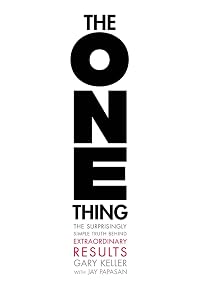
The ONE Thing
by Gary Keller
On This Page
Description
YOU WANT LESS. You want fewer distractions and less on your plate. The daily barrage of e-mails, texts, tweets, messages, and meetings distract you and stress you out. The simultaneous demands of work and family are taking a toll. And what's the cost? Second-rate work, missed deadlines, smaller paychecks, fewer promotions—and lots of stress. AND YOU WANT MORE. You want more productivity from your work. More income for a better lifestyle. You want more satisfaction from life, and more time show more for yourself, your family, and your friends. NOW YOU CAN HAVE BOTH-LESS AND MORE. In The ONE Thing, you'll learn to cut through the clutter achieve better results in less time build momentum toward your goal dial down the stress overcome that overwhelmed feeling revive your energy stay on track master what matters to you The ONE Thing delivers extraordinary results in every area of your life—work, personal, family, and spiritual. WHAT'S YOUR ONE THING? show lessTags
Recommendations
Member Reviews
Have you ever watched people whose careers and lives seem to be driven by one central passion and wondered how they do it? In The One Thing, entrepreneur Gary Keller explains how to make that happen in your life – if you’re willing to take the journey.
The first step is to identify what your “one thing” is. Are you a writer? Or an organizer? Or do you start businesses? What field are you interested in? At first, the answers seem obvious, but upon further introspection, many of these answers aren’t so clear. Deciding who you are – that is, learning self-knowledge – is a key first step to your journey.
Next, you need to learn time management. Especially at first, life is usually not amenable to big dreams. We have show more responsibilities and tasks to do that get in the way of pursuing our one thing. Keller recommends deliberately blocking off several hours each day to the one thing.
He cites writer Stephen King as an inspiration. He blocks off about four hours to write each day. What’s impressive is that he started this habit while working a full-time job as a young man when his schedule was not centered around writing. As he mastered his trade and his life, more freedoms came. You don’t have to quit your “day job” to pursue your one thing; you just have to structure your time enough around engaging in the task.
I also found Keller’s comments about “work-life balance” thought-provoking. He says that balance should not be the goal. Rather a “counterbalance” of pursuing both life and work ambitions should be a goal. I might describe this perspective as a work-life synergy. At times, either end of the spectrum might predominate, but we just can’t stay at one end or the other too long lest we neglect the other end.
His overall goal is to master the one thing. He cites the famous 10,000-hour challenge to master complex tasks as a guide. Mastery takes time and deliberate effort. Both have to win priority – that is, first place – in one’s life. Mastery begins as a youth, but often adult life overwhelms our attempts at mastery. Blocking off time and not letting interruptions dominate are key steps to achieving mastery over a domain.
I personally recommend the audiobook version of this book as an option for those inclined to learning by listening. Music is incorporated in the display, and the overall project displays good technical mastery itself. I enjoyed listening to it as I went about my weekend chores.
Overall, this book offers more than inspiration: it offers a plan to make your life more deliberate and more structured around what matters most to you. The “one thing” doesn’t have to be something that inspires awe. Rather, it can be any task that you want to intensify your focus to master. Maybe more mastery is only a few steps away if you’re willing to walk along the journey… show less
The first step is to identify what your “one thing” is. Are you a writer? Or an organizer? Or do you start businesses? What field are you interested in? At first, the answers seem obvious, but upon further introspection, many of these answers aren’t so clear. Deciding who you are – that is, learning self-knowledge – is a key first step to your journey.
Next, you need to learn time management. Especially at first, life is usually not amenable to big dreams. We have show more responsibilities and tasks to do that get in the way of pursuing our one thing. Keller recommends deliberately blocking off several hours each day to the one thing.
He cites writer Stephen King as an inspiration. He blocks off about four hours to write each day. What’s impressive is that he started this habit while working a full-time job as a young man when his schedule was not centered around writing. As he mastered his trade and his life, more freedoms came. You don’t have to quit your “day job” to pursue your one thing; you just have to structure your time enough around engaging in the task.
I also found Keller’s comments about “work-life balance” thought-provoking. He says that balance should not be the goal. Rather a “counterbalance” of pursuing both life and work ambitions should be a goal. I might describe this perspective as a work-life synergy. At times, either end of the spectrum might predominate, but we just can’t stay at one end or the other too long lest we neglect the other end.
His overall goal is to master the one thing. He cites the famous 10,000-hour challenge to master complex tasks as a guide. Mastery takes time and deliberate effort. Both have to win priority – that is, first place – in one’s life. Mastery begins as a youth, but often adult life overwhelms our attempts at mastery. Blocking off time and not letting interruptions dominate are key steps to achieving mastery over a domain.
I personally recommend the audiobook version of this book as an option for those inclined to learning by listening. Music is incorporated in the display, and the overall project displays good technical mastery itself. I enjoyed listening to it as I went about my weekend chores.
Overall, this book offers more than inspiration: it offers a plan to make your life more deliberate and more structured around what matters most to you. The “one thing” doesn’t have to be something that inspires awe. Rather, it can be any task that you want to intensify your focus to master. Maybe more mastery is only a few steps away if you’re willing to walk along the journey… show less
Good advice wrapped up in a trite and overly long package. I rate it higher than I would have otherwise because, unlike much of the advice about how you will get the most out of life if you find your one most important thing and focused on it, this book did cover some under examined areas. For example, the author realizes that life has multiple domains and that having a focus does not mean neglecting them. Having one thing is more applicable in terms of personal or work achievement goals, but those goals won't be realized if they aren't built on a firm foundation of mental and emotional health and strong relationships. Another challenge the author discussed is that by focusing on one thing, yes, you will be dropping other things. Unlike show more many, he does not dismiss this concern.
I also liked the way that the author bridged the gap between having a big picture purpose and day-to-day activities via the mechanism of a focusing question: "Based on my goal, what's the one thing I can do such that by doing it everything else will be easier or unnecessary?" At the big picture level, this can help you discovery what your one thing should be. At the day-to-day level this same question can help you focus on the most important next step. The gap between these is bridged incrementally: "What's the one thing I want to do someday?" "Based on that, what's the one thing I can do in the next 5 years?" Then one year, then next month, then week, then day, then right now.
All-in-all, a good message, but I could have done without the repetition and most of the anecdotes. show less
I also liked the way that the author bridged the gap between having a big picture purpose and day-to-day activities via the mechanism of a focusing question: "Based on my goal, what's the one thing I can do such that by doing it everything else will be easier or unnecessary?" At the big picture level, this can help you discovery what your one thing should be. At the day-to-day level this same question can help you focus on the most important next step. The gap between these is bridged incrementally: "What's the one thing I want to do someday?" "Based on that, what's the one thing I can do in the next 5 years?" Then one year, then next month, then week, then day, then right now.
All-in-all, a good message, but I could have done without the repetition and most of the anecdotes. show less
This book is a gem! Reading it gave me a much-needed altered perspective and shifted the way I approach my daily tasks. As a multipassionate creative, I frequently become scattered, overwhelmed, and confused about what I should work on next. My productivity has always been challenged by my myriad interests, scattering my focus to the winds.
This book provided an eye-opening perspective on how to cope with my overflowing plate of interests and roles. It taught me to tackle the most crucial tasks and projects first. Previously, trying to give equal attention to all aspects was a balancing act I was losing. Now I can concentrate my efforts, resulting in better outcomes and more satisfaction in the work I do.
I was entirely engrossed in the show more book. So much so, I read it in one sitting! I took notes, highlighted, and underlined frequently. Definitely one for my keeper shelf! show less
This book provided an eye-opening perspective on how to cope with my overflowing plate of interests and roles. It taught me to tackle the most crucial tasks and projects first. Previously, trying to give equal attention to all aspects was a balancing act I was losing. Now I can concentrate my efforts, resulting in better outcomes and more satisfaction in the work I do.
I was entirely engrossed in the show more book. So much so, I read it in one sitting! I took notes, highlighted, and underlined frequently. Definitely one for my keeper shelf! show less
Okay, here's something you won't see me do too often on this blog, I'm going to recommend a business productivity book. Hey! Wait! Come back here. It's a good one.
In fact, What's Your One Thing? by Gary Keller with Jay Papasan is not just a business book. (Though I've been arguing that writers do need to think like business people for ages.) It is an excellent book for life in general and for artists and creative people of all stripes.
What it boils down to is "What is the One thing you can do right now that will help you reach your goal?"
That question is a focus question. You have to make a very specific answer for it. You can't have a to do of 10 things. What is the One Thing that must get done right now to make your goal show more attainable. Of course, you also need to have a goal and actually think about and create a progression from here to there. I'm not re-capping all the steps, just the biggies. READ the BOOK.
Follow up? Why aren't you doing that thing?
Second step, after this focus question, is to make time for that one thing and to guard that time jealously. Keller and Papasan suggest a four hour block in the morning. I would adjust that to a four hour block whenever you are at your best. If you're a night owl, carve out a slice of time at night. If you're a morning person, do it in the morning.
I say, if you can't do four hours right now, carve out half-an-hour. If you can't do that, you don't actually give a shit about your goal and need to find one you *do* care about.
Make that time, that precious, precious time, and do it every day, five days a week. Your goal will get closer and closer. And once you spend 2-3 months carving out your time, it will be a habit and you'll feel *wrong* when you don't spend the time on your goal. After that, it's inertia and time to work on the next habit you want to create.
Time, repetition, habit. Train in new habits, and over-write old ones.
When I say guard that time, it means, work without distractions. Turn off the internet. Kill the phone. Do not move away from whatever your task is until it is done.
One task a day, that's not that hard right? Write 5 pages. Hell, write 5 sentences. Whatever the goal is, hammer at it every day.
But first, read the book. It's worth the time. show less
In fact, What's Your One Thing? by Gary Keller with Jay Papasan is not just a business book. (Though I've been arguing that writers do need to think like business people for ages.) It is an excellent book for life in general and for artists and creative people of all stripes.
What it boils down to is "What is the One thing you can do right now that will help you reach your goal?"
That question is a focus question. You have to make a very specific answer for it. You can't have a to do of 10 things. What is the One Thing that must get done right now to make your goal show more attainable. Of course, you also need to have a goal and actually think about and create a progression from here to there. I'm not re-capping all the steps, just the biggies. READ the BOOK.
Follow up? Why aren't you doing that thing?
Second step, after this focus question, is to make time for that one thing and to guard that time jealously. Keller and Papasan suggest a four hour block in the morning. I would adjust that to a four hour block whenever you are at your best. If you're a night owl, carve out a slice of time at night. If you're a morning person, do it in the morning.
I say, if you can't do four hours right now, carve out half-an-hour. If you can't do that, you don't actually give a shit about your goal and need to find one you *do* care about.
Make that time, that precious, precious time, and do it every day, five days a week. Your goal will get closer and closer. And once you spend 2-3 months carving out your time, it will be a habit and you'll feel *wrong* when you don't spend the time on your goal. After that, it's inertia and time to work on the next habit you want to create.
Time, repetition, habit. Train in new habits, and over-write old ones.
When I say guard that time, it means, work without distractions. Turn off the internet. Kill the phone. Do not move away from whatever your task is until it is done.
One task a day, that's not that hard right? Write 5 pages. Hell, write 5 sentences. Whatever the goal is, hammer at it every day.
But first, read the book. It's worth the time. show less
I like the premise and the main question that the book revolves around: "What's the ONE thing you can do this week, such that by doing it, everything else would be easier or unnecessary?" The emphasis on ONE is the key. What I found lacking was examples from the author's life - which I expected should/would include some failures and refinements, but there were none. The book could have easily been 50 pages or less, including such examples. Nevertheless, I'm glad I read it just for the core idea. What I did find incongruous was the author exhorting the reader to find that ONE thing... but then turn around and apply the ONE thing mantra to the 17 dimensions of our lives. I think it needs to be ONE thing.
The best part: The Focusing Question, which is "What's the one thing that I can do such that by doing it everything else will be easier or unnecessary?". The exploration of this question alone is worth reading the chapter which dives into this question
The good parts: The sections on how multi-tasking doesn't work, how working on your "one thing" when you have the most energy in the day is important, and how to use the "one thing" focusing question throughout the day.
The rest: Lots of effort made in using famous authors to support the basic premise of the book.
The "please, no more": Cites the "Marshmallow Test" as proof of diminishing willpower, cites Carol Dwyer's "growth mindset" for thinking big, and adds Jared Diamond's "Guns, Germs, show more and Steel" as evidence of... y'know, I was skimming the book so fast by this point that it doesn't matter. Point being is I'm tired of reading about these things as part of whatever "research" the author uses to make their premise seem more authentic. show less
The good parts: The sections on how multi-tasking doesn't work, how working on your "one thing" when you have the most energy in the day is important, and how to use the "one thing" focusing question throughout the day.
The rest: Lots of effort made in using famous authors to support the basic premise of the book.
The "please, no more": Cites the "Marshmallow Test" as proof of diminishing willpower, cites Carol Dwyer's "growth mindset" for thinking big, and adds Jared Diamond's "Guns, Germs, show more and Steel" as evidence of... y'know, I was skimming the book so fast by this point that it doesn't matter. Point being is I'm tired of reading about these things as part of whatever "research" the author uses to make their premise seem more authentic. show less
This book made me question so many things—important ones! I think very similarly to the author, but over time I lost my own path. He basically made me realize so many things I had never noticed before. Wonderful work! It’s a must-read in your lifetime, and definitely something you should re-read after some time.
---
The book revolves around one central idea: extraordinary results come from narrowing your focus to the ONE thing that matters most at any given moment. Most people spread their time and attention across too many tasks, which makes everything harder and leads to mediocre results. The truly successful consistently identify the single highest-impact action and give it their full attention.
The Power of Narrow Focus
Success is show more less about doing more and more about doing what matters. When you shrink your focus to the few activities that generate most of the results, everything else becomes easier or irrelevant. This idea is tied to the 80/20 principle—a small number of actions drive most outcomes.
A giant to-do list often sends people in every direction except the one they actually want. When everything matters, nothing does.
Why Multitasking Fails
Research shows that switching tasks drains mental energy and massively increases mistakes. Multitasking steals time, weakens focus, and creates stress. People who constantly switch between tasks lose time reorienting themselves, leave more loose ends, and often overestimate how long things take.
The message: don’t multitask when working on what matters most.
Discipline and Habits
Success doesn’t require massive discipline—just the discipline to build the right habits.
One strong habit, built intentionally, can carry you forward without needing constant willpower.
Modern research shows it takes about 66 days on average to form a habit, not 21. So the strategy is:
Build habits one at a time
Stick with one long enough for it to become automatic
Use discipline only long enough to lock the habit in place
Willpower Is Limited
Willpower functions like a battery that drains throughout the day.
To get the best outcomes, you must do your most important work early, when willpower is highest. This is why time blocking is essential.
The Balance Myth & Counterbalancing
Work and life will never be perfectly balanced.
Extraordinary success requires going out of balance toward your ONE Thing in work, while maintaining basic attention in your personal life so nothing collapses.
Work requires going “extreme.” Personal life requires constant gentle course-correction.
Thinking Big
High achievers don’t limit themselves to incremental thinking. They ask bigger questions:
If your goal is 10, how can you reach 20?
Big goals pull you into better strategies and better long-term behavior.
Big thinking also requires bold action and accepting failure as part of the path. You “fail your way” to extraordinary results.
The Focusing Question
Everything in the book centers around one question:
“What’s the ONE Thing I can do such that by doing it everything else will be easier or unnecessary?”
It works in two forms:
Big-picture: What’s my ONE Thing in life, career, relationships, mastery, or purpose?
Right-now: What’s my ONE Thing today or this moment?
This question helps identify the first domino that knocks down everything else.
Purpose, Priority, Productivity
Happiness comes from pursuing meaningful goals, not chasing happiness directly.
Purpose gives clarity.
Clarity gives priority.
Priority gives you a path to productivity.
Your “Big Why” fuels long-term drive. If you don’t know your purpose, pick a promising direction and refine it as you go.
Goal Setting to the Now
People tend to overestimate what they can do quickly but underestimate what they can do long-term.
To overcome the planning fallacy, break long-term goals into smaller steps:
Annual → Monthly → Weekly → Daily → Right now.
Your ONE Thing today should align with your ONE Thing this week, month, and year.
Time Blocking
The book insists on blocking at least four hours a day for your ONE Thing.
During that time:
No distractions
No meetings
No multitasking
No permission for interruptions
If someone examined your calendar, they should see clear evidence of what your ONE Thing is.
Mastery and 10,000 Hours
Extraordinary performance requires long periods of focused practice.
Many elite performers accumulate around 10,000 hours—about four hours a day for ten years—of deliberate work.
This is why the book pushes four-hour daily blocks.
Commitment, Purposefulness, Accountability
Highly successful people take full ownership of their outcomes. They:
Commit to being their best
Seek better models and systems
Stay purposeful even when things get hard
Refuse to play the victim
Work with coaches to push farther
The Reality of Chaos
When you pursue your ONE Thing:
Other tasks fall behind
Chaos builds up around you
Loose ends multiply
This is normal. Accepting this chaos is part of the journey. Trying to “keep everything clean” prevents you from achieving anything big.
Supporting Environment
Your physical environment and the people around you must support your ONE Thing.
Both can either pull you forward or quietly sabotage your progress.
Align your surroundings and relationships with your goals.
Last Message
Extraordinary results come from deliberately living in alignment with your purpose, focusing on the most important task, and doing it with consistency. Live in a way where you can say “I’m glad I did,” not “I wish I had.” show less
---
The book revolves around one central idea: extraordinary results come from narrowing your focus to the ONE thing that matters most at any given moment. Most people spread their time and attention across too many tasks, which makes everything harder and leads to mediocre results. The truly successful consistently identify the single highest-impact action and give it their full attention.
The Power of Narrow Focus
Success is show more less about doing more and more about doing what matters. When you shrink your focus to the few activities that generate most of the results, everything else becomes easier or irrelevant. This idea is tied to the 80/20 principle—a small number of actions drive most outcomes.
A giant to-do list often sends people in every direction except the one they actually want. When everything matters, nothing does.
Why Multitasking Fails
Research shows that switching tasks drains mental energy and massively increases mistakes. Multitasking steals time, weakens focus, and creates stress. People who constantly switch between tasks lose time reorienting themselves, leave more loose ends, and often overestimate how long things take.
The message: don’t multitask when working on what matters most.
Discipline and Habits
Success doesn’t require massive discipline—just the discipline to build the right habits.
One strong habit, built intentionally, can carry you forward without needing constant willpower.
Modern research shows it takes about 66 days on average to form a habit, not 21. So the strategy is:
Build habits one at a time
Stick with one long enough for it to become automatic
Use discipline only long enough to lock the habit in place
Willpower Is Limited
Willpower functions like a battery that drains throughout the day.
To get the best outcomes, you must do your most important work early, when willpower is highest. This is why time blocking is essential.
The Balance Myth & Counterbalancing
Work and life will never be perfectly balanced.
Extraordinary success requires going out of balance toward your ONE Thing in work, while maintaining basic attention in your personal life so nothing collapses.
Work requires going “extreme.” Personal life requires constant gentle course-correction.
Thinking Big
High achievers don’t limit themselves to incremental thinking. They ask bigger questions:
If your goal is 10, how can you reach 20?
Big goals pull you into better strategies and better long-term behavior.
Big thinking also requires bold action and accepting failure as part of the path. You “fail your way” to extraordinary results.
The Focusing Question
Everything in the book centers around one question:
“What’s the ONE Thing I can do such that by doing it everything else will be easier or unnecessary?”
It works in two forms:
Big-picture: What’s my ONE Thing in life, career, relationships, mastery, or purpose?
Right-now: What’s my ONE Thing today or this moment?
This question helps identify the first domino that knocks down everything else.
Purpose, Priority, Productivity
Happiness comes from pursuing meaningful goals, not chasing happiness directly.
Purpose gives clarity.
Clarity gives priority.
Priority gives you a path to productivity.
Your “Big Why” fuels long-term drive. If you don’t know your purpose, pick a promising direction and refine it as you go.
Goal Setting to the Now
People tend to overestimate what they can do quickly but underestimate what they can do long-term.
To overcome the planning fallacy, break long-term goals into smaller steps:
Annual → Monthly → Weekly → Daily → Right now.
Your ONE Thing today should align with your ONE Thing this week, month, and year.
Time Blocking
The book insists on blocking at least four hours a day for your ONE Thing.
During that time:
No distractions
No meetings
No multitasking
No permission for interruptions
If someone examined your calendar, they should see clear evidence of what your ONE Thing is.
Mastery and 10,000 Hours
Extraordinary performance requires long periods of focused practice.
Many elite performers accumulate around 10,000 hours—about four hours a day for ten years—of deliberate work.
This is why the book pushes four-hour daily blocks.
Commitment, Purposefulness, Accountability
Highly successful people take full ownership of their outcomes. They:
Commit to being their best
Seek better models and systems
Stay purposeful even when things get hard
Refuse to play the victim
Work with coaches to push farther
The Reality of Chaos
When you pursue your ONE Thing:
Other tasks fall behind
Chaos builds up around you
Loose ends multiply
This is normal. Accepting this chaos is part of the journey. Trying to “keep everything clean” prevents you from achieving anything big.
Supporting Environment
Your physical environment and the people around you must support your ONE Thing.
Both can either pull you forward or quietly sabotage your progress.
Align your surroundings and relationships with your goals.
Last Message
Extraordinary results come from deliberately living in alignment with your purpose, focusing on the most important task, and doing it with consistency. Live in a way where you can say “I’m glad I did,” not “I wish I had.” show less
Members
- Recently Added By
Lists

Mindset
8 works; 2 members

Men's healing resources
747 works; 1 member

Books Read in 2021
5,361 works; 114 members

Education
16 works; 1 member
Author Information

All Editions
Awards and Honors
Work Relationships
Common Knowledge
- Canonical title
- The ONE Thing
- Original title
- The ONE Thing
- Original publication date
- 2014
- Epigraph
- "If you chase two rabbits... you will not catch either one." (Russian proverb)
- First words
- On June 7, 1991, the earth moved for 112 minutes.
- Last words
- (Click to show. Warning: May contain spoilers.)And make doing the answer your first ONE Thing!
Classifications
Statistics
- Members
- 1,893
- Popularity
- 11,305
- Reviews
- 32
- Rating
- (3.83)
- Languages
- 13 — Chinese, Czech, Dutch, English, French, German, Italian, Marathi, Russian, Spanish, Tamil, Vietnamese, Portuguese (Portugal)
- Media
- Paper, Audiobook, Ebook
- ISBNs
- 35
- ASINs
- 14