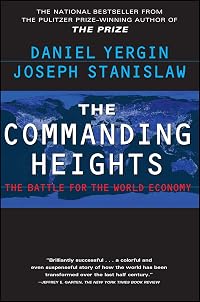
The Commanding Heights : The Battle for the World Economy
by Daniel Yergin, Joseph Stanislaw (Author)
On This Page
Description
Trillions of dollars in assets and fundamental political power are changing hands as free markets wrest control from government of the "commanding heights"--The dominant businesses and industries of the world economy. Daniel Yergin and Joseph Stanislaw demonstrate that words like "privatization" and "deregulation" are inadequate to describe the enormous upheaval that is unfolding before our eyes. Along with the creation of vast new wealth, the map of the global economy is being redrawn. show more Indeed, the very structure of society is changing. New markets and new opportunities have brought great new risks as well. How has all this come about? Who are the major figures behind it? How does it affect our lives? The collapse of the Soviet Union, the awesome rise of China, the awakening of India, economic revival in Latin America, the march toward the European Union - all are a part of this political and economic revolution. Fiscal realities and financial markets are relentlessly propelling deregulation; achieving a new balance between government and marketplace will be the major political challenge in the coming years. Looking back, the authors describe how the old balance was overturned, and by whom. Looking forward, they explore these equations: Will the new balance prevail? Or does the free market contain the seeds of its own destruction? Will there be a backlash against any excesses of the free market? And finally, The Commanding Heights illuminates the five tests by which the success or failure of all these changes can be measured, and defines the key issues as we enter the twenty-first century. The Commanding Heights captures this revolution in ideas in accounts of the history and the politics of the postwar years and tales of the astute politicians, brilliant thinkers, and tenacious businessmen who brought these changes about. Margaret Thatcher, Ronald Reagan, Deng Xiaoping, and Bill Clinton share the stage with the "Minister of Thought" Keith Joseph, the broomaker's son Domingo Cavallo, and Friedrich von Hayek, the Austrian economist who was determined to win the twenty-year "battle of ideas." It is a complex and wide-ranging story, and the authors tell it brilliantly, with a deep understanding of human character, making critically important ideas lucid and accessible. Written with unique access to many of the key players, The Commanding Heights, like no other book, brings us an understanding of the last half of the twentieth century - and sheds a powerful light on what lies ahead in the twenty-first century. show lessTags
Recommendations





Member Reviews
All right, it feels very dated, not destined to be the classic that The Prize is. As economic history, it only goes up to the 1997 Asian crisis, which means that the success of post-communist states, NAFTA and the EU were still in flux and, of course, the dot-com collapse and 2008-2009 aren't covered and nor anticipated (however, the euro crisis is). But let's not forget: it's not so easy to write compellingly about economic choices. Yergin knows how to spin a story, building it around personalities with ideas like Jacques Delors, Margaret Thatcher, Domingo Cavallo, Vargas Llosa,
What I liked best was the economic history of Europe post-WW2 and of Russia and Eastern Europe following the fall of communism. Everyone knows that shock show more therapy was too much of a shock for Russia but I didn't realize how quickly it worked in Poland (and Jeffrey Sachs' role there). I also found it a good primer on the crises in Latin America (Argentina, Peru, Brazil) in recent decades. I know what the Washington Consensus is but didn't realize the term was awarded after a series of policy reforms that were implemented successfully in Latin America.
Seemed to me the authors were perfunctory in their coverage of India, China and the 4 East Asian newly industrialized economies but then I have read a lot more about these countries. For better coverage of the NIEs, start with Ezra Vogel's The Four Little Dragons (it's short too). Unraveling India, more journalistic and personal, is the best intro to India's economic journey, imo. China--whew, there's loads but I suppose Vogel again. show less
What I liked best was the economic history of Europe post-WW2 and of Russia and Eastern Europe following the fall of communism. Everyone knows that shock show more therapy was too much of a shock for Russia but I didn't realize how quickly it worked in Poland (and Jeffrey Sachs' role there). I also found it a good primer on the crises in Latin America (Argentina, Peru, Brazil) in recent decades. I know what the Washington Consensus is but didn't realize the term was awarded after a series of policy reforms that were implemented successfully in Latin America.
Seemed to me the authors were perfunctory in their coverage of India, China and the 4 East Asian newly industrialized economies but then I have read a lot more about these countries. For better coverage of the NIEs, start with Ezra Vogel's The Four Little Dragons (it's short too). Unraveling India, more journalistic and personal, is the best intro to India's economic journey, imo. China--whew, there's loads but I suppose Vogel again. show less
Full disclosure: I've owned the book since first semester of grad school and have read certain chapters for use in papers and such, and I also own and have watched several times the PBS-produced DVDs that excellently tell the story (you can too at the link). But, I'd never read the entire book all the way through.
This book is the most comprehensive story of the neoliberal revolution ever written. It explains the post-WWII transition to state-run economies and top-down development to the much more free market oriented neoliberal revolution that started with the end of the 1970s, and the book goes through 2002.
Scott Sumner calls these events an "underreported phenomenon" in an essay he wrote recently, which reads as sort of a brief show more summary of this book (which I don't know that he's read).
I don't know that it's "underreported" so much as it seems to have been forgotten in the wake of the Great Recession and the backlash against capitalism, and what people perceive to be "market failures" that are really just consequences of unmitigated greed.
Billions of people in China, India, SE Asia, Eastern Europe and elsewhere have risen from stark poverty to a much more empowered lifestyle because of their governments' embrace of freer markets. Governments all over the world used to own everything from train lines to nightclubs to grocery stores, but eventually re-figured out that those would be better run privately. Modern-day Greece is a perfect example of where near statism gets you-- 25% of Greece's population had a lifetime-guaranteed government job going into their EU-mandated fiscal austerity plan. Governments, including the U.S., used to commonly set wages and prices which led to shortages , surpluses, and poverty.
If you want the (mostly) complete story, read Commanding Heights. The appendices alone are great for reference. I recently used the book to refute a fairly well-known liberal blogger's view that "there are zero historical examples of conservatives mobilizing to make the deficit smaller." The young liberal pundit class apparently don't remember anything further back than 15 years and never leave the country. And they parse things in simple terms: "How'd that free market thing work out for Mexico and Bolivia?" ignoring rampant government intervention in those economies or poor monetary policy, or other things that are vitally important.
If Commanding Heights has one obvious flaw, it's at the conclusion of its chapter on Russia. On one page it notes that the new freedoms that Russians enjoy, including freedoms of the press, can never be rolled back. Then, on the next page, it paints a dark uncertain picture where those freedoms are indeed rolled back by Putin & co. Perhaps this is the result of bad editing in a revision?
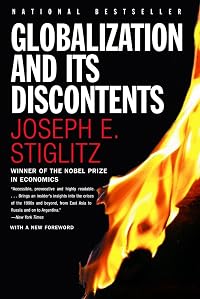
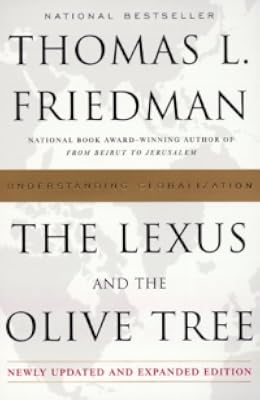
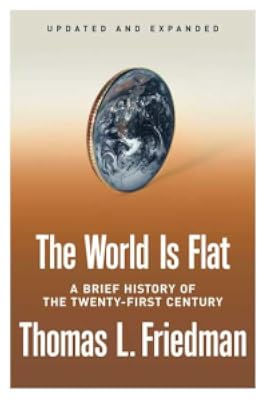
If you want the most complete picture of world economics from 1945-2002, read Commanding Heights. If you want a view of some of the guiding principles of that neoliberal revolution, read Hayek's The Road to Serfdom, or Milton Friedman's Capitalism and Freedom, or just watch Milton Friedman's Free to Choose series. If you want a more on-the-ground view of how the neoliberal revolution looked in the 1990s, read Tom Friedman's The Lexus and the Olive Tree or The World is Flat. If you want to read a critique of much of the above, read Joseph Stiglitz's Globalization and Its Discontents. show less
Resource Allocation and the Battle of Economic Ideals
In Carl Sagan's "Contact," the unknown entity encountered by Arroway after her journey into the wormhole delivers a scathing critique of the human condition, and goes on to express his concern about Earth's "astonishingly backward economic systems." "Commanding Heights" is a comprehensive account of those "backward" economic systems and chronicles the seemingly amaranthine battle between governments and the marketplace for control of the most important elements of the global economy. The discussion centers on the economic events of the second half of the twentieth century, sandwiched between the establishment of the British welfare state at the conclusion of the Second World War and show more the Asian financial contagion unfolding at the time of the book's publication.
The theme of "Commanding Heights" is the superiority of resource allocation via free markets vis--vis resource allocation by means of government control of strategic business undertakings. Along this free market-government control continuum, there are three fundamental, ideological positions concerning the workings of an economy: economic totalitarianism, strategic intervention, and non-interventionism. Given this backdrop, the second half of the twentieth century is depicted as a colossal experiment in wealth creation and redistribution. Advocates of neoclassical economics such as Friedrich von Hayek pitted their ideas against Keynesians and supporters of the command-and-control system.
World War II and its concomitant cost in human lives and shattered economic potential served as the catalyst for a remaking of the global economic order. Policymakers and politicians began questioning the effectiveness of a purely laissez-faire market system in mitigating the impact of macroeconomic failures and in addressing the issues of equity, poverty, and unemployment. Keynes provided a blueprint for the emergence of the so-called mixed economy, advocating government intervention through fiscal and monetary measures. Nationalization of strategic industries, central planning, and direct regulation were some of the tools made available to administrators.
By the time of the oil shocks of the 1970s, it became increasingly clear that this system of state control over essential economic activities was ill-equipped to deal with market shocks, and that regulatory capture rendered direct government supervision of natural monopolies and fundamental services ineffective and untenable. At the end of the 1980s, concerns about market failure started to give way to belief in the superiority of the market in allocating resources and ensuring that economic actors adhere to the principles of equity and fair play. Government began to take a back seat from managing the commanding heights of the economy, and privatization, deregulation, and liberalization became the norm.
The authors are unabashedly in favor of laissez-faire economics; this is shown by the recounting of recent economic history as a set of multifarious journeys undertaken by various countries that nearly invariably leads to the adoption of neoclassical economics as the sole logical solution to the ills caused by big government.
Ultimately, whether the experiment with `enlightened' free enterprise and the continuing retreat of government will succeed or not in the long term will depend on a host of factors, such as: (1) is the pursuit of pure profit by erstwhile government-owned entities detrimental to public welfare? (2) will liberalization ensure a fair distribution of wealth? (3) does internationally mobile capital impinge on national sovereignty? (4) is the marketplace inherently superior in price determination, especially in the short term? and (5) will the "balance of confidence" turn out to be in favor of free markets? show less
In Carl Sagan's "Contact," the unknown entity encountered by Arroway after her journey into the wormhole delivers a scathing critique of the human condition, and goes on to express his concern about Earth's "astonishingly backward economic systems." "Commanding Heights" is a comprehensive account of those "backward" economic systems and chronicles the seemingly amaranthine battle between governments and the marketplace for control of the most important elements of the global economy. The discussion centers on the economic events of the second half of the twentieth century, sandwiched between the establishment of the British welfare state at the conclusion of the Second World War and show more the Asian financial contagion unfolding at the time of the book's publication.
The theme of "Commanding Heights" is the superiority of resource allocation via free markets vis--vis resource allocation by means of government control of strategic business undertakings. Along this free market-government control continuum, there are three fundamental, ideological positions concerning the workings of an economy: economic totalitarianism, strategic intervention, and non-interventionism. Given this backdrop, the second half of the twentieth century is depicted as a colossal experiment in wealth creation and redistribution. Advocates of neoclassical economics such as Friedrich von Hayek pitted their ideas against Keynesians and supporters of the command-and-control system.
World War II and its concomitant cost in human lives and shattered economic potential served as the catalyst for a remaking of the global economic order. Policymakers and politicians began questioning the effectiveness of a purely laissez-faire market system in mitigating the impact of macroeconomic failures and in addressing the issues of equity, poverty, and unemployment. Keynes provided a blueprint for the emergence of the so-called mixed economy, advocating government intervention through fiscal and monetary measures. Nationalization of strategic industries, central planning, and direct regulation were some of the tools made available to administrators.
By the time of the oil shocks of the 1970s, it became increasingly clear that this system of state control over essential economic activities was ill-equipped to deal with market shocks, and that regulatory capture rendered direct government supervision of natural monopolies and fundamental services ineffective and untenable. At the end of the 1980s, concerns about market failure started to give way to belief in the superiority of the market in allocating resources and ensuring that economic actors adhere to the principles of equity and fair play. Government began to take a back seat from managing the commanding heights of the economy, and privatization, deregulation, and liberalization became the norm.
The authors are unabashedly in favor of laissez-faire economics; this is shown by the recounting of recent economic history as a set of multifarious journeys undertaken by various countries that nearly invariably leads to the adoption of neoclassical economics as the sole logical solution to the ills caused by big government.
Ultimately, whether the experiment with `enlightened' free enterprise and the continuing retreat of government will succeed or not in the long term will depend on a host of factors, such as: (1) is the pursuit of pure profit by erstwhile government-owned entities detrimental to public welfare? (2) will liberalization ensure a fair distribution of wealth? (3) does internationally mobile capital impinge on national sovereignty? (4) is the marketplace inherently superior in price determination, especially in the short term? and (5) will the "balance of confidence" turn out to be in favor of free markets? show less
The authors flap the illusion of a "movement" from state control to "market consensus". [399] Published in 1999, the authors are oblivious to the signs of takeover of the world by pirates who fund a constant noise of destabilization and hostility to all governments, regardless of the type. The authors proclaim the "shift" of public services to "private corporations" without showing a single example of this providing a benefit to the community. They do document the dramatic increase of profiteering prisons, security forces, and "schools"--the "core" functions of government. [366] They accept, without any basis for doing so, the illusion that "local control" will benefit citizens, when in fact economic fiefdoms are formed (seized) for the show more benefit of local monopolists.
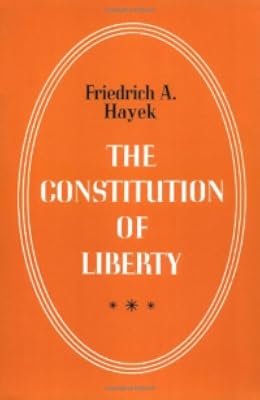
The authors document the fact that after publishing his "outstanding work"--The Constitution of Liberty--which was praised by Keynes, Hayek fell into depression, tried repeatedly to abandon his "supporters" in Chicago, and took an appointment at the University of Freiburg, amid the Ordoliberals. [144] While his followers continue to misread him, the bottom line is that Hayek's most important theme remains this: "Laissez-faire does not work. Government has a clear and required role to ensure the development, protection and maintenance of the institutions without which a competitive market cannot endure: Laws and regulation, and recourse for the victims of those who commit crimes and steal wealth from the "free market" using force and fraud. [144] show less
The authors document the fact that after publishing his "outstanding work"--The Constitution of Liberty--which was praised by Keynes, Hayek fell into depression, tried repeatedly to abandon his "supporters" in Chicago, and took an appointment at the University of Freiburg, amid the Ordoliberals. [144] While his followers continue to misread him, the bottom line is that Hayek's most important theme remains this: "Laissez-faire does not work. Government has a clear and required role to ensure the development, protection and maintenance of the institutions without which a competitive market cannot endure: Laws and regulation, and recourse for the victims of those who commit crimes and steal wealth from the "free market" using force and fraud. [144] show less
A book of two parts (literally).
The first part is purely informative, about how the titans of the world economies (power, heavy Industry, the huge specialist Industrial sectors in those countries that have / had them) developed in the world's various economies. The general idea is that as industries grew their needs changed.
The second part is more of a cheerleading for giving away these national assets to the nearest rich person and opposing the "explosion of (human) rights" so annoying to the small-minded 1%. Lots of obvious mistakes and tenuous connections here - hence this book''s bad reputation.
Wanted to give 5 stars, but couldn't.
The first part is purely informative, about how the titans of the world economies (power, heavy Industry, the huge specialist Industrial sectors in those countries that have / had them) developed in the world's various economies. The general idea is that as industries grew their needs changed.
The second part is more of a cheerleading for giving away these national assets to the nearest rich person and opposing the "explosion of (human) rights" so annoying to the small-minded 1%. Lots of obvious mistakes and tenuous connections here - hence this book''s bad reputation.
Wanted to give 5 stars, but couldn't.
The Commanding Heights is a book about the control of the economic policies of nations. It goes into discussions about Communism and Socialism and other forms of Market Planning and goes over what happened to them. It is actually quite fascinating and interesting since it reminded me of a lot of World Events that I lived through but was too young to care about.
There isn’t much else to say, except that the book is a bit dated since it was printed in 1998.
There isn’t much else to say, except that the book is a bit dated since it was printed in 1998.
Good globalization primer.
Members
- Recently Added By
Author Information

24 Works 4,523 Members
Daniel Yergin was born in Los Angeles on February 6, 1947. He received a B. A. from Yale University in 1968 and an M. A. and Ph. D. from Cambridge University. Yergin is the chairman of Cambridge Energy Research Associates, the vice chairman of the Global Decisions Group and has chaired the U. S. Department of Energy Task Force on the future of show more energy research. He is the author of The Prize: The Epic Quest for Oil, Money and Power, which won the 1992 Pulitzer Prize for General Nonfiction and was made into a PBS/BBC series. His other published works include Shattered Peace: The Origins of the Cold War and the National Security State, The U.S. Strategic Petroleum Reserve, and The Quest: Energy, Security, and the Remaking of the Modern World. (Bowker Author Biography) show less
Some Editions
Work Relationships
Has the adaptation
Common Knowledge
- Canonical title*
- La grande bataille. Les marchés à l'assaut du pouvoir
- Original title
- The commanding heights, the battle between government and the marketplace, that is remaking the modern world
- Original publication date
- 1998
- Related movies
- Commanding Heights: The Battle for the World Economy (2002 | IMDb)
- Original language*
- Anglais (Etats-Unis) (Etats-Unis)
*Some information comes from Common Knowledge in other languages. Click "Edit" for more information.
Classifications
- Genres
- Economics, Nonfiction, General Nonfiction, History, Business, Politics and Government
- DDC/MDS
- 338.9 — Society, government, & culture Economics Production Economic Development And Growth
- LCC
- HD87 .Y47 — Social sciences Industries. Land use. Labor Industries. Land use. Labor Economic growth, development, planning
- BISAC
Statistics
- Members
- 606
- Popularity
- 48,173
- Reviews
- 8
- Rating
- (3.66)
- Languages
- 7 — English, French, German, Italian, Japanese, Spanish, Swedish
- Media
- Paper, Audiobook, Ebook
- ISBNs
- 20
- UPCs
- 5
- ASINs
- 5