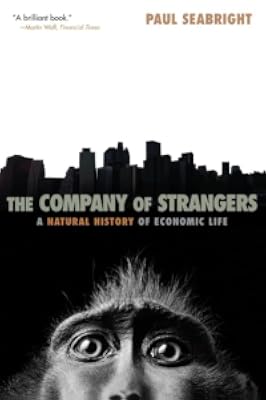
The Company of Strangers: A Natural History of Economic Life
by Paul Seabright
On This Page
Description
The Company of Strangers shows us the remarkable strangeness, and fragility, of our everyday lives. This completely revised and updated edition includes a new chapter analyzing how the rise and fall of social trust explain the unsustainable boom in the global economy over the past decade and the financial crisis that succeeded it. Drawing on insights from biology, anthropology, history, psychology, and literature, Paul Seabright explores how our evolved ability of abstract reasoning has show more allowed institutions like money, markets, cities, and the banking system to provide the foundations of social trust that we need in our everyday lives. Even the simple acts of buying food and clothing depend on an astonishing web of interaction that spans the globe. How did humans develop the ability to trust total strangers with providing our most basic needs? show lessTags
Recommendations










Member Reviews
The author is haunted by the spectre of murderous apes. But why is there so little killing, among apes and among humans. The answer is morality, which is not in the index of the book. Human life would be impossible without morality, which is the set of rules for living in society. We were social before we were human. First we had ape social life and trust, then human family life, then all the rest of human life. Social scientists not only need to know other social social sciences besides economics, they also need to know biology. We can think of social science as one form of biology.
«La paura degli estranei, recentemente risvegliatasi, disgrega l'intera tela di relazioni che legano insieme le persone in una sana società moderna e mina tutte le istituzioni da cui tale società dipende». Questo breve pensiero, inserito nella parte finale del libro, chiarisce la linea di ricerca che ha spinto Seabright a indagare le origini delle società moderne. La fiducia nei confronti degli sconosciuti è ciò che storicamente ci ha permesso da emanciparci dalle logiche dei clan e dei nuclei familiari, per costruire società ricche e complesse, sia dal punto di vista culturale che economico. Comprendere le basi di questa dinamica è fondamentale.
Very interesting book about trust, how unnatural it is for human beings, and how modern society is made possible through trust.
AN INSIGHTFUL EXAMINATION OF HOW HUMAN COOPERATION HAS EVOLVED FROM SMALL COMMUNITIES TO COMPLEX GLOBAL ECONOMIES, GROUNDED IN BIOLOGY AND HISTORY.
There is some truth here, but he is leaning heavily on evo-psych, a controversial field.
Ratings
Members
- Recently Added By
Lists

The Enlightened Economist
107 works; 1 member
Author Information

5 Works 365 Members
Paul Seabright is professor of economics at the Toulouse School of Economics. He has been a fellow of All Souls College, University of Oxford, and Churchill College, University of Cambridge.
Common Knowledge
- Original publication date
- 2004
- Dedication
- to Alice, Edmond, and Luke
- First words
- This morning I went out and bought a shirt.
- Last words
- (Click to show. Warning: May contain spoilers.)This experiment is still young, and needs all the help it can get.
Classifications
- Genres
- Economics, Nonfiction, Sociology, Science & Nature, General Nonfiction, History, Anthropology
- DDC/MDS
- 306.3 — Society, government, & culture Social sciences, sociology & anthropology Social Behavior - Dating, Marriage, Divorce Economic institutions
- LCC
- HM708 .S43 — Social sciences Sociology (General) Sociology
- BISAC
Statistics
- Members
- 286
- Popularity
- 112,748
- Reviews
- 5
- Rating
- (3.66)
- Languages
- English, French, Italian, Japanese
- Media
- Paper, Ebook
- ISBNs
- 9
- ASINs
- 2