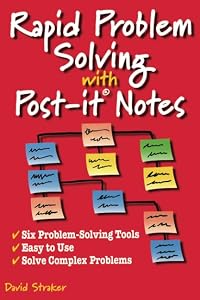
Rapid Problem Solving with Post-It Notes
by David Straker 
On This Page
Description
Problem Solved! Uses your favorite top-drawer tool--the Post-it® Note. Great for individuals, great for groups--large or small. Problems come in all shapes and sizes, yet most have common characteristics that can be addressed with the techniques found in this book. Rapid Problem-Solving with Post-it® Notes shows you how to use six types of techniques: The Post-up-Provides methods for getting information into chunks The Swap Sort-Shows listing and organization methods The Top-down show more Tree-Works when the nature of the problem is unknown The Information Map-Maps messy problems and complex relationships The Action Map-Plans actions or maps an existing process More than 70 diagrams and examples for solving everyday problems This refreshing book reminds us the simplest ideas are often the most effective. Solve problems, create solutions and find answers fast-all with the help of Post-it® Notes. Tens of millions of Post-it® Notes users can now learn how to do far more with these great little tools. Post-it® Notes can be used to help solve difficult problems because they: Are the right size to hold one piece of information from a problem Are easily to attached to flat surfaces and stay put Can be moved and reattached many times show lessTags
Recommendations































Member Reviews
While this title is a decade old, it use the ubiquitous sticky notes as a problem solving technique; a combination of visual and text. The book is worth its re0examination because it provides some excellent techniques for arranging random ideas into shapes of ideas that help in the solution of the problem at hand. Sic techniques are featured: post-up, swap sort, top-down tree, bottom-up tree, information map, and action map. While we can’t show you these configurations here, we can promise that the ideas illustrated are invaluable when various technologies are not available. And, the ideas can be incorporated into technology. For example, one can arrange Wallwisher brainstorms using Straker’s ideas, and, it starts you thinking about show more how to arrange ideas in tools such as Google Forms/spreadsheets. show less
I'm torn about how much value I got out of this book. In practice, it does serve up a valuable, if very focussed, guide to use of Post-ItTM Notes in defining, sorting, prioritising and giving structure to knowledge. You have the Post-Up and Swap-Out for general information gathering and sorting, the Top-Down and Bottom-Up for either generating or coalescing data, and you have the Information Map and the Action Map, either for finding commonality between the disparate or creating flow. It all makes sense, but I'm not sure whether it needed to be Post-ItTM Note focussed or quite so long.
OK - a viable toolset that somehow left me leaving short for the time spent reading it.
OK - a viable toolset that somehow left me leaving short for the time spent reading it.
Accurate title, and more useful seeming than it sounds. Straker describes several protocols for using sticky notes to gather ideas from everyone involved at once, and then rearrange them with authority or consensus to figure out what needs to be done, sometimes in what order, without losing any of the inputs.
Dorky title, but to the point. 70 different ways of displaying information diagramatically for problem solving, decision making etc. Inexpensive reference.
Ratings
Members
- Recently Added By
Author Information

8 Works 291 Members
David Straker is a LibraryThing Author, an author who lists their personal library on LibraryThing.
Classifications
Statistics
- Members
- 235
- Popularity
- 137,985
- Reviews
- 4
- Rating
- (3.68)
- Languages
- English
- Media
- Paper, Ebook
- ISBNs
- 3
- ASINs
- 1