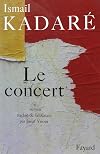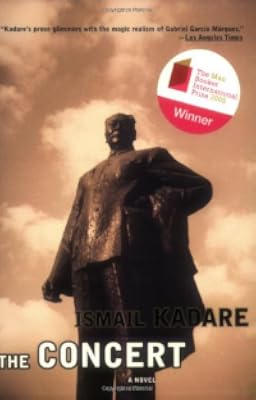
The Concert
by Ismaïl Kadaré
On This Page
Description
A group of Albanian friends are torn apart by the political turmoil of the mid 1970s, as the nation's diplomatic ties with China begin to unravel, and their personal entanglements follow suit in the face of governmental insecurity.Tags
Recommendations














Member Reviews
A complex, multilayered novel set against the background of the Sino-Albanian split of 1972-1978, when the formerly cordial relationship between the Hoxha and Mao governments was soured by the death of Lin Biao, Nixon’s state visit to China, and various other factors. Kadare takes us behind the scenes in Beijing where we see Mao and Zhou Enlai reacting to this weird pinprick of hostility from a tiny country no-one has ever heard of, follows the consequences of (presumed) Chinese plots to destabilise the Albanian government and looks at the lives of people at various different levels of Albanian society affected by the rapid scaling-down of Chinese economic aid — in ways ranging from mildly ridiculous to seriously tragic. A couple of show more Albanian writers, one of them perhaps a self-portrait, are sent on a delegation to China where no-one knows what to do with them, as literature and its institutions have officially been abolished by the Cultural Revolution. And hundreds of foreign diplomats are invited to an odd, symbolic evening of Chinese theatre on what turns out to be the night of Mao’s death.
Kadare plays around with timelines and juxtapositions of historical characters in ways that clearly aren’t meant to be taken completely literally. Dreams and bits of Shakespeare turn up here and there as required too. It’s sometimes a bit hard to follow exactly what he is up to, but his technique does seem to work very well as a way of bringing together big events and historical figures with the stories of more ordinary people that we can identify with ourselves. show less
Kadare plays around with timelines and juxtapositions of historical characters in ways that clearly aren’t meant to be taken completely literally. Dreams and bits of Shakespeare turn up here and there as required too. It’s sometimes a bit hard to follow exactly what he is up to, but his technique does seem to work very well as a way of bringing together big events and historical figures with the stories of more ordinary people that we can identify with ourselves. show less
Despite its title, The Concert requires no real knowledge of music. What it does require is an interest in Sino-Albanian politics and a fascination with the final hours of Lin Biao. Certainly not a novel for everyone, but definitely one for me.
As negotiations for the Sino American rapprochement were going on, Gjerj Dibra flew to Beijing to deliver a letter from the Albanians, asking that the meeting with the American president be cancelled. Who was little Albania to demand such a thing? China's only ally, a tiny country cut off from the Europe which should have been its natural home dared defy Chairman Mao. Back in Tirana, Chinese diplomats, engineers, scientists, workers and trade delegations were disappearing from Albania as if they show more had never arrived, abandoning engineering projects, construction sites and trade missions.
This wouldn't be a Kadare book though without elements of the surreal. One nameless man, high in the Arctic, constantly sifts through transmissions in the ether, reading the tea leaves of changes in the rankings of the Chinese Politbureau. Mao Zedong wanders in and out of lucidity in his favourite cave retreat. The x-ray of the broken foot of a Chinese diplomat causes a rift between the two countries.
All these elements are essentially shadows, glimpses of greater realities. It is in this contrast between the world of conjecture and the harsh reality of Enver Hoxha's Albania that Kadare excels, setting up a real and justified paranoia. There are repeated references to [MacBeth] (was it because Mao and Lin Biao "were both hatching a plot based on treachery at a banquet?"), ghosts and isolation. Alone in China, Albanian Party member Skënder Berema repeatedly works out scenarios for Lin Biao's flight and death.
Finally there is the concert itself. Zhou Enlai had said the way to understand Chinese politics was to study Chinese theatre. Eleven hundred people, including Berema, received invitations on the very day of the concert.
Zhou Enlai, the man who knew all and controlled all, was contemplating his masks.
As the high level audience assembled, speculation ran rife.What was the plot of the performance? Were the movements of the second female dancer going to signify anything? Where and with whom was everyone seated? Hua Guofeng was working on his best imitation of Mao's hair to impress the audience. Finally all were assembled. Tensions built throughout the concert. The end of the performance brought a completely unexpected panic.
Kadare shifts events somewhat and timelines are unclear. Mao may die before Zhou, or the deaths may be the same day. The magic realism he employs, the varying iterations of the same story be it the massacre of Albanians in Kosovo, the war in Cambodia, or the leitmotif of the death of Lin Biao, illustrate the many forms history can take, and the impossibility of knowing the truth. This is classic Kadare. show less
As negotiations for the Sino American rapprochement were going on, Gjerj Dibra flew to Beijing to deliver a letter from the Albanians, asking that the meeting with the American president be cancelled. Who was little Albania to demand such a thing? China's only ally, a tiny country cut off from the Europe which should have been its natural home dared defy Chairman Mao. Back in Tirana, Chinese diplomats, engineers, scientists, workers and trade delegations were disappearing from Albania as if they show more had never arrived, abandoning engineering projects, construction sites and trade missions.
This wouldn't be a Kadare book though without elements of the surreal. One nameless man, high in the Arctic, constantly sifts through transmissions in the ether, reading the tea leaves of changes in the rankings of the Chinese Politbureau. Mao Zedong wanders in and out of lucidity in his favourite cave retreat. The x-ray of the broken foot of a Chinese diplomat causes a rift between the two countries.
All these elements are essentially shadows, glimpses of greater realities. It is in this contrast between the world of conjecture and the harsh reality of Enver Hoxha's Albania that Kadare excels, setting up a real and justified paranoia. There are repeated references to [MacBeth] (was it because Mao and Lin Biao "were both hatching a plot based on treachery at a banquet?"), ghosts and isolation. Alone in China, Albanian Party member Skënder Berema repeatedly works out scenarios for Lin Biao's flight and death.
Finally there is the concert itself. Zhou Enlai had said the way to understand Chinese politics was to study Chinese theatre. Eleven hundred people, including Berema, received invitations on the very day of the concert.
Zhou Enlai, the man who knew all and controlled all, was contemplating his masks.
He had three masks: the mask of a leader, the mask of one who obeys, and the mask as cold as ice. The first two he usually wore to government and Politbureau meetings or committees. The third he kept for occasions when he had to appear in public.
The clock on the wall behind him struck six. This was the first time he had gone out without one of his three masks. They were all out of date now. Instead he now wore a fourth. A death mask.
As the high level audience assembled, speculation ran rife.What was the plot of the performance? Were the movements of the second female dancer going to signify anything? Where and with whom was everyone seated? Hua Guofeng was working on his best imitation of Mao's hair to impress the audience. Finally all were assembled. Tensions built throughout the concert. The end of the performance brought a completely unexpected panic.
Kadare shifts events somewhat and timelines are unclear. Mao may die before Zhou, or the deaths may be the same day. The magic realism he employs, the varying iterations of the same story be it the massacre of Albanians in Kosovo, the war in Cambodia, or the leitmotif of the death of Lin Biao, illustrate the many forms history can take, and the impossibility of knowing the truth. This is classic Kadare. show less
> LE CONCERT Ismaïl Kadaré Fayard, 1989; 39,95$
Se reporter au compte rendu de Richard TARDIF
In: (1990). Compte rendu de [Littérature étrangère]. Nuit blanche, le magazine du livre, n° 40 (juin–juillet–août 1990), 35–36… ; (en ligne),
URL : https://id.erudit.org/iderudit/19815ac
Se reporter au compte rendu de Richard TARDIF
In: (1990). Compte rendu de [Littérature étrangère]. Nuit blanche, le magazine du livre, n° 40 (juin–juillet–août 1990), 35–36… ; (en ligne),
URL : https://id.erudit.org/iderudit/19815ac
Feb 25, 2021French
Ratings
Members
- Recently Added By
Author Information

182+ Works 7,843 Members
Ismail Kadare is the most prominent of contemporary Albanian writers. He has written poetry, short stories, literary criticism, and seven novels. His works have been translated and published in more than two dozen countries. An internationally known figure, he has visited and lectured in many countries. He was also a representative to Albania's show more People's Assembly. In 1990 Kadare left Albania for Paris where he became openly dissident. (Bowker Author Biography) show less
Series
Belongs to Publisher Series
Harvill (173)
Common Knowledge
- Canonical title
- The Concert
- Original title
- Koncert në fund të dimrit
- Original publication date
- 1988
- Important places
- Albania; Beijing
- Important events
- Sino Albanian split
- First words
- The window looked down on the street, where the passers-by, all muffled up, seemed to be hurrying along as fast as they could.
Classifications
- Genres
- Fiction and Literature, General Fiction
- DDC/MDS
- 891.9913 — Literature & rhetoric Asian Literature East Indo-European and Celtic literatures Baltic and other Indo-European languages Other Indo-European languages Albanian Albanian fiction
- LCC
- PG9621 .K3 .C6613 — Language and Literature Slavic languages and literatures. Baltic languages. Albanian language Slavic. Baltic. Albanian Albanian
- BISAC
Statistics
- Members
- 173
- Popularity
- 188,784
- Reviews
- 3
- Rating
- (3.86)
- Languages
- 6 — Albanian, English, French, German, Portuguese, Spanish
- Media
- Paper, Ebook
- ISBNs
- 14
- ASINs
- 1