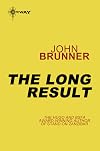
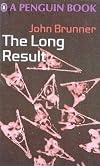
The long result
by John Brunner
On This Page
Description
When racial hatred turns to murderous menace . . . First a rocket ship loses its engines on take-off and is destroyed. On board - an important extra-terrestrial visitor. Next someone slams into the sealed vehicle used for transporting aliens around in the lethal atmosphere of Earth. Then the vital controlled environment for the Tau Cetian delegation is sabotaged. Oxygen leaks in, and the aliens are half burnt alive. Even if it means brutal murder, The Stars Are For Man League is determined show more to shatter the harmony between Earth and civilizations on other planets - and to keep mankind supreme among the alien life forms. Only one man can stop them - a man who unknowingly nurses a viper in his bosom . . .First published in 1965. show lessTags
Recommendations
















Member Reviews
I must have last read The Long Result almost 45 years ago. I’ve had a copy on my bookshelves since at least the 1980s, and it’s a paperback published in 1979 and bought new, so probably 1980 or 1981. And pretty much nothing from the book had stayed with me over the decades. Except…
Many, many years ago in my late teens I remember creating an alien race for something - a story, a role-playing game adventure; I don’t remember. I later used a variation on that alien race for a spoof space opera story written in the late 1980s and published in the very early 1990s. It wasn’t a very good story, and has thankfully vanished into obscurity. The alien - if I ever named the race, I no longer recall the name - was slightly larger than a show more human, with four arms, blue skin, and a vaguely equine head.
So I was a little surprised on this reread of The Long Result to discover the book was the inspiration for the alien race. In Brunner’s novel, they are the Regulans, and are pretty much indestructible. Only one appears in the book (at least until the epilogue, when a ship-full makes an appearance).
The narrator, Roald Vincent, is an assistant chief at the Bureau of Cultural Relations, the organisation which keeps tabs on Earth’s two colonies, Starhome and Viridis, and the handful of alien races so far discovered. When Starhomers turn up at Earth with a delegation of newly-contact chlorine-breathing aliens, this kicks off a series of attacks by the Stars Are For Man, a previously crank human supremacist group now turned terrorist. Vincent is in the thick of it, and manages to figure out the conspiracy before too much damage is done.
He’s supposed to be extremely clever, destined for great things, but a bit of a coaster. The narrative makes much of his uncanny ability to uncover what’s going on, yet he continually misses the most suspicious person in the entire novel.
I’ve never been a fan of Brunner’s fiction. I’ve read some of his better known works - Stand on Zanzibar, The Jagged Orbit, The Squares of the City - but I didn't like them all that much. And he wrote a lot more bad novels than he wrote good ones. So if I didn’t like the good ones… He strikes me as a writer whose reach mostly exceeded his grasp. Or is it the other way round? The Long Result makes a couple of good points, but the world-building is thin (and dated, but in an interesting 1960s futurist aesthetic sort of way), and the plot relies too much on Vincent being almost psychic at times and not at all bright at others. It’s a slight book - it took me an afternoon to read the 186 page Penguin paperback - and I’m not in the least bit surprised I remembered none of it.
Except for the Regulans. Which was a bit weird. show less
Many, many years ago in my late teens I remember creating an alien race for something - a story, a role-playing game adventure; I don’t remember. I later used a variation on that alien race for a spoof space opera story written in the late 1980s and published in the very early 1990s. It wasn’t a very good story, and has thankfully vanished into obscurity. The alien - if I ever named the race, I no longer recall the name - was slightly larger than a show more human, with four arms, blue skin, and a vaguely equine head.
So I was a little surprised on this reread of The Long Result to discover the book was the inspiration for the alien race. In Brunner’s novel, they are the Regulans, and are pretty much indestructible. Only one appears in the book (at least until the epilogue, when a ship-full makes an appearance).
The narrator, Roald Vincent, is an assistant chief at the Bureau of Cultural Relations, the organisation which keeps tabs on Earth’s two colonies, Starhome and Viridis, and the handful of alien races so far discovered. When Starhomers turn up at Earth with a delegation of newly-contact chlorine-breathing aliens, this kicks off a series of attacks by the Stars Are For Man, a previously crank human supremacist group now turned terrorist. Vincent is in the thick of it, and manages to figure out the conspiracy before too much damage is done.
He’s supposed to be extremely clever, destined for great things, but a bit of a coaster. The narrative makes much of his uncanny ability to uncover what’s going on, yet he continually misses the most suspicious person in the entire novel.
I’ve never been a fan of Brunner’s fiction. I’ve read some of his better known works - Stand on Zanzibar, The Jagged Orbit, The Squares of the City - but I didn't like them all that much. And he wrote a lot more bad novels than he wrote good ones. So if I didn’t like the good ones… He strikes me as a writer whose reach mostly exceeded his grasp. Or is it the other way round? The Long Result makes a couple of good points, but the world-building is thin (and dated, but in an interesting 1960s futurist aesthetic sort of way), and the plot relies too much on Vincent being almost psychic at times and not at all bright at others. It’s a slight book - it took me an afternoon to read the 186 page Penguin paperback - and I’m not in the least bit surprised I remembered none of it.
Except for the Regulans. Which was a bit weird. show less
review of
John Brunner's The Long Result
by tENTATIVELY, a cONVENIENCE - February 24, 2013
I'm now a full-fledged Brunner enthusiast. I'm happy to finally be reading his work after having more or less ignored it for the, at least, 40 yrs I've known about it. I think I wasn't interested in him b/c I had the impression that he's a somewhat 'generic' SF writer. WCH, in a sense, he is. He doesn't have that obvious topical distinction that J. G. Ballard does, eg. Ballard pries open the festering subconscious of the culture of his (& my) time & serves it up like Burroughs' Naked Lunch. & Brunner's writing style remains prosaic, limited by both his writerly philosophy & the commercial constraints of his publishers.
W/ that sd, he's also a show more writer full of ideas, of inspiration, & I'm glad he was as prolific as he was since it means that he's left behind a substantial reservoir of pleasurable stimulation for me to while away w/. The Long Result is essentially an anti-racist novel extrapolated into a future where distinctions between humans are no longer the negative obsession of the bigot but, rather, distinctions between humans & extraterrestrials. & Brunner does an excellent job w/ the theme. I'm beginning to think that it'd be hard for me to dislike any SF writer but my enthusiasm for Brunner isn't really reflective of that.
As seems to be so often the case, I found myself focusing on details not necessarily central to the main plot when I took my notes for this review. This is partially b/c I figure discussions of the main plot will be out & about in the world in plenty already. EG:
"I decided I would probably like bin Ishmael more than our previous casual - purely social - encounters had already made me. Old-fashioned or not, I liked people who had private libraries, and even Patricia - who took the modern attitude that all you needed was access to a good computer memory - couldn't make me change my views." (p 42)
Now, THAT'S prescient! The copyright date on my copy of this is 1965. Such a distinction about computer use vs private libraries is very here-&-now of 2013. I participated in a 'Zine Fair back in the fall of 2011 & 2 guys told me that they'd had & liked some records of mine but'd gotten rid of all their records for CDs or some-such. The thing is, one of the records they mentioned is a RECORD, complete w/ things records have that CDs don't: parallel & lock grooves, etc.. THERE WILL NOT BE A CD TO REPLACE IT. Therefore, by getting rid of the record, they got rid of all its meta-content too. Not only do computers & the internet & e-bks, etc, NOT replace hard-copy publications, the powers-that-be can use the corporate control of servers to wink information out of accessibility. & let's not forget internet censorship, there's plenty of it. I had a movie removed from YouTube simply b/c someone complained about the accompanying notes. The movie was a critique of the Pavlovian 'believability' of mass media & the person who complained about it is an aspiring media studies professor. She complained b/c she's in the movie & in the notes I sd that the dog that's also in the movie was the most intelligent.
A bit more central to the plot is this:
""Well . . . Viridis was planted about a hundred and ten years ago by a group of neo-Roussellians who wanted to return to a pre-technological civilization. On Earth they'd become a laughing-stock, of course, but since the sociologists were pressing the government to aid the study of alternative solutions to the problem of organizing a mass society, their colony was approved and subsidized."
""They got on well?"
""Oh yes. About half of our modern music, drama and verse is Viridian in origin. Their society has a-" I fumbled for the right word. "A depth, a richness, which ours lacks."
""You prefer their society to the Starhomers'?"
""Well - yes. Starhome was founded to see how far a technologically oriented society could be driven. Of course in their own way the Starhomers have done exceedingly well: their level of mechanization is amazing. And, naturally, my department deals with the social consequences of this - well - experiment."" (p 54)
& Brunner's writing does get better & better: his descriptions get more & more subtly realistic, there's an attn to detail that I love:
""No, you're at least here - though what help that is I don't really know. I can't find your boss, I can't find the head of alien contact, the woman with the impossible to pronounce name -"
""Indowegiatuk," Jacky supplied. It meant something in an Eskimo dialect, they said; I'd never found out what." (p 73)
People are exasperated, people are frustrated by not being able to get in touch w/ someone, there're problems w/ pronouncing a person's name. Such details are ignored by hack writers in the interest of just moving ahead w/ the action.
&, as in The Whole Man, Brunner mentions a theremin in passing:
"The number of interests this room reflected was fantastic. A theremin stood under the main window, its flex coiled over an antique and fabulously valuable guitar. Rows of loose-leaf binders containing semantic and sociological notes were half-hidden behind reproductions of classical sculpture: a Rodin, a Henry Moore, the Venus of Milo, and Kasneky's Virtue." (p 90)
& then there're amusing touches such as the discovery & appreciation of science fiction as an obsolete antique. How many SF writers think about that?!
""Oh, I don't think I've shown you this," he said, switching subjects once more with the same disconcerting rapidity. He reached behind him and drew out a small, rather tattered volume. He held his hand over the top of it so all I could see was the picture on the front: a painting of Mars with a spaceship in the foreground.
""What about it?" I said.
""Well - what do you think it is?"
""It's a spaceship, obviously. One of our early pure-rocket models, I presume, though I'm no expert on that."
""Take a look at the date on it. Handle with care!"
"I took it gingerly. It was old, and made of woodpulp paper which had been coated with plastic to preserve it; even so it was brittle to the touch. I looked for the date Micky had mentioned, and found it on the spine. It was - 1959.
"I said, "But -"
"And stopped. It was one of the most violent double-takes I'd ever made.
""Correct," Micky said. "There weren't any spaceships flying to Mars in 1959." (p 93)
& Brunner isn't afraid to give credit where credit is due - even when it probably rubs somewhat against what're possibly his own personal political feelings:
""Starhome - as you damned well know - is a force-grown society. It's not exactly regimented, but it's sure as hell disciplined. It was planted by the spiritual descendants of the twentieth-century totalitarians. I know that's a dirty word, but it's an accurate description. Their supreme goal is efficiency. It's the most workable compromise ever achieved between the laxity of individual freedom and the rigidity of the corporate state. Most important, it's a far more efficient basic design than we have." (p 95)
Now I'm as anti-Fascist & as anti-Nazi as ever - but I wdn't mind having 'the trains run on time' - to use that reference to Mussolini metaphorically.
Brunner has revived my enthusiasm for science fiction like no other has for a while. C. M. Kornbluth & Frederik Pohl were his predecessors in this respect. & I'm grateful for it. Brunner's yet-another person I'd wish I'd gotten to know when he was alive. Our life-times overlapped by 42 yrs. Maybe I shd go to more SF conventions, eh?! show less
John Brunner's The Long Result
by tENTATIVELY, a cONVENIENCE - February 24, 2013
I'm now a full-fledged Brunner enthusiast. I'm happy to finally be reading his work after having more or less ignored it for the, at least, 40 yrs I've known about it. I think I wasn't interested in him b/c I had the impression that he's a somewhat 'generic' SF writer. WCH, in a sense, he is. He doesn't have that obvious topical distinction that J. G. Ballard does, eg. Ballard pries open the festering subconscious of the culture of his (& my) time & serves it up like Burroughs' Naked Lunch. & Brunner's writing style remains prosaic, limited by both his writerly philosophy & the commercial constraints of his publishers.
W/ that sd, he's also a show more writer full of ideas, of inspiration, & I'm glad he was as prolific as he was since it means that he's left behind a substantial reservoir of pleasurable stimulation for me to while away w/. The Long Result is essentially an anti-racist novel extrapolated into a future where distinctions between humans are no longer the negative obsession of the bigot but, rather, distinctions between humans & extraterrestrials. & Brunner does an excellent job w/ the theme. I'm beginning to think that it'd be hard for me to dislike any SF writer but my enthusiasm for Brunner isn't really reflective of that.
As seems to be so often the case, I found myself focusing on details not necessarily central to the main plot when I took my notes for this review. This is partially b/c I figure discussions of the main plot will be out & about in the world in plenty already. EG:
"I decided I would probably like bin Ishmael more than our previous casual - purely social - encounters had already made me. Old-fashioned or not, I liked people who had private libraries, and even Patricia - who took the modern attitude that all you needed was access to a good computer memory - couldn't make me change my views." (p 42)
Now, THAT'S prescient! The copyright date on my copy of this is 1965. Such a distinction about computer use vs private libraries is very here-&-now of 2013. I participated in a 'Zine Fair back in the fall of 2011 & 2 guys told me that they'd had & liked some records of mine but'd gotten rid of all their records for CDs or some-such. The thing is, one of the records they mentioned is a RECORD, complete w/ things records have that CDs don't: parallel & lock grooves, etc.. THERE WILL NOT BE A CD TO REPLACE IT. Therefore, by getting rid of the record, they got rid of all its meta-content too. Not only do computers & the internet & e-bks, etc, NOT replace hard-copy publications, the powers-that-be can use the corporate control of servers to wink information out of accessibility. & let's not forget internet censorship, there's plenty of it. I had a movie removed from YouTube simply b/c someone complained about the accompanying notes. The movie was a critique of the Pavlovian 'believability' of mass media & the person who complained about it is an aspiring media studies professor. She complained b/c she's in the movie & in the notes I sd that the dog that's also in the movie was the most intelligent.
A bit more central to the plot is this:
""Well . . . Viridis was planted about a hundred and ten years ago by a group of neo-Roussellians who wanted to return to a pre-technological civilization. On Earth they'd become a laughing-stock, of course, but since the sociologists were pressing the government to aid the study of alternative solutions to the problem of organizing a mass society, their colony was approved and subsidized."
""They got on well?"
""Oh yes. About half of our modern music, drama and verse is Viridian in origin. Their society has a-" I fumbled for the right word. "A depth, a richness, which ours lacks."
""You prefer their society to the Starhomers'?"
""Well - yes. Starhome was founded to see how far a technologically oriented society could be driven. Of course in their own way the Starhomers have done exceedingly well: their level of mechanization is amazing. And, naturally, my department deals with the social consequences of this - well - experiment."" (p 54)
& Brunner's writing does get better & better: his descriptions get more & more subtly realistic, there's an attn to detail that I love:
""No, you're at least here - though what help that is I don't really know. I can't find your boss, I can't find the head of alien contact, the woman with the impossible to pronounce name -"
""Indowegiatuk," Jacky supplied. It meant something in an Eskimo dialect, they said; I'd never found out what." (p 73)
People are exasperated, people are frustrated by not being able to get in touch w/ someone, there're problems w/ pronouncing a person's name. Such details are ignored by hack writers in the interest of just moving ahead w/ the action.
&, as in The Whole Man, Brunner mentions a theremin in passing:
"The number of interests this room reflected was fantastic. A theremin stood under the main window, its flex coiled over an antique and fabulously valuable guitar. Rows of loose-leaf binders containing semantic and sociological notes were half-hidden behind reproductions of classical sculpture: a Rodin, a Henry Moore, the Venus of Milo, and Kasneky's Virtue." (p 90)
& then there're amusing touches such as the discovery & appreciation of science fiction as an obsolete antique. How many SF writers think about that?!
""Oh, I don't think I've shown you this," he said, switching subjects once more with the same disconcerting rapidity. He reached behind him and drew out a small, rather tattered volume. He held his hand over the top of it so all I could see was the picture on the front: a painting of Mars with a spaceship in the foreground.
""What about it?" I said.
""Well - what do you think it is?"
""It's a spaceship, obviously. One of our early pure-rocket models, I presume, though I'm no expert on that."
""Take a look at the date on it. Handle with care!"
"I took it gingerly. It was old, and made of woodpulp paper which had been coated with plastic to preserve it; even so it was brittle to the touch. I looked for the date Micky had mentioned, and found it on the spine. It was - 1959.
"I said, "But -"
"And stopped. It was one of the most violent double-takes I'd ever made.
""Correct," Micky said. "There weren't any spaceships flying to Mars in 1959." (p 93)
& Brunner isn't afraid to give credit where credit is due - even when it probably rubs somewhat against what're possibly his own personal political feelings:
""Starhome - as you damned well know - is a force-grown society. It's not exactly regimented, but it's sure as hell disciplined. It was planted by the spiritual descendants of the twentieth-century totalitarians. I know that's a dirty word, but it's an accurate description. Their supreme goal is efficiency. It's the most workable compromise ever achieved between the laxity of individual freedom and the rigidity of the corporate state. Most important, it's a far more efficient basic design than we have." (p 95)
Now I'm as anti-Fascist & as anti-Nazi as ever - but I wdn't mind having 'the trains run on time' - to use that reference to Mussolini metaphorically.
Brunner has revived my enthusiasm for science fiction like no other has for a while. C. M. Kornbluth & Frederik Pohl were his predecessors in this respect. & I'm grateful for it. Brunner's yet-another person I'd wish I'd gotten to know when he was alive. Our life-times overlapped by 42 yrs. Maybe I shd go to more SF conventions, eh?! show less
Not throwaway Brunner, like many of his lesser known books, but not something to seek out. It's one of those SF books from the 1960s and 1970s that make me wonder if our brains worked differently then. It's fairly far into the future, where we have some space colonies, and have met several alien races, but everything pretty much functions just the same, with a tiny bit more automation. Our hero works for the Bureau of Cultural Affairs, doing low level policy with said aliens. He has a boss that yells at him at the drop of hat for hard to fathom reasons. That appear to stem from our hero being a bit of a sandbagger. That seems to bother people more than the discovery of a new race of aliens. There's an inordinate amount of concern that show more they first made contact with one of the colonies, called Starhome. There's suspicion that Starhome is doing some devious with protocol but it all seems like a tempest in a teapot, given what should seem to be a major event in human history. There's the usual chauvinistic attitudes towards women. With a title like "The Long Result" I was expecting something a bit more cosmic.
Only for Brunner completists. show less
Only for Brunner completists. show less
Roald Vincent works as an official mediating the relationships between Earth and its two colonies while keeping an eye on the Alien Relations section as well. When Starhome, a colony, makes it's bid for independence by attempting a First Contact in an increasing atmosphere of anti-alien sentiments Roald is thrown into the middle of it.
Charming, slightly dated and very readable.
Charming, slightly dated and very readable.
Set in a future where humans have achieved interstellar travel, becoming a dominant species that has established colonies and contacted several alien races.
An extremist group called The Stars Are For Man League attempts to maintain human supremacy by sabotaging peaceful relations with alien visitors, including attacking a Tau Cetian delegation.
After a series of murders and sabotage, Vincent investigates the attacks, eventually tracing them to a separatist movement on the human colony world of Starhome.
An extremist group called The Stars Are For Man League attempts to maintain human supremacy by sabotaging peaceful relations with alien visitors, including attacking a Tau Cetian delegation.
After a series of murders and sabotage, Vincent investigates the attacks, eventually tracing them to a separatist movement on the human colony world of Starhome.
This is an average SF novel by British writer Brunner. He is one of the many successful SF writers from the Golden Age of Sci-Fi. This is a typical alien diplomatic mystery.
Is someone trying to kill the visiting aliens?
OK story, but not his best.
Is someone trying to kill the visiting aliens?
OK story, but not his best.
Ratings
Members
- Recently Added By
Author Information

290+ Works 24,612 Members
Legendary science fiction author John Brunner was the winner of the Hugo award and two-time winner of the British Science Fiction Award. He was perhaps the first science fiction author to predict the Internet and coined the term "worm" to descibe computer viruses. Mr. Brunner died in 1995
Some Editions
Series
Belongs to Publisher Series
Common Knowledge
- Canonical title
- The long result
- Original publication date
- 1965
Classifications
Statistics
- Members
- 364
- Popularity
- 86,868
- Reviews
- 6
- Rating
- (3.28)
- Languages
- 6 — Dutch, English, French, German, Italian, Romanian
- Media
- Paper, Ebook
- ISBNs
- 8
- ASINs
- 20