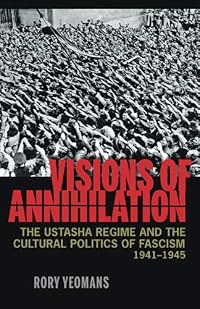
Visions of Annihilation: The Ustasha Regime and the Cultural Politics of Fascism, 1941–1945 (Russian and East European Studies)
by Rory Yeomans
On This Page
Description
The fascist Ustasha regime and its militias carried out a ruthless campaign of ethnic cleansing that killed an estimated half million Serbs, Jews, and Gypsies, and ended only with the defeat of the Axis powers in World War II. In Visions of Annihilation, Rory Yeomans analyzes the Ustasha movement's use of culture to appeal to radical nationalist sentiments and legitimize its genocidal policies. He shows how the movement attempted to mobilize poets, novelists, filmmakers, visual artists, and show more intellectuals as purveyors of propaganda and visionaries of a utopian society. Meanwhile, newspapers, radio, and speeches called for the expulsion, persecution, or elimination of "alien" and "enemy" populations to purify the nation. He describes how the dual concepts of annihilation and national regeneration were disseminated to the wider population and how they were interpreted at the grassroots level. Yeomans examines the Ustasha movement in the context of other fascist movements in Europe. He cites their similar appeals to idealistic youth, the economically disenfranchised, racial purists, social radicals, and Catholic clericalists. Yeomans further demonstrates how fascism created rituals and practices that mimicked traditional religious faiths and celebrated martyrdom. Visions of Annihilation chronicles the foundations of the Ustasha movement, its key actors and ideologies, and reveals the unique cultural, historical, and political conditions present in interwar Croatia that led to the rise of fascism and contributed to the cataclysmic events that tore across the continent. show lessTags
Member Reviews
I came away from this study with rather mixed feelings in terms of what the author has accomplished. While I can respect the sheer labor Yeomans put forth in trawling through the cultural detritus of the Croatian fascist experience I found myself wishing that I had a little more historical context to further my understanding of what was driving the Ustashe. I don't normally think of the royal Yugoslavian state as being a machine for producing urban modernity and secular humanist culture but such was apparently the case if you believe the cultural theorists of the Croatian fascist party. The resulting impression is their fear was that Croatian national character would evaporate before it had the chance to achieve its own essential show more culture; thus justifying the lethal and brutal measures the party instituted once it achieved power. This ties into my other main point I take away from this book in that never have I read such reactionary and bombastic drivel originating from a messianic political movement, at least until we had the example of the American "Alt-Right," it makes one embarrassed to be of Croatian descent. show less
Members
- Recently Added By
Author Information
2 Works 21 Members
Rory Yeomans is a senior international research analyst at the International Directorate of the UK Ministry of Justice.
Classifications
- Genres
- History, Nonfiction, Politics and Government
- DDC/MDS
- 949.72 — History & geography History of Europe Other parts of Europe Former Yugoslavia (Bosnia and Herzegovina ∙ Croatia ∙ Kosovo ∙ Montenegro ∙ Macedonia ∙ Serbia ∙ Slovenia) [formerly also Bulgaria] Croatia
- LCC
- DR1591 .Y46 — History of Europe, Asia, Africa and Oceania Balkan Peninsula History of Balkan Peninsula Yugoslavia Local history and description Croatia
- BISAC
Statistics
- Members
- 12
- Popularity
- 1,869,432
- Reviews
- 1
- Rating
- (3.50)
- Languages
- English
- Media
- Paper, Ebook
- ISBNs
- 2