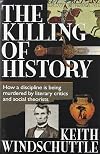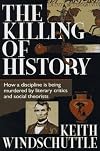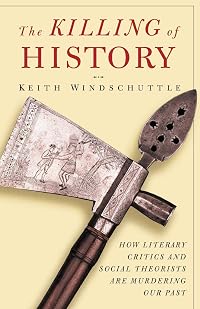
The Killing of History
by Keith Windschuttle
On This Page
Description
For 2,500 years, since the time of Herodotus and Thucydides, historians have sought to record the truth about the past. Today, however, the discipline is suffering a potentially lethal attach from the rise to prominence of an array of French-inspired literary and social theories, each of which denies that truth and knowledge about the past are possible. These theories claim the central point on which history was founded no longer holds: there is no fundamental distinction between history and show more myth or between history and fiction. Historians in classrooms from Berkeley to Paris have embraced these views, and an increasing number of literary critics and social theorists now feel free to define their own work as history and to call themselves historians. The result is revolutionary: historians have not only changed how history is taught, they are also increasingly obscuring the very facts on which the truth must be built. In The Killing of History, Keith Windschuttle offers both a devastating expose of the absurdity of these developments and a defense of the integrity of Western intellectual traditions which are now so widely attacked. Windschuttle examines exactly what is being taught about Columbus' discovery of the New World; the history of asylums and prisons in Europe; the fall of Communism in 1989; and the Battle of Quebec in 1759. He offers a much needed defense of traditional history as a properly scientific endeavor and argues that the great works of history should still be regarded as among the finest forms of Western literature. show lessTags
Recommendations











Member Reviews
Interesting polemic denouncing the damage caused to history as a discipline by tendencies more interested in promoting a given discourse than in studying the facts (mainly postmodernism and poststructuralism). Windschuttle not only responds adequately to his arguments but also exposes them with the clarity that the refuted rarely practice. Although several years have passed since its initial publication, its validity only has increased (Specially with the aggravation of the problem in these post-truth times)
Keith Windschuttle takes a number of modern fads in history, most descended from literary theory, and attempts to show how incoherent and damaging they are to the discipline of history. Windschuttle takes on semiotics, structuralism, poststructuralism, postmodernism, relativism, and so on. He does this primarily by attacking the faulty research of these practitioners, their illogical conclusions, then he tries to trounce their philosophical underpinnings.
All in all, he does a fine job, though the relativists and postmodernists he attacks will state that the "logic" he uses is provincial and Western, thus, not to be trusted. I have to deal with such ideas all the time in pursuing my Ph.D. in history. People like Foucault and Said are show more worshiped mainly because they attack the establishment, which means anything Western, Christian, conservative, or capitalist (four things which define me). Windschuttle makes many arguments against these people, which I will not go into here.
To allay fears that this is not, as many on Amazon claim, just a "right-wing" screed or hit piece, he attacks one of the beloved figures in "right-wing" historiography: Fukuyama. Why? Fukuyama used Marx's beloved Hegel to attack Marx, but Windschuttle hates any grand over-arching theory, Hegel included, even when supportive of the West.
A problem, though, Windschuttle does not acknowledge that these theorists, however odious, do bring something to the table. Postmodernists and structuralists do make the valid point that everybody, no matter how hard they try, is biased. It is only when they use this point to attack everything that they hate that it becomes silly. It is when they attack the historical heroes of the past, say Washington, turning him from a demi-god to nothing but pure evil. It is when they, as an example J. B. Harley, "cartographic postmodernist," goes about highlighting the motes in other eyes and ignoring the beams in his own. (Ah, how oppressive and culturally biased of me, so typically Western, to allude to the Gospels!) But Windschuttle too does not offer any philosophy in exchange for the ones he attacks, and seems to intimate that an objective, factual history is possible. While I think, in some ways, it can be possible, he offers no philosophical reasoning behind it.
Thus, four stars. Still, I believe that this is an important book, and should be assigned in historical methods courses alongside books by the like of Keith Jenkins, and others. show less
All in all, he does a fine job, though the relativists and postmodernists he attacks will state that the "logic" he uses is provincial and Western, thus, not to be trusted. I have to deal with such ideas all the time in pursuing my Ph.D. in history. People like Foucault and Said are show more worshiped mainly because they attack the establishment, which means anything Western, Christian, conservative, or capitalist (four things which define me). Windschuttle makes many arguments against these people, which I will not go into here.
To allay fears that this is not, as many on Amazon claim, just a "right-wing" screed or hit piece, he attacks one of the beloved figures in "right-wing" historiography: Fukuyama. Why? Fukuyama used Marx's beloved Hegel to attack Marx, but Windschuttle hates any grand over-arching theory, Hegel included, even when supportive of the West.
A problem, though, Windschuttle does not acknowledge that these theorists, however odious, do bring something to the table. Postmodernists and structuralists do make the valid point that everybody, no matter how hard they try, is biased. It is only when they use this point to attack everything that they hate that it becomes silly. It is when they attack the historical heroes of the past, say Washington, turning him from a demi-god to nothing but pure evil. It is when they, as an example J. B. Harley, "cartographic postmodernist," goes about highlighting the motes in other eyes and ignoring the beams in his own. (Ah, how oppressive and culturally biased of me, so typically Western, to allude to the Gospels!) But Windschuttle too does not offer any philosophy in exchange for the ones he attacks, and seems to intimate that an objective, factual history is possible. While I think, in some ways, it can be possible, he offers no philosophical reasoning behind it.
Thus, four stars. Still, I believe that this is an important book, and should be assigned in historical methods courses alongside books by the like of Keith Jenkins, and others. show less
Post-Modernism is once again the culprit in the destruction of standards as they apply to the study and writing of history. Highly critical of the whole enterprise of literary theory and how its incoherence has caused irreparable damage to western culture.
Gives a very clear explanation of all the post-modern theories of culture and history, and explains why their influence on historians has effectively destroyed objective historical research and writing.
Although written 20 years ago, the text is not dated; if anything, it is even more applicable.
Describes semiotics, structuralism, ethnohistory, poststructuralism, anti-humanism, post-history, postmodernism, relativism, hermeneutics, induction.
For those not inclined to wade through the weeds, chapter 7 is the most important.
Note to self: page 144 relates to a post on Neoneocon. com of 2017-11-06.
Although written 20 years ago, the text is not dated; if anything, it is even more applicable.
Describes semiotics, structuralism, ethnohistory, poststructuralism, anti-humanism, post-history, postmodernism, relativism, hermeneutics, induction.
For those not inclined to wade through the weeds, chapter 7 is the most important.
Note to self: page 144 relates to a post on Neoneocon. com of 2017-11-06.
There are many excesses and absurdities in postmodern theory, as there are in any other academic movement or endeavor. However, Windshuttle in this book merely shows himself either disingenuous or incapable of reading. If you were to follow his prescriptions to their logical extent, no historian's work would ever be acceptable.
A critique of social and historical theory written from the right.
香港大學歷史系
Members
- Recently Added By
Author Information

21+ Works 475 Members
Keith Windschuttle has been a lecturer in history, social policy, and media studies at the University of New South Wales and other Australian academic institutions
Common Knowledge
- Canonical title
- The Killing of History
- Original publication date
- 1996
- First words
- History is an intellectual discipline more than 2400 years old.
- Last words
- (Click to show. Warning: May contain spoilers.)The preservation of this intellecutal heritage is what ultimately is at stake in the current contest over the status of history.
Classifications
Statistics
- Members
- 337
- Popularity
- 93,920
- Reviews
- 7
- Rating
- (3.65)
- Languages
- English
- Media
- Paper
- ISBNs
- 4