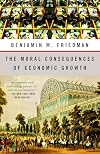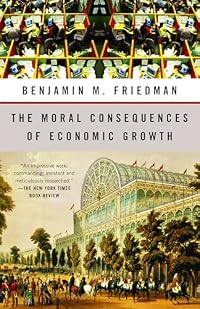
The Moral Consequences of Economic Growth
by Benjamin M. Friedman
On This Page
Description
""Are we right," Benjamin M. Friedman asks, "to care so much about economic growth as we clearly do?" To answer, Friedman reaches beyond economics. He examines the political and social histories of the large Western democracies - particularly of the United States since the Civil War - distinguishing times of generally rising living standards from those of pervasive stagnation to illustrate how rising incomes render a society more open and democratic. He shows, too, how our attitudes toward show more economic growth and its consequences have roots in the thinking of prior centuries, especially the Enlightenment, and also include significant strands of religious influence." "Friedman also delineates the role of economic growth in determining which developing nations extend the broadest freedoms to their citizenry. He makes clear that growth, rather than just the level of living standards, is key to effecting political and social liberalization in the third world. But he also warns that the democratic values of countries even as wealthy as our own are at risk whenever incomes stagnate for extended periods. Merely being rich is no protection against a society's retreat into rigidity and intolerance once enough of its citizens lose the sense that they are getting ahead." "Finally, Friedman shows us why, if America is to strengthen democratic institutions around the world as a bulwark against terrorism and social unrest, we must aggressively pursue growth at home and promote worldwide economic expansion beyond what purely market-driven forces would create. And for the United States, he offers concrete suggestions for policy steps to achieve those objectives."--Jacket. show lessTags
Recommendations











Member Reviews
The basic argument in this book appears to be that periods of good economic growth overlap with relatively benign social and foreign policy. The author goes to great lengths to correlate periods of economic growth with the social-political responses in various regions and countries. While the hypothesis sounds sensible, it does not provide for counter-intuitive or vicious circles of stimulus and response (cause and effect). Since the author is apparently already highly committed to his theory, he tends to bring up examples that support his thesis, while glossing over inconsitencies as random exceptions. The most cited example of his thesis is, of course, the way post-World War I Germany was pushed into dictatorship and mass genocide by show more the harshness of the war reparations; or so the popular perception goes. This begs the question of the personal culpability of the individual leaders and demogogues like Hitler. The thesis is that certain economic conditions will necessarily throw up such political forces, leading to a less liberal and tolerant regime.
We can, however, think of mainstream examples that seem to portray the opposite of the thesis. For instance, it was as a response to the suffering of the Great Depression in the 1930s that the New Deal and the welfare state was thought up in America. It was as a reaction to the excesses of authoritarian rule that the welfare state was conjured in the post-World War II period. On the other hand, period of continuous growth and prosperity may lead to increasin belligerancy and hubris and the military state, as is the popular perception, for instance, of the resurgent Chinese state, or even of the rise of more authoritarian, less tolerant regimes in many democracies across the world. The book serves as a valable record of the economic and social record of the post-War world; it would, perhaaps, have read better were it not hobbled by the author's pre-conceived theory. show less
We can, however, think of mainstream examples that seem to portray the opposite of the thesis. For instance, it was as a response to the suffering of the Great Depression in the 1930s that the New Deal and the welfare state was thought up in America. It was as a reaction to the excesses of authoritarian rule that the welfare state was conjured in the post-World War II period. On the other hand, period of continuous growth and prosperity may lead to increasin belligerancy and hubris and the military state, as is the popular perception, for instance, of the resurgent Chinese state, or even of the rise of more authoritarian, less tolerant regimes in many democracies across the world. The book serves as a valable record of the economic and social record of the post-War world; it would, perhaaps, have read better were it not hobbled by the author's pre-conceived theory. show less
This is a thick book with small print, and I must admit, I wondered if I would get through it. Sounded really dry and academic, but my non-fiction book club was reading it. I was pleasantly surprised to find it so engaging.
The author explores the relationship between economic progress and moral progress: do they go together? Yes, they do. But how exactly? Does economic progress result from morality? Or is it a demonstration or proof of morality? Or does it foster morality? These are the key questions examined in the context of the United States and three European countries.
There are a few instances where the author may have overstated his case. For example, on page 345, he states taht high income countries where freedom and democracy show more are well developed are at risk if incomes stagnate. Maybe in emerging democracies, but in Canada? I doubt it.
The policy prescriptions at the end of the book are its weakest part. Having read many books on public policy and almost always having this view, I believe academics/authors would provide more value by properly framing the important issues to be addressed and leaving the policy development work to policy makers. The author doesn't seem to understand how governments act. At times, government is completely absent from the analysis, yet all the "solutions" are based on government action. Cultural and religious contexts are also missing from the analysis of morality, which is never defined.
The author's blending of psychology with economic analysis is the strength of this book; it is the innovative idea, at least for me. The book is well researched and easy to read. show less
The author explores the relationship between economic progress and moral progress: do they go together? Yes, they do. But how exactly? Does economic progress result from morality? Or is it a demonstration or proof of morality? Or does it foster morality? These are the key questions examined in the context of the United States and three European countries.
There are a few instances where the author may have overstated his case. For example, on page 345, he states taht high income countries where freedom and democracy show more are well developed are at risk if incomes stagnate. Maybe in emerging democracies, but in Canada? I doubt it.
The policy prescriptions at the end of the book are its weakest part. Having read many books on public policy and almost always having this view, I believe academics/authors would provide more value by properly framing the important issues to be addressed and leaving the policy development work to policy makers. The author doesn't seem to understand how governments act. At times, government is completely absent from the analysis, yet all the "solutions" are based on government action. Cultural and religious contexts are also missing from the analysis of morality, which is never defined.
The author's blending of psychology with economic analysis is the strength of this book; it is the innovative idea, at least for me. The book is well researched and easy to read. show less
Attempts to demonstrate that economic growth leads to morally-favourable outcomes for society. Does so in part by defining 'moral consequences' in a way that makes them increasingly synonymous with 'economic growth' - making his argument somewhat tautological.
The rest of Friedman's claims hinge on correlation not causation, and the book is appended with a chapter entitled 'Great Depression, Great Exception' - which acknowledges that the largest period of economic regression in modern history does not follow his model.
Nevertheless - well-written, detailed and thorough, if a little uninspiring at times.
The rest of Friedman's claims hinge on correlation not causation, and the book is appended with a chapter entitled 'Great Depression, Great Exception' - which acknowledges that the largest period of economic regression in modern history does not follow his model.
Nevertheless - well-written, detailed and thorough, if a little uninspiring at times.
Well argued. Develops the historical and psychological background for the argument that economic growth is a near requirement for the creation of a more "moral", free and open society. Sometimes weak when the author leaves US history where he is obviously more comfortable. The final section makes some half-hearted policy prescriptions primarily for US fiscal policy to stimulate future growth and is quite lightweight when compared to the rest of the book.
Interesting hypothesis: relates economic growth to development of personal liberties. The big exception to this theory in the modern world is China, but one can see how tenuous their economic growth might be, not to mention push for personal liberties. Interesting and useful theory.
Purchased at Half Price on 7/28 for 18$.
Ratings
Members
- Recently Added By
Author Information
10 Works 579 Members
Classifications
- Genres
- Economics, Nonfiction, General Nonfiction, History, Philosophy, Politics and Government, Business
- DDC/MDS
- 174 — Philosophy and Psychology Ethics Occupational ethics
- LCC
- HD82 .F7168 — Social sciences Industries. Land use. Labor Industries. Land use. Labor Economic growth, development, planning
- BISAC
Statistics
- Members
- 325
- Popularity
- 97,511
- Reviews
- 6
- Rating
- (3.68)
- Languages
- 5 — English, Hungarian, Italian, Portuguese, Swedish
- Media
- Paper, Ebook
- ISBNs
- 7
- ASINs
- 2