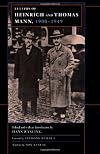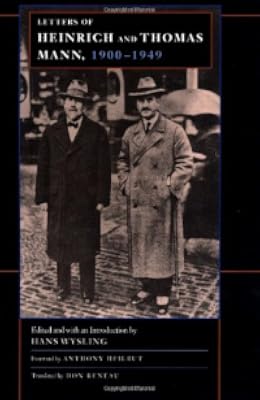
The Letters of Heinrich and Thomas Mann, 1900-1949 (Weimar and Now: German Cultural Criticism, No 12)
by Thomas Mann  , Heinrich Mann (Author)
On This Page
Description
Few figures in twentieth-century literary life enjoyed such a stormy sibling relationship as the brothers Thomas and Heinrich Mann. This book, the first complete English-language translation of their correspondence, provides an introduction to the intimate details of their personal and professional lives. From their differing views on the First World War and the question of Germany's future after the Second to the intense rivalry that accompanied their experiences of literary success, Thomas show more and Heinrich Mann were brothers whose relationship was marked by intense conflict and complex ties of loyalties. Moving from Germany at the turn of the century to their American exile in Princeton and Los Angeles in the 1930s, their letters portray their struggle as novelists and socially engaged intellectuals to apprehend the momentous historical changes in Germany and their experience of American exile. show lessTags
Recommendations























Member Reviews
An important book demonstrating the importance of the neglected Heinrich Mann. His political views were far better than his famous brother.
Ratings
Members
- Recently Added By
Author Information

946+ Works 51,369 Members
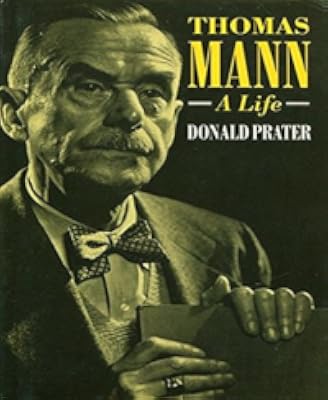
Thomas Mann was born into a well-to-do upper class family in Lubeck, Germany. His mother was a talented musician and his father a successful merchant. From this background, Mann derived one of his dominant themes, the clash of views between the artist and the merchant. Mann's novel, Buddenbrooks (1901), traces the declining fortunes of a merchant show more family much like his own as it gradually loses interest in business but gains an increasing artistic awareness. Mann was only 26 years old when this novel made him one of Germany's leading writers. Mann went on to write The Magic Mountain (1924), in which he studies the isolated world of the tuberculosis sanitarium. The novel was based on his wife's confinement in such an institution. Doctor Faustus (1947), his masterpiece, describes the life of a composer who sells his soul to the devil as a price for musical genius. Mann is also well known for Death in Venice (1912) and Mario the Magician (1930), both of which portray the tensions and disturbances in the lives of artists. His last unfinished work is The Confessions of Felix Krull, Confidence Man (1954), a brilliantly ironic story about a nineteenth-century swindler. An avowed anti-Nazi, Mann left Germany and lived in the United States during World War II. He returned to Switzerland after the war and became a celebrated literary figure in both East and West Germany. In 1929 he was awarded the Nobel Prize for literature. (Bowker Author Biography) show less
Thomas Mann has a Legacy Library. Legacy libraries are the personal libraries of famous readers, entered by LibraryThing members from the Legacy Libraries group.

Heinrich Mann wrote about artists and poets and voluptuaries, for whom art is a "perverse debauch." His novels set in Germany are usually grotesque caricatures with political implications; those set in Italy tend to be feverish riots of experience in an amoral world. His "Professor Unrat" (1905) was made into the famous film "The Blue Angel." "The show more Little Town" (1909) is perhaps his most benign novel. Heinrich Mann, like his brother Thomas Mann, fled Nazi Germany and came to the United States. His literary reputation is strongest in Europe. In the United States, his reputation is clouded partly by the rancor of his brilliant, hectic prose and partly by his admiration of the former Soviet Union. (Bowker Author Biography) show less
All Editions
Series
Belongs to Publisher Series
Classifications
- Genres
- Fiction and Literature, Literature Studies and Criticism
- DDC/MDS
- 833.912 — Literature & rhetoric German & related literatures German fiction 1900- 1900-1990 1900-1945
- LCC
- PT2625 .A44 .Z485 — Language and Literature German, Dutch and Scandinavian literatures German literature Individual authors or works 1860/70-1960
- BISAC
Statistics
- Members
- 27
- Popularity
- 1,012,575
- Reviews
- 1
- Rating
- (4.00)
- Languages
- English, German
- Media
- Paper
- ISBNs
- 2