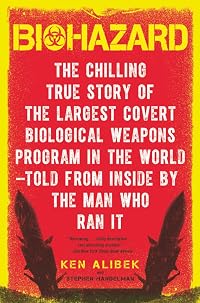
Biohazard: The Chilling True Story of the Largest Covert Biological Weapons Program in the World--Told from Inside by the Man Who Ran It
by Ken Alibek
On This Page
Description
Describes the massive Soviet Cold War effort to manufacture, stockpile, and deploy biological weapons. Publisher description: For fifty years, while the world stood in terror of a nuclear war, Russian scientists hidden in heavily guarded secret cities refined and stockpiled a new kind of weapon of mass destruction--an invisible weapon that would strike in silence and could not be traced. It would leave hundreds of thousands dead in its wake and would continue to spread devastation long after show more its release. The scientists were bioweaponeers, working to perfect the tools of a biological Armageddon. They called it their Manhattan Project. It was the deadliest and darkest secret of the cold war. What you are about to read has never before been made public. Ken Alibek began his career as a doctor wanting to save lives and ended up running the Soviet biological weapons program--a secret military empire masquerading as a pharmaceutical company. At its peak, the program employed sixty thousand people at over one hundred facilities. Seven reserve mobilization plants were on permanent standby, ready to produce hundreds of tons of plague, anthrax, smallpox, and Venezuelan equine encephalitis, to name only a few of the toxic agents bred in Soviet labs. Almost every government ministry was implicated, including the Academy of Sciences and the KGB. Biohazard is a terrifying, fast-paced account of tests and leaks, accidents and disasters in the labs, KGB threats and assassinations. The book is full of revelations--evidence of biowarfare programs in Cuba and India, actual deployments at Stalingrad and in Afghanistan, experiments with mood-altering agents, a contingency plan to attack major American cities, and the true story behind the mysterious anthrax outbreak in Sverdlovsk. But beyond these is a twisted world of lies and mirrors, and the riveting parable of the greatest perversion of science in history. No one knows the actual capabilities of biological weapons better than Dr. Alibek. Many of the scientists who worked with him have been lured away from low-paying Russian labs to rogue regimes and terrorist groups around the world. In our lifetime, we will most likely see a terrorist attack using biological weapons on an American city. Biohazard tells us--in chilling detail--what to expect and what we can do. Not since Arthur Koestler's Darkness at Noon has there been such a book--a report from inside the belly of the beast. show lessTags
Recommendations





Member Reviews
Kanatjan Alibekov has done some horrible things. Most notably creating a formidable strain of weaponized anthrax, but that is a mere droplet in the aerosolized mist of Alibekov's shady past. You would think his memoir, recounting his rise through the ranks of the Soviet biological warfare program, would be an eye-opening, jaw-dropping, awe-inducing read...right? Most absurdly, it wasn't.
The first noticeable problem with the book was the writing. It just wasn't good. While the book was touted as reading 'like a thriller,' it jumped around in time so much I struggled forming a timeline in my head of what was happening when. Alibekov has delivers the events of his previous life, which should be astonishing, in such a dry and bland cadence show more that I found the book rather boring. This is not what I expected considering the topic, and who it was written by.
Another problem is Alibekov's lack of detail. He frequently tells you he was weaponizing this and tinkering with that, but he alludes to it such an distant, emotionless manner that it didn't feel all that significant. I've never read a book about the engineering of biological weapons and found myself shrugging noncommittally, but there was just no passion in this book, and I found msyelf dissinterested.
The author also spends a lot of time guessing at things he doesn't know about. Suspicious deaths, what other people might be doing in other labs, why his leaders want biological agents, etc. He should have plenty to say about himself, but he spends much more time theorizing and hinting at things he had no part in.
The oddest part is, I didn't learn much. How can that happen? Granted I've read a quite a bit on this particular topic, but this is a book about a secret biowarfare program that few people have written about, and written by the man who was at the head of it all. How can I go through 300 pages of that and not learn something new? The only thing I learned about was Russian politics, and that was credited to someone else in the Acknowledgements section.
So...what does Kanatjan Alibekov have to offer here? Strangely, it seems not a whole lot. Yes, there is an occasional shocking detail here and there, but overall I felt very unenlightened. The book didn't carry the impact I expected, and I'm just finding myself nonplussed by the whole thing. Disappointing. show less
The first noticeable problem with the book was the writing. It just wasn't good. While the book was touted as reading 'like a thriller,' it jumped around in time so much I struggled forming a timeline in my head of what was happening when. Alibekov has delivers the events of his previous life, which should be astonishing, in such a dry and bland cadence show more that I found the book rather boring. This is not what I expected considering the topic, and who it was written by.
Another problem is Alibekov's lack of detail. He frequently tells you he was weaponizing this and tinkering with that, but he alludes to it such an distant, emotionless manner that it didn't feel all that significant. I've never read a book about the engineering of biological weapons and found myself shrugging noncommittally, but there was just no passion in this book, and I found msyelf dissinterested.
The author also spends a lot of time guessing at things he doesn't know about. Suspicious deaths, what other people might be doing in other labs, why his leaders want biological agents, etc. He should have plenty to say about himself, but he spends much more time theorizing and hinting at things he had no part in.
The oddest part is, I didn't learn much. How can that happen? Granted I've read a quite a bit on this particular topic, but this is a book about a secret biowarfare program that few people have written about, and written by the man who was at the head of it all. How can I go through 300 pages of that and not learn something new? The only thing I learned about was Russian politics, and that was credited to someone else in the Acknowledgements section.
So...what does Kanatjan Alibekov have to offer here? Strangely, it seems not a whole lot. Yes, there is an occasional shocking detail here and there, but overall I felt very unenlightened. The book didn't carry the impact I expected, and I'm just finding myself nonplussed by the whole thing. Disappointing. show less
A bit dated, this insider story from a defector high up in the Soviet biological weapons program details his career and Soviet advances with anthrax, plague, glanders, etc. Most dramatic moments come around a lethal hot zone infection and an Aral sea island where chained monkeys proved unfortunate test subjects. Most interestingly to me was the insider's view of the 1991 Soviet coup d'état attempt and the disruption of the Soviet state that followed, ultimately leading to the Kazakh's informal emigration to the U.S.
Well told history and description of the covert Soviet bioweapons program by someone who was a part of it.
Credible and terrifying account by former leading Soviet bioweapons scientist.
An in-depth book about the Soviet Union / Russia's bioweapons program, written by a man who was there.
ein Alptraum
Jul 7, 2014German
Ratings
Members
- Recently Added By
Author Information

5 Works 539 Members
All Editions
Common Knowledge
- Original publication date
- 1999
- Epigraph
- (We are) determined for the sake of all mankind, to exclude completely the possibility of bacteriological agents and toxins being used as weapons;
(We are) convinced that such use would be repugnant to the conscience ... (show all)of mankind and that no effor should be spared to minimize this risk...
-Preamble to the biological and Toxin Weapons Convention, 1972 - First words
- Late in the winter of 1988, I was called to a meeting at Soviet army headquarters on Kirov Street in Moscow.
- Blurbers
- Cook, Robin; Preston, Richard; Peters, C. J.
Classifications
- Genres
- Nonfiction, General Nonfiction, Science & Nature, History
- DDC/MDS
- 358 — Society, government, & culture Public administration & military science Air and other specialized forces and warfare; engineering and related services
- LCC
- UG447.8 .A45 — Military Science Military engineering. Air forces Military engineering Attack and defense. Siege warfare
- BISAC
Statistics
- Members
- 527
- Popularity
- 56,718
- Reviews
- 6
- Rating
- (3.83)
- Languages
- Czech, English, Polish
- Media
- Paper, Ebook
- ISBNs
- 10
- ASINs
- 3