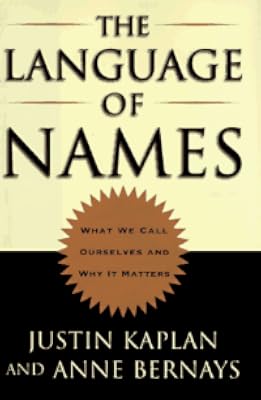
The Language of Names: What We Call Ourselves and Why It Matters
by Justin Kaplan, Anne Bernays
On This Page
Description
A history of names and naming drawn from social and literary accounts, psychology, and anthropology, discussing how names can define class structure, ethnic and religious practices, manners, and everyday life, and argues that one's name is inextricably bound to personality, character, and role.Tags
Recommendations



































Member Reviews
See, now, this could have been a pretty good book. It had a lot of interesting chapters, even if they tended to skim the surface of what initially promised to be a rather fascinating subject. But it's a BIG subject, and the book is relatively short, so you know...one shouldn't expect too much. It's interesting to read about names and social structures...and names and their mystical power...character names in literature. All that was cool, and I was enjoying it. But then, dear me, they got to the chapter on (whisper it) MAIDEN names.
Holy crap, what is up with Anne Bernays? Apparently, if you give up your maiden name and take your husband's name YOU HAVE TOTALLY GIVEN IT TO THE MAN, you silly oppressed boot-licker, you. Um, is it just me? show more Or did it escape Darling Anne's notice that a maiden name is actually the name of the woman's FATHER? And that there isn't a whole lot of difference (oppression-wise) between carrying your daddy's name or your sweetie's name? Apparently, for Anne, the very notion of taking Justin's last name was an agonizing blow to her WHOLE IDENTITY(which must be very loosely anchored indeed).
WhatEVER. The rest of the book was not insanely ideological. I guess she needed to blow off steam somewhere. Maybe Justin is a big pain in the neck and never washes the dishes and drops his dirty underwear on the floor. show less
Holy crap, what is up with Anne Bernays? Apparently, if you give up your maiden name and take your husband's name YOU HAVE TOTALLY GIVEN IT TO THE MAN, you silly oppressed boot-licker, you. Um, is it just me? show more Or did it escape Darling Anne's notice that a maiden name is actually the name of the woman's FATHER? And that there isn't a whole lot of difference (oppression-wise) between carrying your daddy's name or your sweetie's name? Apparently, for Anne, the very notion of taking Justin's last name was an agonizing blow to her WHOLE IDENTITY(which must be very loosely anchored indeed).
WhatEVER. The rest of the book was not insanely ideological. I guess she needed to blow off steam somewhere. Maybe Justin is a big pain in the neck and never washes the dishes and drops his dirty underwear on the floor. show less
Interesting but not overwhelming; perhaps the examples rolled on beyond what was necessary and kept going beyond what was tolerable; the sub-title conveys that "what we call ourselves" matters and that point is made; however then it's made again and again with a lot of subtle political agenda along the way. Summary: presents some novel message, but definitely not a must-read.
The focus of The Language of Names is far narrower than the rather grandiose title suggests, though a careful reading of the back cover copy (which mentions "contemporary society") would reveal its limitations. There are a lot of interesting questions about names to be explored: that no culture has ever been encountered that doesn't use them (and indeed, there are indications that some species of whales and dolphins use some form of individual identifiers); the development of last names rather than patronymics or ad-hoc identifiers based on occupation or location; the wide variation in the number of names available in different cultures (we all know that most Koreans are named Kim, Park, or Lee, but why?); and other anthropological show more questions. Unfortunately, this book answers none of those questions.
Instead, it explores a set of situations rather narrowly confined to modern American naming practices -- immigrants Anglicizing their names (though no discussion of how and why this has fallen out of favor in the last century), celebrities changing theirs, and the deep ire with which many men view the apparently shocking practice of women choosing not to change their names upon marriage. Overall, the book read like a somewhat padded magazine article -- an okay way to pass the time, but not worth seeking out. show less
Instead, it explores a set of situations rather narrowly confined to modern American naming practices -- immigrants Anglicizing their names (though no discussion of how and why this has fallen out of favor in the last century), celebrities changing theirs, and the deep ire with which many men view the apparently shocking practice of women choosing not to change their names upon marriage. Overall, the book read like a somewhat padded magazine article -- an okay way to pass the time, but not worth seeking out. show less
Ratings
Members
- Recently Added By
Author Information

18+ Works 2,073 Members
Justin Kaplan was born in Manhattan, New York on September 5, 1925. He received a bachelor's degree in English from Harvard University, followed by graduate work in the field there, but he left before earning a doctorate to work as a freelance writer and book editor. His first book, Mr. Clemens and Mark Twain, won the Pulitzer Prize for biography show more in 1967 and a National Book Award. His other works include Lincoln Steffens: A Biography, When the Astors Owned New York: Blue Bloods and Grand Hotels in a Gilded Age, and Walt Whitman: A Life, which won a National Book Award. He also wrote books with his wife Anne Bernays including The Language of Names and Back Then: Two Lives in 1950s New York. He was the editor of Bartlett's Familiar Quotations. He died from complications of Parkinson's disease on March 2, 2014 at the age of 88. (Bowker Author Biography) show less

Common Knowledge
- Canonical title
- The Language of Names: What We Call Ourselves and Why It Matters
- Original publication date
- 1997-02-07
Classifications
Statistics
- Members
- 176
- Popularity
- 184,695
- Reviews
- 3
- Rating
- (3.34)
- Languages
- English
- Media
- Paper
- ISBNs
- 2