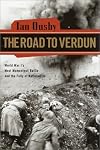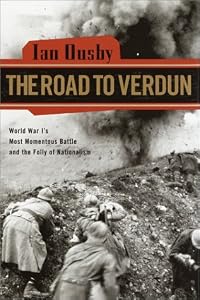
The Road to Verdun: World War I's Most Momentous Battle and the Folly of Nationalism
by Ian Ousby
On This Page
Description
This work gives a vivid account of the generals' planning and the troops' suffering in the largest, longest and bloodiest battle of World War I. It challenges the narrow horizons of military history and should challenge the reader's view of France, and the very nature of warfare.Tags
Recommendations










Member Reviews
How was a battle like Verdun possible? The question has been answered often in its political, military, and technological aspects, but here [a:Ian Ousby|174858|Ian Ousby|https://s.gr-assets.com/assets/nophoto/user/m_50x66-82093808bca726cb3249a493fbd3bd0f.png] sets out to find its social origins.
At first this might sound odd, but consider that about 70% of the French army was rotated through the meat grinder of Verdun during the battle of February to December 1916 with at least 150,000 dying there and leaving the front line little changed. Why did men put themselves through this?
We know that politics and the alliance with Russia brought France into the war. We know that the military movements of August and September 1914 gave the front show more line its shape and gave the allies the poisoned chalice of the initiative. We also know that developments in military technology in preceding decades had given the advantage on the battlefield to the defence.
But what drove men forward into hails of machine gun fire time and time again? Why did men living with the permanent possibility of vapourisation by artillery shell not break in greater numbers than they did? These questions are less explored and Ousby goes searching for the answers in an examination of French social life from the Franco-Prussian War to 1916.
Ousby's book, his last before his early death, is a bold and fascinating thrust into new ground on the historiography of the battle and the war itself. show less
At first this might sound odd, but consider that about 70% of the French army was rotated through the meat grinder of Verdun during the battle of February to December 1916 with at least 150,000 dying there and leaving the front line little changed. Why did men put themselves through this?
We know that politics and the alliance with Russia brought France into the war. We know that the military movements of August and September 1914 gave the front show more line its shape and gave the allies the poisoned chalice of the initiative. We also know that developments in military technology in preceding decades had given the advantage on the battlefield to the defence.
But what drove men forward into hails of machine gun fire time and time again? Why did men living with the permanent possibility of vapourisation by artillery shell not break in greater numbers than they did? These questions are less explored and Ousby goes searching for the answers in an examination of French social life from the Franco-Prussian War to 1916.
Ousby's book, his last before his early death, is a bold and fascinating thrust into new ground on the historiography of the battle and the war itself. show less
Ratings
Members
- Recently Added By
Author Information
14 Works 1,496 Members
Common Knowledge
- Original publication date
- 2002
- Important places
- Verdun, Meuse, Grand-Est, France; France
- Important events
- World War I (1914 | 1918); Battle of Verdun (1916-02-21 | 1916-12-20)
Classifications
Statistics
- Members
- 277
- Popularity
- 115,834
- Reviews
- 1
- Rating
- (3.60)
- Languages
- Dutch, English, Italian, Swedish
- Media
- Paper, Ebook
- ISBNs
- 10
- ASINs
- 6