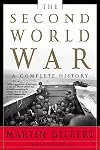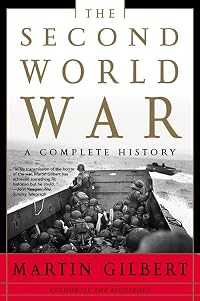
The Second World War: A Complete History
by Martin Gilbert
On This Page
Description
In the hands of master historian Martin Gilbert, the complex and compelling story of the Second World War comes to life. This narrative captures the perspectives of leading politicians and war commanders, journalists, civilians, and ordinary soldiers, offering gripping eyewitness accounts of heroism, defeat, suffering, and triumph. This is one of the first historical studies of World War II that describes the Holocaust as an integral part of the war. It also covers maneuvers, strategies, and show more leaders operating in European, Asian, and Pacific theatres. In addition, this book brings in survivor testimonies of occupation, survival behind enemy lines, and the experience of minority groups such as the Roma in Europe, to offer a comprehensive account of the war's impact on individuals on both sides. This is a sweeping narrative of one of the most deadly wars in history, which took almost forty million lives, and irrevocably changed countless more. show lessTags
Recommendations













Member Reviews
Gilbert's history of world war 2 should be the first choice of anyone not only interested in the military campaigns but also in the social atmosphere of the times. He is amazing in his ability and willingness to blend the two into this amazing narrative of possibly the largest human undertaking in history. I was enthralled from beginning to end. The story really comes alive. The refreshing thing is that it's not just told through the stories of the big names that we all know, much of it is seen from the perspective of everyday folks like you and me caught up in the whirlwind. An impressive work through and through.
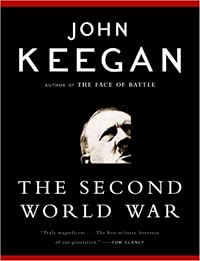
If you are looking for a more strictly military history of the war try John Keegan's book by the same name.
If you are looking for a more strictly military history of the war try John Keegan's book by the same name.
Gilbert's a very able historian of WWII and his choice to follow a strict, day by day, chronological approach was obviously very conscious, but it's also a serious flaw. I think he chose it primarily to bring out details and maintain focus on Nazi atrocities large and small, and those of the German army generally, as well as those of Imperial Japan. It works, to the point where it gets tiresome for me, and that’s because it so badly interferes with coherent historical narrative. Maybe more importantly, it contributes to this preposterously subtitled “complete” history of the war having large gaps in important areas. The battles for Stalingrad and St. Petersburg, for example, are so chopped up that it’s hard to pull the disparate show more pieces together. But they’re nevertheless covered reasonably well; we’re never told how and when German forces got into Italy, in what numbers, formations, with what materiel, etc. The Pacific war is particularly chopped up, and you’ll have to go elsewhere to get any clarity or detail about what was happening on the east Asian mainland.
To be fair, Gilbert certainly knew the weaknesses inherent in his approach and he surely chose it knowingly. It is too easy to think of the Holocaust as an abstraction, and a sanitized one, and to use that abstraction to avoid thinking about its true horrors, about the very human depths of evil involved, and about all the other atrocities and evils that weren’t part of the plan to eliminate European Jewry. Apparently, cutting through this tendency was Gilbert’s first, second and third priority. He probably succeeded, but that precluded producing a good history of the war. For me, that’s unfortunate. The book has its place, and a valuable one, but it misrepresents itself. It probably should have let the context of the war be more of a background to the book’s primary focus, allowing the author to both focus more on the atrocities and not pretend to be presenting a solid history of the war. I wouldn’t suggest this book to anyone who hasn’t read a couple other good histories of WWII. As a footnote, it does have many very good maps, which similar books often don’t have. show less
Wow! What a terrible, horrific, bloody, incomprehensible, period of world history. The book gives almost a day by day account from the war's beginning, with the military/racial conquests of Nazi Germany, to the long lasting effects years later. It really re-defines what human beings are possible of, from the extremes of unthinkable brutality, and lack of conscience and respect for human life, to the amazing perseverance of people of many races, and from many countries, facing unthinkable pain, loss, and odds.
An amazing overview of the whole conflict, I would recommend this book to everyone, to bring to light what this huge part of our recent history was about, the sacrifices and trials involved, and to gain from it, knowledge that show more might help inform our opinions and about right and wrong, what is morally acceptable, both in life, and in current conflicts, and issues that we have a say in.
There were many times during Hitler's rise to power, where situations could have been turned, and years of strife, been avoided. Hitler preyed upon people's fears, promoted hate, and justified morally unthinkable acts in the name of a political and racial ideology. It's sad to see people today, promoting causes in the same ways. Why can't we learn?
There are a couple quotes that have stuck with me, ones that ring true in current politics, both in the nationally, and internationally, that I think speak volumes about the WWII era, as well as current times:
“The great mass of people will more easily fall victim to a big lie than to a small one.” --Adolf Hitler --
“All you have to do is tell them they are being attacked, and denounce the pacifists for lack of patriotism and exposing the country to danger. It works the same in any country.” --Hermann Goering-- show less
An amazing overview of the whole conflict, I would recommend this book to everyone, to bring to light what this huge part of our recent history was about, the sacrifices and trials involved, and to gain from it, knowledge that show more might help inform our opinions and about right and wrong, what is morally acceptable, both in life, and in current conflicts, and issues that we have a say in.
There were many times during Hitler's rise to power, where situations could have been turned, and years of strife, been avoided. Hitler preyed upon people's fears, promoted hate, and justified morally unthinkable acts in the name of a political and racial ideology. It's sad to see people today, promoting causes in the same ways. Why can't we learn?
There are a couple quotes that have stuck with me, ones that ring true in current politics, both in the nationally, and internationally, that I think speak volumes about the WWII era, as well as current times:
“The great mass of people will more easily fall victim to a big lie than to a small one.” --Adolf Hitler --
“All you have to do is tell them they are being attacked, and denounce the pacifists for lack of patriotism and exposing the country to danger. It works the same in any country.” --Hermann Goering-- show less
A receita para este excelente livro é uma pitada de tudo e nada em excesso. Assim, tem economia quanto baste, ideologia na medida em que é necessária para explicar os factos, estratégia militar e política porque é disso que afinal se trata, mas também episódios de gente comum que luta, sofre e morre, quer em combate, quer atrás das linhas. Talvez dê demasiada importância aos judeus, mas o autor investigou a questão judaica por isso quis utilizar todo o material disponível.
Por detrás das grandes tendências há dramas humanos que o autor quis revelar. Acho que a História só fica a ganhar. Finalmente, há uma isenção que por vezes até dói. Apesar de tudo, gostei mais do livro do mesmo autor sobre a I Guerra Mundial. show more Pareceu-me mais dramático. Ou talvez fosse porque conheço melhor a história da Segunda Guerra do que a da Primeira. show less
Por detrás das grandes tendências há dramas humanos que o autor quis revelar. Acho que a História só fica a ganhar. Finalmente, há uma isenção que por vezes até dói. Apesar de tudo, gostei mais do livro do mesmo autor sobre a I Guerra Mundial. show more Pareceu-me mais dramático. Ou talvez fosse porque conheço melhor a história da Segunda Guerra do que a da Primeira. show less
Mar 19, 2021Portuguese (Portugal)
Historia general de la II guerra mundial.
I tomo 1939-1942
II tomo 1943-1945
I tomo 1939-1942
II tomo 1943-1945
Feb 24, 2024Spanish
Aria, acqua, terra. E fuoco, fuoco ovunque, esploso dalle bombe degli Junkers nella battaglia d’Inghilterra, dai razzi degli aerosiluranti giapponesi Kate negli scontri alle isole Midway, dai fucili dell’Armata rossa per le strade di Berlino (fonte: Google Books)
May 6, 2020Italian
Tit. orig.: Second World War Ed. especial concebida para o Jornal Expresso
Apr 23, 2020Portuguese (Portugal)
Members
- Recently Added By
Published Reviews
ThingScore 100
Martin Gilbert's "The Second World War" (1989) is another fine, readable account, with a bit more emphasis on the decisions that drove the war rather than on the decision makers themselves. Mr. Gilbert manages the neat trick of telling the stories of the war on the Eastern Front, in North Africa and Italy and in the Pacific in a nearly simultaneous narrative. Time and again, he points out show more where Enigma decrypts and U.S. "Magic" breaks of the Japanese code gave the Allies an edge. And his meticulous notations of Nazi deportation and slaughter of Jews resonate through the story like tolling bells until just days before the fall of Berlin. show less
added by Stbalbach
Lists

THE WAR ROOM
813 works; 24 members
Author Information

190+ Works 16,735 Members
Martin Gilbert was born in London, England on October 25, 1936. He was sent to Canada during World War II, but returned on a liner bringing American troops to Britain in preparation for D-day. After national service in the intelligence corps, he was educated at Magdalen College at Oxford. He graduated from Oxford in 1960 and wrote his first book show more entitled The Appeasers. In 1961, after a year of research and writing, he was asked to join a team of researchers working for Winston Churchill. At the age of 25, he was formally inducted into the team, doing all of his own research. Gilbert became known as Churchill's official biographer, but he also wrote books on the Holocaust, the first and second world wars, and Jewish history. During his lifetime, he wrote over 80 books including Winston Churchill, Auschwitz and the Allies, The Holocaust: The Jewish Tragedy, The Jews of Hope: The Plight of Soviet Jewry Today, Shcharansky: Hero of Our Time, Letters to Auntie Fori: The 5,000-Year History of the Jewish People and Their Faith, and In Search of Churchill. He died after a long illness on February 3, 2015 at the age of 78. (Bowker Author Biography) show less
Some Editions
Series
Belongs to Publisher Series
Common Knowledge
- Canonical title
- The Second World War: A Complete History
- Original title
- The Second World War: A Complete History
- Original publication date
- 1989
- Important events
- The Blitz; World War II
Classifications
Statistics
- Members
- 923
- Popularity
- 29,055
- Reviews
- 7
- Rating
- (4.04)
- Languages
- 8 — Chinese, Czech, English, German, Italian, Portuguese (Brazil), Portuguese (Portugal), Spanish
- Media
- Paper, Audiobook, Ebook
- ISBNs
- 37
- ASINs
- 14