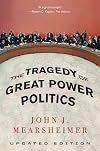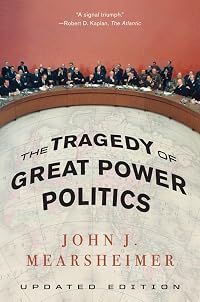
The Tragedy of Great Power Politics
by John J. Mearsheimer
On This Page
Description
An analysis of the inevitability of war. As the Cold War fades, leaders and theorists alike speak of a new era, when democracy and open trade will join hands to banish outright war. The author exposes the truth behind this rhetoric: in a world where no international authority reigns, hegemony is the only insurance of security.Tags
Recommendations









Member Reviews
This is the most insightful and best argued case for structural realism you will ever read. It is brilliant. We are doomed to endless insecurity - unless we recognize that fact. Mearsheimer rightly points out that the world system drives nations into arms races and wars whether they want it or not. I tend to agree with him but as a dialectical materialist I also recognize 1) that is a general principle 2) there are specific exceptions which, exceptionally, enable us to escape the inevitable arms race and conflict. I don't agree with everything Mearsheimer says, especially about Ukraine, but he says it well. His arguments are logical, grounded, compelling. They reach conclusions I don't like but am forced to acknowledge. However, at show more least exceptionally "grand bargains" and international cooperation is possible. This is what Mao called "the unity and conflict of opposites". Mearsheimer hasn't treated Marxism for 30 years: might want to dust the books...
I would gladly review any or all of Mearsheimers works in great detail if provided review copies.
In any case: writes well, insightful, well worth reading! For me in fact a "must read" but only a must read if you are into professional political analysis of international affairs. show less
I would gladly review any or all of Mearsheimers works in great detail if provided review copies.
In any case: writes well, insightful, well worth reading! For me in fact a "must read" but only a must read if you are into professional political analysis of international affairs. show less
Mearsheimer's writing is extremely clear and his arguments are assertively made. However, he cherry-picks from the historical record and distorts even the examples he chooses to make his point. Even conceding that he's right about state behavior during WWII (which he isn't), he is incapable of conceiving of how nuclear weapons have changed world politics. He maintains that the great powers will once again go to war even though it has been 70 years and his prediction has yet to come to fruition. At times, he resorts to absurd contentions lacking in even the barest shred of plausibility in order to rescue the explanatory power of his theory (example: To explain Britain's failure to seek regional hegemony, he argues that "stopping power of show more water" means the British government couldn't project power onto the European continent during the very period when their impressive navy allowed them to maintain an empire upon which the sun never set). show less
Mearsheimer takes the "offensive realist" approach, that in an unstable, anarchic world, countries will do what is necessary to a. maintain the balance of power, and b. gain any additional power they are able to. For each claim of offensive realism, Mearsheimer goes great lengths to back it up with historical examples from the late 1800's to present day (and in some places, back to the 1700's). It is well worth the read for any student of international politics, providing a foundational knowledge of realism and divergent theories, while presenting his case - of which I could see much of in today's world. Easy to comprehend and very well written. One of the better IR books I've had the pleasure of reading.
It was worth reading this non-fiction explanation of how countries act towards one another, but the author spends a lot of time telling us what his theory is, over and over. There is certainly enough information to make it a valuable book, but I did not like the style.
Very clearly written, almost too much so. Argues that the international system is inherently unstable do to constant quest for power, which is driven by survival instinct and fear of other states. Argues that unbalanced multipolar systems are far and away the most unstable and are likely to very quickly lead to war.
If only it were that simple - checks and balances leading to feelings of oppression and eventual power-play. A worthy read, but definitely not the only answer.
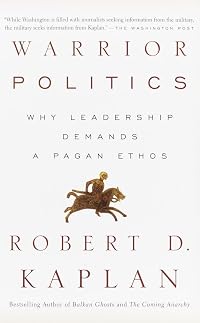
2001…foresaw China in the starkest terms as the future great power rival of the United States. Footnote RD Kaplan 2023 page 245.
Members
- Recently Added By
Lists

Política - Clásicos
164 works; 2 members

Reading list
170 works; 1 member

Political Theory
23 works; 1 member
Author Information

18 Works 2,157 Members
He is R. Wendell Harrison Distinguished Service Professor of Political Science at the University of Chicago & a regular contributor to The New Republic & The Atlantic. (Bowker Author Biography)
Awards and Honors
Classifications
- Genres
- Politics and Government, Nonfiction, General Nonfiction, History, Philosophy
- DDC/MDS
- 338 — Society, government, & culture Economics Production
- LCC
- D397 .M38 — History of Europe, Asia, Africa and Oceania History (General) Modern history, 1453- 1789- 19th century. 1801-1914/1920 1871- . Later 19th century
- BISAC
Statistics
- Members
- 710
- Popularity
- 40,006
- Reviews
- 7
- Rating
- (3.94)
- Languages
- 6 — Chinese, English, Italian, Japanese, Polish, Romanian
- Media
- Paper, Audiobook, Ebook
- ISBNs
- 12
- ASINs
- 7