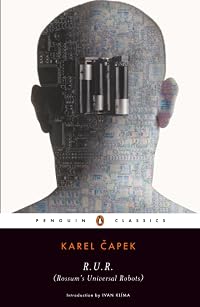
R.U.R.
by Karel Čapek
On This Page
Description
We have Czech writer Karel ?apek to thank for the invention of the word robot and generally for the introduction of the idea of artificial intelligence to the world of literature. His play, "R. U. R. (Rossum's Universal Robots)" was written in 1920 and was first performed in 1921. The play was an instant success and was translated into over 30 languages within two years of its first performance. The play begins in a factory that makes the "robots", which could be more accurately described as show more cyborgs, since they are more living creature than machine. "R. U. R." envisions a future where robots have become universal and all of humanity is now dependent on the labor that they provide, which remains a timely subject even one hundred years later. At first, everything seems perfect and the robots are happy to serve humans until the robots are later stirred into revolt. ?apek's vision of a dystopian future where humans may be ruled by machines was immediately and profoundly influential on the science fiction genre and to future authors. "R. U. R." is ?apek's prophetic and dark dystopian vision of the future which would solidify his place in dramatic history and leave a lasting legacy on modern literature. show lessTags
Recommendations
















Member Recommendations
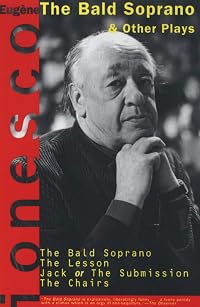
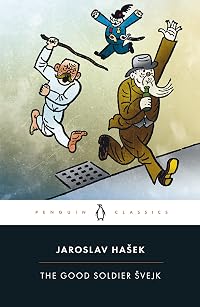
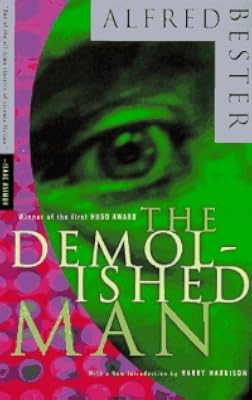
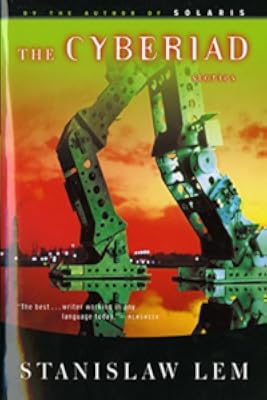
CGlanovsky Explores the societal implications of replacing humans with artificial labor.
Member Reviews
Everyone knows this is the book where robots were invented (do they? at least, that's the thing people know about it when they know anything). But I don't know that enough people have actually read it. Go ahead, read it. Or read it again. It hits differently during different eras, in moments; not in the conclusion it decides on necessarily but the questions it raises.
"And that's not what your RUR shareholders dream of, either. They dream of dividends. And their dividends are the ruin of mankind."
"And that's not what your RUR shareholders dream of, either. They dream of dividends. And their dividends are the ruin of mankind."
Curious about the origin of the word "robot," I picked up this short play. I was pleased with the read, shining inspiration light on pieces of modern-day fiction (Rossum Corporation from Dollhouse, for one) and an interesting depiction of the AI takeover. Yes, it is a play from 1920, and so it needs to be read with a set of assumptions - sexism is funny; stage directions leave a lot to the imagination; and costuming can make subtle character differences stand out.
All in all, from a historical perspective, this is a stellar piece of writing, and I look forward to reading more by Capek.
All in all, from a historical perspective, this is a stellar piece of writing, and I look forward to reading more by Capek.
I cannot prove this was the intent, nor can I rule it out but this little absurdist 1920's sci fi play struck me as equal parts H G Wells and Marx Brothers. (The fact that this was originally conceived as a play is enough to blow my mind.) Famous for coining the term "robot", it has also served as a template for robot themed story arcs up to the present. Not just that robots in one form or another (see AI) will ultimately seek to take over, but also the anthropomorphic application of human traits upon robots (Star Wars, Star Wars, Star Wars, etc.). In fact, spoiler alert, making the robots more human is what dooms mankind. Is our fear of robots just projection--if robots created mankind (and who says they didn't) wouldn't we seek to show more take over? Gets a little wonky and dated in the last third but still deals with important themes-responsibility, dignity and capitalism. The image of one character attempting to buy his freedom from the robots ("for half a billion I'll be safe") only to be killed by a human engineered booby trap--delicious. show less
After enjoying [THE GARDENER'S YEAR], I turned to R.U.R to explore Karel Capek's legendary reputation.
It delivers a frightening tale of the outcome when men create humanoid robots which only want to kill humans
and to learn from the last remaining human how to reproduce from the original R.U.R formula.
As the robots wait to attack those who created them, the humans feel "It's monstrous to be besieged by silence."
Despite this signaling the end of human civilization, the creators still argue about whether they should have done it,
while the author may mystify readers with: "Do you think that the soul first shows itself by a gnashing of teeth?"
It delivers a frightening tale of the outcome when men create humanoid robots which only want to kill humans
and to learn from the last remaining human how to reproduce from the original R.U.R formula.
As the robots wait to attack those who created them, the humans feel "It's monstrous to be besieged by silence."
Despite this signaling the end of human civilization, the creators still argue about whether they should have done it,
while the author may mystify readers with: "Do you think that the soul first shows itself by a gnashing of teeth?"
This 1921 play seems to be known mostly as the answer to a quiz question — “Where does the word ‘robot’ come from?”. I was mildly curious to see what it actually does with the idea of non-human workers. The answer seems to be: not all that much.
An eccentric inventor, Rossum, has discovered some sort of — unspecified — analogue to biological material, and his son has found a way to turn this into a successful commercial product, manufacturing human-like workers who incorporate all the useful features of real humans, like endurance, strength, versatility and ability to work autonomously, but omit ‘wasteful’ characteristics like personality, capacity for enjoyment, and the ability to reproduce. Of course they are a show more runaway success, humans are freed from the necessity to do unpleasant work, and everybody is moderately happy, until the robots — inevitably — do develop a capacity to seek greater fulfilment in their lives, and it all goes horribly wrong.
Interesting to see all this worked out from a 1920s perspective, long before the age of computers and all the rest, and it’s obviously meant as another warning about the dehumanising effects of 20th century industrial society, in the same spirit as Metropolis and Modern Times, but it’s executed as rather dull science fiction with human characters who are almost as predictable and mechanical in the author’s hands as their robot counterparts. I think it can safely rest on the shelf as the answer to that quiz question. show less
An eccentric inventor, Rossum, has discovered some sort of — unspecified — analogue to biological material, and his son has found a way to turn this into a successful commercial product, manufacturing human-like workers who incorporate all the useful features of real humans, like endurance, strength, versatility and ability to work autonomously, but omit ‘wasteful’ characteristics like personality, capacity for enjoyment, and the ability to reproduce. Of course they are a show more runaway success, humans are freed from the necessity to do unpleasant work, and everybody is moderately happy, until the robots — inevitably — do develop a capacity to seek greater fulfilment in their lives, and it all goes horribly wrong.
Interesting to see all this worked out from a 1920s perspective, long before the age of computers and all the rest, and it’s obviously meant as another warning about the dehumanising effects of 20th century industrial society, in the same spirit as Metropolis and Modern Times, but it’s executed as rather dull science fiction with human characters who are almost as predictable and mechanical in the author’s hands as their robot counterparts. I think it can safely rest on the shelf as the answer to that quiz question. show less
This short Czechoslovakian play (three acts, less than sixty pages of text) from 1922 introduced the work “robot” --derived from a Slavic form of “work” or “drudgery”. It shares (or inspirers) much with Cat’s Cradle: an isolated group, questions about what it is to be human, the end of the world. “It was a great thing to be a man,” intones one of the characters near the end. “There was something immense about it.” Yes, imagination enough to envision and enact our own extinction. Such a hopeful piece.
"Do you think the soul first shows itself by a gnashing of teeth?"
"Nobody can hate men more than men. Turn stones into men and they'd stone us."
Capek's R.U.R. is credited with the invention of the term "robot," but it really shouldn't be; the term as used in the play isn't what we've come to define it as. It derives from the Czech robota, "servitude," and then from the Hebrew golem, "embryo" (I see you there, Michael Chabon), and Capek's robots should be seen as sortof an intermediary hybrid of the robots of Isaac Asimov and the creation of Dr. Frankenstein.
There's another nod to Mary Shelley, too,in Alquist's repeated description of himself as the last man. So the first three acts of R.U.R. represent a fusion of Shelley's two novels show more to create a storyline: Man's invention gets away from him and rises up (Frankenstein), and destroys him (Last Man). It's a great idea, and one that's been ripped off in basically every science fiction movie you've ever seen.
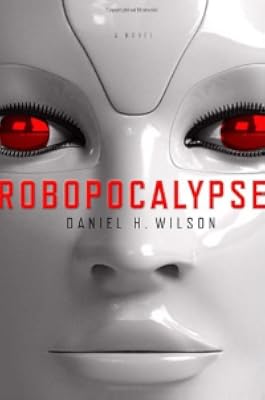
The really weird part doesn't come until Act IV. For more or less the only time ever, Man more or less...succeeds. Dr. Gall has, with Helena's prompting, created a viable post-human. Primus and Robotress Helena are human - maybe better than human! - and the play ends on an optimistic note. Sure, humans are destroyed, but progress moves on. I love this. I often get an unsettled feeling about apocalyptic stories like...I keep thinking of the recent pulp novel Robopocalypse here. It's always assumed that if humans ever invent themselves out of usefulness, that's a bad thing - but as Domain says, he doesn't regret it, "Not even today, the last day of civilization. It was a great adventure." (73) Why not lose? Why shouldn't we be megatherium? That's what Capek seems to suggest in his epilogue, and it's an interesting place to go. show less
"Nobody can hate men more than men. Turn stones into men and they'd stone us."
Capek's R.U.R. is credited with the invention of the term "robot," but it really shouldn't be; the term as used in the play isn't what we've come to define it as. It derives from the Czech robota, "servitude," and then from the Hebrew golem, "embryo" (I see you there, Michael Chabon), and Capek's robots should be seen as sortof an intermediary hybrid of the robots of Isaac Asimov and the creation of Dr. Frankenstein.
There's another nod to Mary Shelley, too,
The really weird part doesn't come until Act IV. For more or less the only time ever, Man more or less...
Members
- Recently Added By
Lists

Best Dystopias
280 works; 277 members

Survey of Classic Science Fiction
171 works; 48 members

Best Science Fiction Originally Published in a Language Other Than English
449 works; 34 members

S.F. Masterworks (Complete)
229 works; 15 members
SF & Fantasy in Translation
95 works; 18 members

Plays I Like
230 works; 31 members

Best of World Literature
435 works; 52 members

Books Read in 2014
2,343 works; 89 members

Harold Bloom - The Western Canon: D. The Chaotic Age
833 works; 24 members

Speculative Fiction from around the World
610 works; 18 members

Books I Would Like to Acquire
20 works; 1 member

Favorite Books in Translation
320 works; 133 members
My Play Collection
769 works; 3 members
Author Information

255+ Works 7,161 Members
Karel Capek is best known abroad for his plays, but at home he is also revered as an accomplished novelist, short-story writer, essayist, and writer of political articles. His bitingly satirical novel The War with the Newts (1936) reveals his understanding of the possible consequences of scientific advance. The novel Krakatit (1924), about an show more explosive that could destroy the world, foreshadows the feared potential of a nuclear disaster. In his numerous short stories he depicts the problems of modern life and common people in a humorous and whimsically philosophical fashion. The plays of Karel Capek presage the Theater of the Absurd. R.U.R. (Rossum's Universal Robots) (1921) was a satire on the machine age. He created the word robot from the Czech noun robota, meaning "work" for the human-made automatons who in that play took over the world, leaving only one human being alive. The Insect Comedy (1921), whose characters are insects, is an ironic fantasy on human weakness. The Makropoulos Secret (1923), later used as the basis for Leos Janacek's opera, was an experimental piece that questioned whether immortality is really desirable. All the plays have been produced successfully in New York. Most deal satirically with the modern machine age or with war. Underlying all his work, though, is a faith in humanity, truth, justice, and democracy, which has made him one of the most beloved of all Czech writers. (Bowker Author Biography) show less
Some Editions
Awards and Honors
Awards
Notable Lists
Series
Belongs to Publisher Series
Work Relationships
Is contained in
Has the adaptation
Is abridged in
Has as a student's study guide
Common Knowledge
- Canonical title
- R.U.R.
- Alternate titles
- R.U.R. (Rossum's Universal Robots) (Rossum's Universal Robots)
- Original publication date
- 1921; 1922 (English translation) (English translation)
- People/Characters
- Helena Glory; Harry Domin
- Important places
- Rossum's Island
- Related movies
- R.U.R. (1938 | IMDb); R.U.R. (1948 | IMDb); Broadway Television Theatre:R.U.R. [Rossum's Universal Robots] (1953 | s2e22 | IMDb)
- First words
- The central office of the Rossum's Universal Robots factory.
- Quotations
- DOMIN: The Robots will wash the feet of the beggar and prepare a bed for him in his own house. Nobody will get bread at the price of life and hatred. (27)
ALQUIST: I'm not very fond of progress and these newfangled ideas.
HELENA: Like Emma?
ALQUIST: Yes, like Emma. Has Emma got a prayer book?
HELENA: Yes, a big, thick one.
ALQUIST: And has it got prayers for v... (show all)arious occasions? Against thunderstorms? Against illness?
HELENA: Against temptations, against floods --
ALQUIST: And not against progress?
HELENA: I don't think so.
ALQUIST: That's a pity. (47)
HELENA: Doctor, has Radius a soul?
DR. GALL: I don't know. He's got something nasty. - Last words
- (Click to show. Warning: May contain spoilers.)[HELENA and PRIMUS embrace and go out arm in arm as the curtain falls.]
The End - Original language
- Czech
Classifications
- Genres
- Fiction and Literature, Science Fiction
- DDC/MDS
- 891.86252 — Literature & rhetoric Literatures of other languages East Indo-European and Celtic literatures West and South Slavic languages (Bulgarian, Slovene, Polish, Czech, Slovak, Serbo-Croatian, and Macedonian) Czech Czech drama 1900–1989 Early 20th century 1900–1945
- LCC
- PG5038 .C3 .R213 — Language and Literature Slavic languages and literatures. Baltic languages. Albanian language Slavic. Baltic. Albanian Slavic Czech
- BISAC
Statistics
- Members
- 1,203
- Popularity
- 20,671
- Reviews
- 38
- Rating
- (3.66)
- Languages
- 17 — Bosnian, Catalan, Czech, Dutch, English, Esperanto, Estonian, Finnish, French, German, Italian, Korean, Portuguese, Slovak, Spanish, Swedish, Turkish
- Media
- Paper, Audiobook, Ebook
- ISBNs
- 69
- UPCs
- 2
- ASINs
- 29