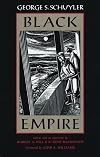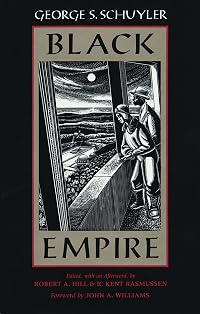
Black Empire
by George S. Schuyler
On This Page
Description
"At once a daring, high-stakes science fiction adventure and a strikingly innovative Afrofuturist classic, this controversial and fearlessly political work lays bare the ethical quandaries of exactly how far one should go in the name of justice"--Tags
Recommendations





































Member Reviews
George S. Schuyler's Black Empire may have been a genre-buster when it was originally published in the Pittsburgh Courier as a serial in the mid-1930s, an Afrofuturist epic before Afrofuturism was a word. A satirical take on the Back to Africa movement and black nationalism, Black Empire is the saga of genius/mad scientist Dr. Henry Belsidus, as told by his secretary Carl Slater, as Belsidus recruits the world’s Black excellence to build a Black Empire in Africa by whatever means necessary, mainly by eliminating white people. Part sci-fi, part melodrama, the story unfolds rapid-fire, and includes prophetic technological innovations (helicopters, solar energy and hydropower, to name a few) and even describes the creation of the Black show more Empire as the “Second World War” several years before a war to be so named began.
The book is entertaining, the pace is quick, but the satire has faded a little. It’s worth reading, particularly if there is a more recent edition available. It seems as if this Mint edition was scanned from original publications and no one proofread the output. The errors and typos in the book were distracting at best. It made for some annoying reading. show less
The book is entertaining, the pace is quick, but the satire has faded a little. It’s worth reading, particularly if there is a more recent edition available. It seems as if this Mint edition was scanned from original publications and no one proofread the output. The errors and typos in the book were distracting at best. It made for some annoying reading. show less
 This review was written for LibraryThing Early Reviewers.
George Schuyler's Black Empire is a satire disguised as pulp-fiction. Like a lot of pulp-fiction, it flows well and is easy to read, but is also predictable at times. Because of its political nature, the book is part George Orwell, but because of its cliff-hangers and one-sided characters, it's also part Jack London.
The book is about a charismatic American doctor who is trying to establish an independent nation for Black Americans in Africa. As such, it takes aim at Black-initiated "back to Africa" philosophers, such as Marcus Garvey's. There is plenty of intrigue, conspiracy, and whiplashing narrative turns.
The satire does not work for me, though. While there may have been a few thinkers who were as radical as Schuyler's doctor, only show more Garvey had enough clout to move on his beliefs, and his simple motive was to give Blacks in the Americas more economic independence.
Schuyler's political philosophies are hard to nail down. Through the course of the 20th century, he went from disillusioned socialist to vocal atheist to Goldwater Republican to someone who had no opinion about South Africa's Apartheid.
I certainly don't think Schuyler's works should be ignored, but I wonder how much of the energy he is given today is because modern conservatives seem to think of him as an intellectual giant and how much is because of his actual writing and thinking. Nevertheless, it's important to keep writers like Schuyler in print.
I applaud Mint Editions for brining high quality printing and publishing standards to the public domain market. The cover, paper, and cut of their books are all wonderful. show less
The book is about a charismatic American doctor who is trying to establish an independent nation for Black Americans in Africa. As such, it takes aim at Black-initiated "back to Africa" philosophers, such as Marcus Garvey's. There is plenty of intrigue, conspiracy, and whiplashing narrative turns.
The satire does not work for me, though. While there may have been a few thinkers who were as radical as Schuyler's doctor, only show more Garvey had enough clout to move on his beliefs, and his simple motive was to give Blacks in the Americas more economic independence.
Schuyler's political philosophies are hard to nail down. Through the course of the 20th century, he went from disillusioned socialist to vocal atheist to Goldwater Republican to someone who had no opinion about South Africa's Apartheid.
I certainly don't think Schuyler's works should be ignored, but I wonder how much of the energy he is given today is because modern conservatives seem to think of him as an intellectual giant and how much is because of his actual writing and thinking. Nevertheless, it's important to keep writers like Schuyler in print.
I applaud Mint Editions for brining high quality printing and publishing standards to the public domain market. The cover, paper, and cut of their books are all wonderful. show less
This review was written for LibraryThing Early Reviewers.In an alternate world in the mid-1930s, this satirical novel tells the story of the deranged megalomaniac Dr. Belsidus. Dr. Belsidus is on a mission to create an all Black empire; conquering African nations, massacring all whites, and repopulating the continent entirely with black people from all over the world.
Max Slater, a reporter in New York, is kidnapped and “recruited” to become the personal assistant to Dr. Belsidus. The story is told from Max’s perspective as the doctor’s right-hand man.
This is not a book for those sensitive to racist language or race related violence but if you don’t mind the continual offensive language it’s beautifully written and well thought out. For those reasons, I highly recommend this book.
Max Slater, a reporter in New York, is kidnapped and “recruited” to become the personal assistant to Dr. Belsidus. The story is told from Max’s perspective as the doctor’s right-hand man.
This is not a book for those sensitive to racist language or race related violence but if you don’t mind the continual offensive language it’s beautifully written and well thought out. For those reasons, I highly recommend this book.
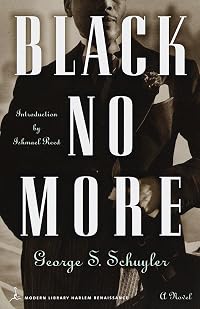
This review was written for LibraryThing Early Reviewers.Let me start by saying that another of George S. Schuyler's novels, Black No More, is fantastic: funny, surprising, with its satire right on point. I highly recommend it. Black Empire may have been all of those things in the time it was written -- and it still has its moments. Much of the satire, though feels dated; a historical introduction or contextual notes would have done much to enhance the reader's experience. As a period piece, it's interesting. As reading for pleasure, though, this was a bust for me.
This review was written for LibraryThing Early Reviewers.An odd book. Basically, evil genius Dr Belsidus decides to exact revenge against Whitey, by building a new Black Empire in Africa. It's totally amoral, focusing of subterfuge, unconventional warfare, and Science! Supposedly, there's a deeper message here, but all I see is second rate Golden Age sci-fi mixed with Black Nationalist paranoia.
I know I agreed to read this novel published by Mint Editions, but Mint Editions obviously didn't read their book before sending it to me. Not only did no one bother to proofread this error-strewn scan (to correct scannos such as "close" for "dose" and fix all the periods that should be commas), no one even bothered to run it through spellcheck. Page 30 has "lorgery" and "endirely dillerem" which at least I could translate to "forgery" and "entirely different" in context. But what could page 34's "tinle green light" possibly be? I'm glad I didn't spend too much time trying to guess and Googled it instead because the answer is "little green light," and the other answer is now I know Penguin has published their own edition of this book in show more 2023, and their version is actually a pleasure to read. show less
This review was written for LibraryThing Early Reviewers.Ratings
Members
- Recently Added By
Lists

Reading LIst
648 works; 1 member

Books Read in 2026
2,075 works; 69 members
Author Information

10+ Works 875 Members
George S. Schuyler was an African American professional journalist of considerable distinction who served as an officer in the army in World War I and later made a name for himself as a satirical polemicist, attacking both white and black positions in the racial politics of this country. He carved out a position for himself as a conservative show more spokesman within the African American community, particularly as an ardent anti-Communist. His ingenious Swiftian fantasy, Black No More (1934), tells the story of a miracle cure for black skin color by means of which, to the great discomfort of the white population, the black and white "races" become indistinguishable. (Bowker Author Biography) show less
Series
Belongs to Publisher Series
Common Knowledge
- Canonical title
- Black Empire
- Original publication date
- 1938
Classifications
Statistics
- Members
- 106
- Popularity
- 306,458
- Reviews
- 6
- Rating
- (3.73)
- Languages
- English, French
- Media
- Paper, Audiobook, Ebook
- ISBNs
- 10
- ASINs
- 1