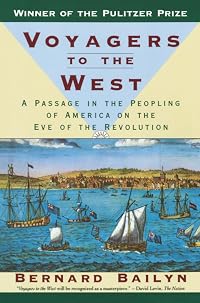
Voyagers to the West: A Passage in the Peopling of America on the Eve of the Revolution
by Bernard Bailyn
The Peopling of British North America (2)
On This Page
Description
Provides official statistics and personal information on immigration to the New World from Britain.Tags
Recommendations



Member Reviews
Voyagers to the West: A Review
by Logan Knight
***************************************
Passenger lists from the colonial era are rare. No real regulation existed concerning people coming to the Americas. Most of the immigrants came from the British Isles, and from a government perspective, it didn’t make much difference if one was in Somerset or Virginia. What few lists existed have often been lost to the ravages of time. This makes the discovery of a passenger list of every officially known person who left Britain for America from December of 1773 to March 1776 a truly immense historical find. The original is located in the Public Record Office in Kew, London.
In his Pulitzer-Prize winning book, “Voyagers to the West: A Passage in the show more Peopling of America on the Eve of the Revolution,” (New York: Vintage Books, 1988), GC 973 B15vo, Harvard professor Bernard Bailyn examines the list in question. He then synthesizes a quantitative analysis and uses historical methods to create a work that anchors the academic discipline of colonial immigration studies.
The first half is devoted to the list itself, a valuable genealogical source. By going through the data, Bailyn is able to present the reader with a view of a world that has long since faded. It is not simply an index of people who immigrated. Rather, the book digs into who they were, what they did for a living, where they came from, where they went, etc. The data is collated to understand these people in a way that makes them more than just names on a list. It should not escape the notice of genealogists how this is useful for tracing one’s family further back into Great Britain and placing them into historical context. The book does a fantastic job showing the minute cause and effect springs of immigration. For example, the ability of French silk makers to sell their product twenty-five percent cheaper in England than domestic producers ensured that a number of people employed in that industry immigrated to the colonies.
All of this motion is haunted by Bailyn’s description of the growing tensions between the colonies and the mother country. As people continued arriving, the formative events of the American Revolution happened. The Battles of Lexington and Concord occurred on April 19, 1775, and the list documents large numbers of immigrants arriving well into 1776. Bailyn’s book shines particularly when it shows how the increasing fear of a depopulated Britain led to the creation of the register in the first place. Genealogical records often depend on such strange quirks of fate, but rarely has an author done such an excellent job of developing the story as we see here.
Much of the second half of the work is devoted to individual evaluations of where the settlers went in the colonies. Areas such as North Carolina, upstate New York, and Georgia are all examined in detail. Interestingly, many of the chapters focus on areas that are often left out of the story, including Newfoundland and East Florida. By looking at individual incidents, such as the ill-fated attempt by James Hogg to settle Scottish Highlanders in North Carolina or the land grabbing machinations of William Johnson among the Iroquois in New York, Bailyn is able to put all of these immigrants into a larger and more fascinating context.
In short, this book is an excellent resource for those who may have ancestors who emigrated from Britain shortly before the American Revolution as well as those who wish to know more about the process and drama of immigration in the late colonial period. show less
by Logan Knight
***************************************
Passenger lists from the colonial era are rare. No real regulation existed concerning people coming to the Americas. Most of the immigrants came from the British Isles, and from a government perspective, it didn’t make much difference if one was in Somerset or Virginia. What few lists existed have often been lost to the ravages of time. This makes the discovery of a passenger list of every officially known person who left Britain for America from December of 1773 to March 1776 a truly immense historical find. The original is located in the Public Record Office in Kew, London.
In his Pulitzer-Prize winning book, “Voyagers to the West: A Passage in the show more Peopling of America on the Eve of the Revolution,” (New York: Vintage Books, 1988), GC 973 B15vo, Harvard professor Bernard Bailyn examines the list in question. He then synthesizes a quantitative analysis and uses historical methods to create a work that anchors the academic discipline of colonial immigration studies.
The first half is devoted to the list itself, a valuable genealogical source. By going through the data, Bailyn is able to present the reader with a view of a world that has long since faded. It is not simply an index of people who immigrated. Rather, the book digs into who they were, what they did for a living, where they came from, where they went, etc. The data is collated to understand these people in a way that makes them more than just names on a list. It should not escape the notice of genealogists how this is useful for tracing one’s family further back into Great Britain and placing them into historical context. The book does a fantastic job showing the minute cause and effect springs of immigration. For example, the ability of French silk makers to sell their product twenty-five percent cheaper in England than domestic producers ensured that a number of people employed in that industry immigrated to the colonies.
All of this motion is haunted by Bailyn’s description of the growing tensions between the colonies and the mother country. As people continued arriving, the formative events of the American Revolution happened. The Battles of Lexington and Concord occurred on April 19, 1775, and the list documents large numbers of immigrants arriving well into 1776. Bailyn’s book shines particularly when it shows how the increasing fear of a depopulated Britain led to the creation of the register in the first place. Genealogical records often depend on such strange quirks of fate, but rarely has an author done such an excellent job of developing the story as we see here.
Much of the second half of the work is devoted to individual evaluations of where the settlers went in the colonies. Areas such as North Carolina, upstate New York, and Georgia are all examined in detail. Interestingly, many of the chapters focus on areas that are often left out of the story, including Newfoundland and East Florida. By looking at individual incidents, such as the ill-fated attempt by James Hogg to settle Scottish Highlanders in North Carolina or the land grabbing machinations of William Johnson among the Iroquois in New York, Bailyn is able to put all of these immigrants into a larger and more fascinating context.
In short, this book is an excellent resource for those who may have ancestors who emigrated from Britain shortly before the American Revolution as well as those who wish to know more about the process and drama of immigration in the late colonial period. show less
Bernard Bailyn did extensive research in order to write his book "Voyagers to the West." He used immigration records as well as letters, diaries, and business records. It is primarily a book about immigrants from England and Scotland who settled in America during the years just before the American Revolution. He describes in detail from which areas of England and Scotland they came, whether they were single or families, rich or poor, how they were employed, and what may have caused them to decide to emigrate to America. He also goes into great detail telling what areas of America they settled in, and how they came to choose those specific areas. For instance, he shows that there were two primary groups immigrating. One group was of show more established farm families, and the other group consisted of mostly young single men from urban areas such as London searching for adventure and jobs.
Bailyn gives us a great picture of what people were going through, and why they made the choices that they did. I must admit though, that some parts of the book were somewhat slow. I might have suggested leaving some parts out to make it a far more interesting read. show less
Bailyn gives us a great picture of what people were going through, and why they made the choices that they did. I must admit though, that some parts of the book were somewhat slow. I might have suggested leaving some parts out to make it a far more interesting read. show less
A Pulitzer Prize winner, maybe for Bernard's amazing research, but truly not for it's readability. This book should be renamed to, Details of the Voyagers to the West. It is nice that detail is available but should be limited to charts, indexes in the back of the book. Not pages of facts, numbers, names, places laced throughout the work.
This 600+ page book contains only a 3-page introduction and relitively no conclusions, though he does a good job sticking to his thesis statements made in the intro. "the magnitudes of immigration were on such a large scale . . . [that it] transformed. . . American life." He proves that the people who emigrated from Scotland & England were immigrating to better their lives in America, and once in America show more their lives were changed. Social norms and living standards as well as a lack of peerage were upturned. This had enormous impact on relationships between America and Briton.
Bailyn claims that emigration numbers were enormous. Newspapers from 1750-1770 bemoaned the horrible effects of people moving to America. But in Colley's "Britons" nothing is mentioned about this, in her index the word emigration is not even mentioned.
Bailyn's book is not for casual readers, but for those scholars interested in immigration of the American colonies. He does not give %'s only numbers making it difficult to judge proportion.
01-2009 show less
This 600+ page book contains only a 3-page introduction and relitively no conclusions, though he does a good job sticking to his thesis statements made in the intro. "the magnitudes of immigration were on such a large scale . . . [that it] transformed. . . American life." He proves that the people who emigrated from Scotland & England were immigrating to better their lives in America, and once in America show more their lives were changed. Social norms and living standards as well as a lack of peerage were upturned. This had enormous impact on relationships between America and Briton.
Bailyn claims that emigration numbers were enormous. Newspapers from 1750-1770 bemoaned the horrible effects of people moving to America. But in Colley's "Britons" nothing is mentioned about this, in her index the word emigration is not even mentioned.
Bailyn's book is not for casual readers, but for those scholars interested in immigration of the American colonies. He does not give %'s only numbers making it difficult to judge proportion.
01-2009 show less
4535. Voyagers to the West A Passage in the Peopling of America on the Eve of the Revolution, by Bernard Bailyn with the assistance of Barbara DeWolfe (read 13 Feb 2009) (Pulitzer History prize in 1987) This won the 1987 Pulitzer History prize and is the 47th such winner I have read. It is exhaustively researched, and unless one is interested in the genealogy of the people who came from England and Scotland in the 1770's it is likely to be boring--as I often found it to be. Some things are of interest, particularly toward the end of the book, where details are set out of efforts to organize immigration projects and settlements. The plight of indentured servants is brought out--treated almost as slaves were. Not a page-turner, but I am show more glad I read the book.. show less
Ratings
Members
- Recently Added By
Lists

Five star books
1,755 works; 107 members
Author Information

50+ Works 7,372 Members
Bernard Bailyn was born in Hartford, Connecticut, in 1922, and did his undergraduate work at Williams College. He began his teaching career at Harvard University immediately after the university granted him a Ph.D. in 1953, and he remained there until he retired in 1991. During his tenure at Harvard, he was Winthrop Professor, Adams University show more Professor, and James Duncan Phillips Professor of Early American History. For years Bailyn was editor in chief of the Harvard Library and director of the Charles Warren Center for Studies in American History. An innovative and influential historian of early America, Bernard Bailyn has written quantitative studies of the colonial New England economy, probing examinations of the ideological origins of the American Revolution, and penetrating studies of the social and cultural foundations of American education. Bailyn is particularly adept at interweaving social, intellectual, economic, and political factors into coherent narrative history. A pioneer in adapting the new tools of social science to the writing of history, he is also a fine literary stylist. Bailyn has been Pitt Professor at Cambridge University and president of the American Historical Association. He holds membership in the American Academy of Arts and Sciences and in the British Academy. His writings have earned him the Bancroft Prize and the National Book Award. Bailyn received two Pulitzers-one in 1968 for The Ideological Origins of the American Revolution (1967), which challenges traditional interpretations of the causes of the American Revolution, and the other in 1987 for Voyagers to the West (1986), which explores reasons for migration to America just prior to the Revolution. His other work includes The Barbarous Years (2013) and Illuminating History: A Retrospective of Seven Decades (2020). Bernard Bailyn, author of over 20 books, died on August 7, 2020 at the age of 97. (Bowker Author Biography) show less
All Editions
Awards and Honors
Series

Common Knowledge
- Original title
- Voyagers to the West: A Passage in the Peopling of America on the Eve of the Revolution
- Original publication date
- 1986
- Important places
- United Kingdom; USA
- Dedication
- To John Clive
- Original language
- English
Classifications
- Genres
- Nonfiction, History, General Nonfiction
- DDC/MDS
- 304.873041 — Society, government, & culture Social sciences, sociology & anthropology Factors affecting social behavior Movement of people
- LCC
- JV7618 .N7 .B35 — Political Science Colonies and colonization. Emigration and immigration. International migration Colonies and colonization. Emigration and Emigration and immigration. International Europe
- BISAC
Statistics
- Members
- 478
- Popularity
- 63,392
- Reviews
- 4
- Rating
- (3.87)
- Languages
- English
- Media
- Paper, Ebook
- ISBNs
- 5
- ASINs
- 8