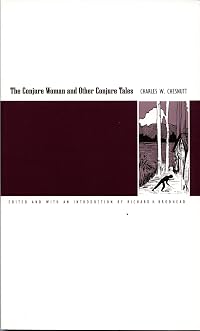
The Conjure Woman and Other Conjure Tales
by Charles W. Chesnutt
On This Page
Description
The stories in The Conjure Woman were Charles W. Chesnutt's first great literary success, and since their initial publication in 1899 they have come to be seen as some of the most remarkable works of African American literature from the Emancipation through the Harlem Renaissance. Lesser known, though, is that the The Conjure Woman, as first published by Houghton Mifflin, was not wholly Chesnutt's creation but a work shaped and selected by his editors. This edition reassembles for the first show more time all of Chesnutt's work in the conjure tale genre, the entire imaginative feat of which the published Conjure Woman forms a part. It allows the reader to see how the original volume was created, how an African American author negotiated with the tastes of the dominant literary culture of the late nineteenth century, and how that culture both promoted and delimited his work.In the tradition of Uncle Remus, the conjure tale listens in on a poor black southerner, speaking strong dialect, as he recounts a local incident to a transplanted northerner for the northerner's enlightenment and edification. But in Chesnutt's hands the tradition is transformed. No longer a reactionary flight of nostalgia for the antebellum South, the stories in this book celebrate and at the same time question the folk culture they so pungently portray, and ultimately convey the pleasures and anxieties of a world in transition. Written in the late nineteenth century, a time of enormous growth and change for a country only recently reunited in peace, these stories act as the uneasy meeting ground for the culture of northern capitalism, professionalism, and Christianity and the underdeveloped southern economy, a kind of colonial Third World whose power is manifest in life charms, magic spells, and ha'nts, all embodied by the ruling figure of the conjure woman.Humorous, heart-breaking, lyrical, and wise, these stories make clear why the fiction of Charles W. Chesnutt has continued to captivate audiences for a century. show lessTags
Recommendations




Member Reviews
The Conjure Woman and Other Tales is a collection of short stories tied together under the umbrella of a frame story in which a white northern couple has relocated to the South and has met a man on their property who they hire on as caretaker. The poor black southerner regales them with tales which they find entertaining but are actually pointing a finger directly at them. The book was first published in the late 1800's and the dialect is that of a poor southern black man and the stories themselves offer a glimpse into the rich cultural heritage of the people and the times in which they lived.
The tales presented in The Conjure Woman are entertaining and humorous on their own but the real value of this work is how the protagonist uses show more his tales in order to point out the flaws in the views and attitudes of the white couple and goad or guilt them into getting things done on the farm in the way that he wants them sometimes for his own benefit but usually for the benefit of everyone involved. I really did enjoy this book as both the individual stories and the ongoing tale as a whole teach the reader a lot about the views of society during that era whilst maintaining a lighter air so that the reader doesn't feel as if they are being scolded or sitting in a lecture. show less
The tales presented in The Conjure Woman are entertaining and humorous on their own but the real value of this work is how the protagonist uses show more his tales in order to point out the flaws in the views and attitudes of the white couple and goad or guilt them into getting things done on the farm in the way that he wants them sometimes for his own benefit but usually for the benefit of everyone involved. I really did enjoy this book as both the individual stories and the ongoing tale as a whole teach the reader a lot about the views of society during that era whilst maintaining a lighter air so that the reader doesn't feel as if they are being scolded or sitting in a lecture. show less
I found it a fascinating & thought-provoking collection of stories (one author, all stories have something to do with "conjuring" or "hoodoo" as it related to the post-Civil War era in rural NC).
Some of the stories were originally bundled & sold as a book, but this edition has stories the author wrote that were not included in the original book edition. (Some of the others were published separately in magazines & such.)
Chesnutt was an educated black man who could "pass" as white. He did not choose that route.
In this collection of stories, he writes in both a "white" & a "black" voice. The conceit surrounding all the stories centers around a northern couple who have relocated to NC for the climate (for the wife's health). Once there, show more they hire Julius who was once a slave. Most every chapter starts with the white landowner setting the scene, then Julius mentioning something that will lead to a story he will tell his audience. All of Julius' stories are told in heavy dialect & are based on African-American/slave folk tales. It's quite a bit of oral folklore being set into print. Many have an underlying, heartbreaking message related to the horrors of slavery, but are still told in a somewhat understated way.
A very worthy & worthwhile collection to read. show less
Some of the stories were originally bundled & sold as a book, but this edition has stories the author wrote that were not included in the original book edition. (Some of the others were published separately in magazines & such.)
Chesnutt was an educated black man who could "pass" as white. He did not choose that route.
In this collection of stories, he writes in both a "white" & a "black" voice. The conceit surrounding all the stories centers around a northern couple who have relocated to NC for the climate (for the wife's health). Once there, show more they hire Julius who was once a slave. Most every chapter starts with the white landowner setting the scene, then Julius mentioning something that will lead to a story he will tell his audience. All of Julius' stories are told in heavy dialect & are based on African-American/slave folk tales. It's quite a bit of oral folklore being set into print. Many have an underlying, heartbreaking message related to the horrors of slavery, but are still told in a somewhat understated way.
A very worthy & worthwhile collection to read. show less
Loved these little short stories. All told by Uncle Julius, who manages to use the stories to get what he wants out of the rich white Northerners, one of whom suspects what he's up to, but gives in all the same. These are told in heavy dialect, the kind that makes Huck Finn and Uncle Remus look simple, so if that's going to bother you, don't pick it up. I usually don't mind that, but I admit that I found it slow going. It helped me to imagine that I heard it told out loud, like a Brer Rabbit story, but it wasn't a quick read. Still, that made it even more fun, because the stories were long enough to finish a couple at a time and then come back for more. My favorites were the first one, the story of the missing will, and the slave owner show more who got goophered into a slave. show less
Charles W. Chesnutt (1858-1932) was the first African-American author to achieve commercial success, writing three novels, a book of short stories, and numerous articles for The Atlantic Monthly and other national publications. According to The Library of America, "Chesnutt laid bare the deep contradictions at the heart of American attitudes toward race and history, and in the process created the modern African-American model."
Chesnutt was born in Cleveland to two free persons of color, but spent most of his early life in North Carolina before moving back to Ohio. Although he could pass for white, as his paternal grandfather was a white slaveholder, he identified himself as a Negro throughout his life. He wrote extensively on racial show more issues, particularly involving persons of mixed heritage.
His first book, The Conjure Woman, published in 1899, consists of a series of "conjure" tales set in post-Civil War North Carolina. The narrator is a white midwesterner who has purchased an abandoned plantation, who hires, amongst others, Julius McAdoo, a former slave on the plantation. The new owner and his wife are quite fond of "Uncle Julius" and his stories of plantation life, and each of the six tales are told in slave narrative form. These stories collectively provide a complex portrait of the lives of slaves, slaveowners, freedmen, and poor whites in the antebellum South, and the influence of conjurers on blacks and whites during that time. show less
Chesnutt was born in Cleveland to two free persons of color, but spent most of his early life in North Carolina before moving back to Ohio. Although he could pass for white, as his paternal grandfather was a white slaveholder, he identified himself as a Negro throughout his life. He wrote extensively on racial show more issues, particularly involving persons of mixed heritage.
His first book, The Conjure Woman, published in 1899, consists of a series of "conjure" tales set in post-Civil War North Carolina. The narrator is a white midwesterner who has purchased an abandoned plantation, who hires, amongst others, Julius McAdoo, a former slave on the plantation. The new owner and his wife are quite fond of "Uncle Julius" and his stories of plantation life, and each of the six tales are told in slave narrative form. These stories collectively provide a complex portrait of the lives of slaves, slaveowners, freedmen, and poor whites in the antebellum South, and the influence of conjurers on blacks and whites during that time. show less
On the surface, this book seems to be a series of tales that hark back to the days of plantations and slavery, all connected by The Conjure Woman, who, for a small payment, helps ease the trials and hardships of the slaves by her "goopherin." The book begins when a man, John, and his wife, Annie, move to North Carolina for Annie's health, and they meet Uncle Julius, who becomes their paid servant. Whenever John has plans for his land, he discusses his ideas with Uncle Julius, who then relates a tale about certain slaves on the plantation, generally designed to get John to change his mind. So you might think that you've got a collection of quaint stories about superstition here, but then you start picking up what lies beneath.
When you show more get into the stories, you start getting the underlying message -- about the harsh treatment of slave owners and their overseers toward their slaves. There are instances of slaves being physically abused, or being separated from their loved ones, especially women and babies. Considering that this was written in the late 1890s, and that the earlier "plantation fiction" glorified the slave-owning life to almost a romantic degree, Chesnutt's work probably set that whole genre on its ear. As an example, you've got Uncle Julius, an ex-slave, doing what he can to preserve his small measure of entrepreneurship by pulling one over on his white boss and his wife.
Overall, it was a fine work. Chesnutt chose to have the slaves and Uncle Julius speak using a Southern dialect, which makes for difficult reading at first until you pick up the rhythm. I would recommend it to readers who are interested in the plantation-era American South and the lives of the slaves, and those who perhaps aren't familiar with this author.
Definitely recommended, and a welcome addition to my library. show less
When you show more get into the stories, you start getting the underlying message -- about the harsh treatment of slave owners and their overseers toward their slaves. There are instances of slaves being physically abused, or being separated from their loved ones, especially women and babies. Considering that this was written in the late 1890s, and that the earlier "plantation fiction" glorified the slave-owning life to almost a romantic degree, Chesnutt's work probably set that whole genre on its ear. As an example, you've got Uncle Julius, an ex-slave, doing what he can to preserve his small measure of entrepreneurship by pulling one over on his white boss and his wife.
Overall, it was a fine work. Chesnutt chose to have the slaves and Uncle Julius speak using a Southern dialect, which makes for difficult reading at first until you pick up the rhythm. I would recommend it to readers who are interested in the plantation-era American South and the lives of the slaves, and those who perhaps aren't familiar with this author.
Definitely recommended, and a welcome addition to my library. show less
These plantation legends explore the emotions of slavery in magical stories suitable for everyone. This edition has versions that have been "translated" into modern English with standardized American English spelling and specific terms replacing racial slurs, except where crucial to the story. The original versions, written in dialect, are in appendixes.
An underread classic. Dialect is a bit of a challenge, but worth it.
Members
- Recently Added By
Lists

American Realism
15 works; 1 member
Author Information

38+ Works 2,364 Members
Series
Belongs to Publisher Series
Work Relationships
Classifications
Statistics
- Members
- 365
- Popularity
- 86,958
- Reviews
- 8
- Rating
- (3.84)
- Languages
- English
- Media
- Paper, Audiobook, Ebook
- ISBNs
- 49
- ASINs
- 11