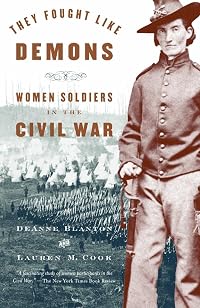
They Fought Like Demons: Women Soldiers in the Civil War
by De Anne Blanton
Conflicting Worlds: New Dimensions of the American Civil War (2002)
On This Page
Description
Explains how hundred of women assumed male aliases, disguised themselves in men's uniforms, and charged into battle as Union and Confederate soldiers during the Civil War.Tags
Recommendations














Member Reviews
Before reading this book, I was aware of one or two women who fought in the U.S. Civil War disguised as men. After reading this book, I now know that there were many more than one or two. It seems like women soldiers were an open secret during the war, and many, if not most, of the combatants were aware that there were women in their midst.
With few surviving letters or journals written by women soldiers, the authors pieced together mentions of women soldiers from official records, newspaper accounts, letters and journals written by men who served, and memoirs and recollections of war veterans. The bibliography and end notes show evidence of extensive research, yet much of the evidence is indirect. The authors accepted at face value the show more account of Melverina Elverina Peppercorn’s service as recounted in the 1916 memoir of Elizabeth Avery Meriwether, yet Melverina and her brother Alexander the Great don’t appear in contemporary censuses, Find-a-grave memorials, etc. It seems more likely that Melverina was either a pseudonym for someone whose identity Meriwether wanted to protect or a composite of women who served in the Civil War. show less
With few surviving letters or journals written by women soldiers, the authors pieced together mentions of women soldiers from official records, newspaper accounts, letters and journals written by men who served, and memoirs and recollections of war veterans. The bibliography and end notes show evidence of extensive research, yet much of the evidence is indirect. The authors accepted at face value the show more account of Melverina Elverina Peppercorn’s service as recounted in the 1916 memoir of Elizabeth Avery Meriwether, yet Melverina and her brother Alexander the Great don’t appear in contemporary censuses, Find-a-grave memorials, etc. It seems more likely that Melverina was either a pseudonym for someone whose identity Meriwether wanted to protect or a composite of women who served in the Civil War. show less
The authors' research into the topic shows that many more women fought in combat roles in the United States Civil War on both sides of the conflict that most of us suspect. Being caught usually meant they were sent home, but sometimes they were moved to non-combative roles such as the nursing. The authors also acknowledge that because so many used assumed male names, we may never know the true extent of the female battlefield presence. Excavations at battlefields such as Shiloh show women's bodies among the corpses. While the authors used some official records, they also used "recollections." In the case of one unusual name who allegedly fought from Tennessee, all references were to such a source. Not once did the authors attempt to show more prove the person or her brother's existence through the census or through official records. Another LibraryThing user and I attempted to find traces and concluded this person should have been omitted until existence could be proven. While the book is eye-opening about the extent of female involvement in combat, the reliance upon less trustworthy documents sometimes weakens it. show less
There is some very interesting information here about trans men in 1860s America. Unfortunately the authors themselves don't seem to realize they are writing about trans men as well as cis women.
Reviewed Jan 2007
Picked this up on a used book outing Mary and the kids. Really enjoyed (esp. the photographs) and learned a lot. Sadly it is not possible to know how many women actually served but it looks like several hundred not thousands. The authors point is that women who passed as men did so for “economic privileges and social opportunities otherwise closed to them. By taking a male social identity, they secured for themselves male power and independence, as well as full status as citizens of their nation.” (p.5) It seems that it wasn’t all that difficult for women to sneak in as the medical search was almost unheard of, they checked feet and teeth mainly. Also because young boys were also enlisting, most women passed for show more boys. Close quarters n army life were not a total challenge. Many soldiers sought privacy when reliving themselves and almost no washing or clothes changing was one for months at a time for everyone. Periods were probably hidden or skipped from stress overwork and bad nutrition. Women joined up for many of the reasons men did, but also to be with loved ones. Some who helped hide their gender and others did not know they were nearby but watching them. Women may have died in higher percentages because they refused to go to hospitals where their gender would have been revealed. When found out many women often tried again with a different name in a different regiment. 2-2007 show less
Picked this up on a used book outing Mary and the kids. Really enjoyed (esp. the photographs) and learned a lot. Sadly it is not possible to know how many women actually served but it looks like several hundred not thousands. The authors point is that women who passed as men did so for “economic privileges and social opportunities otherwise closed to them. By taking a male social identity, they secured for themselves male power and independence, as well as full status as citizens of their nation.” (p.5) It seems that it wasn’t all that difficult for women to sneak in as the medical search was almost unheard of, they checked feet and teeth mainly. Also because young boys were also enlisting, most women passed for show more boys. Close quarters n army life were not a total challenge. Many soldiers sought privacy when reliving themselves and almost no washing or clothes changing was one for months at a time for everyone. Periods were probably hidden or skipped from stress overwork and bad nutrition. Women joined up for many of the reasons men did, but also to be with loved ones. Some who helped hide their gender and others did not know they were nearby but watching them. Women may have died in higher percentages because they refused to go to hospitals where their gender would have been revealed. When found out many women often tried again with a different name in a different regiment. 2-2007 show less
The authors obviously did some extensive research in putting this book together, and I learned quite a lot about how women managed to pass as men during the civil war and have even greater respect for women who had the courage to don the uniform and fight. However, there were some weaknesses and some missing information.
I would have wished for a different method of organization or indexing. It was as though each chapter was an independent entity, with no crossover or acknowledgment of information in other chapters. Women were referenced by both their female names and male identities each time (when known) which became tedious, and the few people that were in every chapter were reintroduced every time with new snippets of information show more included that would have been good to know earlier in the book. I think a more clear picture would have emerged with a chapter or appendix dedicated to each of a few key people, but I can understand why this wasn't done given the information available and length constraints.
I know a lot of details are unavailable, but the authors didn't explore the implications of some of the women dressing as men before and after the conflict unless it was in the context of freedom and fair wages; there had to have been other reasons, right?
Very little reference was made to the downsides of a women being discovered among men in the service or in a POW camp. There was an awful lot of "rah! rah! all the men were so impressed with the women!" and not much speculation or reference to the downsides (i.e. assaults or negative reactions). show less
I would have wished for a different method of organization or indexing. It was as though each chapter was an independent entity, with no crossover or acknowledgment of information in other chapters. Women were referenced by both their female names and male identities each time (when known) which became tedious, and the few people that were in every chapter were reintroduced every time with new snippets of information show more included that would have been good to know earlier in the book. I think a more clear picture would have emerged with a chapter or appendix dedicated to each of a few key people, but I can understand why this wasn't done given the information available and length constraints.
I know a lot of details are unavailable, but the authors didn't explore the implications of some of the women dressing as men before and after the conflict unless it was in the context of freedom and fair wages; there had to have been other reasons, right?
Very little reference was made to the downsides of a women being discovered among men in the service or in a POW camp. There was an awful lot of "rah! rah! all the men were so impressed with the women!" and not much speculation or reference to the downsides (i.e. assaults or negative reactions). show less
Very dry, as it's written pretty much like a doctoral dissertation, but there's a lot of fascinating history. Who knew?
This book was a wonderful read and contained much information that I was not aware of. Only a handful of women are actually discussed in this book, but popular opinion is that as many as 400 women were soldiers during the civil war. This does not count the women who were laundresses, cooks, cleaners, letter carriers or nurses. This book also treats the issue of Loreta Velazquez as truth, stating that there is much recent information that would confirm that she was there and that her story is non-fiction. There were times when the book became a bit repetitive and had the feel of many essays instead of one fluid book. Anyone with interest in the Civil War should read this book though:
Members
- Recently Added By
Author Information
1 Work 384 Members
Series

Common Knowledge
- Original title
- They Fought Like Demons
- Original publication date
- 2002
- People/Characters
- Sarah Emma Edmonds; Loreta Velazquez; Frances Clayton; Malinda Blalock; Albert D. J. Cashier; Lucy Matilda Thompson Gauss Kenney (show all 9); Martha Parks Lindley; Mary A. Brown; Elizabet Finnern
- Important places
- USA
- Important events
- American Civil War (1861 | 1865)
- Dedication
- To all the brave women who possessed the courage and imagination to serve their country in time of crisis and against all odds
- First words
- It is an accepted convention that the Civil War was a man's fight.
- Quotations
- They fought like demons, and we cut them down like dogs.
- Last words
- (Click to show. Warning: May contain spoilers.)They went to extraordinary lengths to defend their beloved country, even though their governments and their societies viewed them as second-class citizens and held them in lower regard than their fathers, husbands, and brothers.
- Publisher's editor
- T. Michael Parrish
Classifications
Statistics
- Members
- 386
- Popularity
- 80,819
- Reviews
- 11
- Rating
- (3.78)
- Languages
- English
- Media
- Paper, Ebook
- ISBNs
- 5
- ASINs
- 3