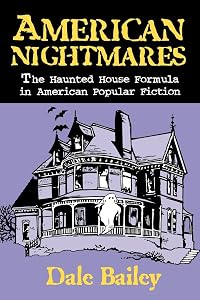
American Nightmares: The Haunted House Formula in American Popular Fiction
by Dale Bailey
On This Page
Description
When Edgar Allan Poe set down the tale of the accursed House of Usher in 1839, he also laid the foundation for a literary tradition that has assumed a lasting role in American culture. "The House of Usher" and its literary progeny have not lacked for tenants in the century and a half since: writers from Nathaniel Hawthorne to Stephen King have taken rooms in the haunted houses of American fiction. Dale Bailey traces the haunted house tale from its origins in English gothic fiction to the show more paperback potboilers of the present, highlighting the unique significance of the house in the domestic, economic, and social ideologies of our nation. The author concludes that the haunted house has become a powerful and profoundly subversive symbol of everything that has gone nightmarishly awry in the American Dream. show lessTags
Member Reviews
A skittery but delightful examination of some of the best known haunted house fictions in American writing. This is not written by an academic for other academics though there is an underlying thesis which requires Bailey to separate 'haunted houses' from other forms of horror (some may find this well-taken and others may find it contrived.) That said, this is a very enjoyable read for people who prize the genre. As a note, Bailey references Stephen King's Danse Macabre throughout the book -- if you have not yet read King's exploration of the broader horror landscape, I would highly recommend that to you.
This book is somewhat elementary because of its close focus on plot and character-related structure, and because of its cataloguing nature and conception, but Bailey's work here is worth reading for anyone who wants to engage in a serious study of horror film or literature as something more than simple entertainment or pop culture. He takes the work seriously, which is refreshing compared to many other critics in exploration of haunted elements of literature, and carefully constructs what is a somewhat dated, but necessary, formula of the understood haunted house. The book is highly readable, and will interest the casual horror reader or writer just so much as the scholarly critic looking for insight, though for the latter it may at show more times be elementary in explanation. Still, if you're interested, I highly recommend this work as a whole; it's worth a look, and Bailey has smart insights on the haunted house formula in American popular culture and literature. show less
Ratings
Members
- Recently Added By
Author Information

58+ Works 650 Members
Dale Bailey teaches at Lenoir-Rhyne College in Hickory, North Carolina.
Common Knowledge
- Epigraph
- Maybe this is the wave of the future. It isn't the thing that goes bump in your house in the night that is going to do you in in this brave new world; it's your house itself. In a world where the very furniture of your life,... (show all) the basic bones of your existence, turn terrible and strange, perhaps the only thing we're going to have to fall back on is whatever innate decency we can find deep within ourselves. -Anne Rivers Siddons
- Dedication
- Jean
Light in haunted places - First words
- Preface - This book grows out of a misspent youth - a twenty-plus-year love-affair with the macabre begun during clandestine raids on my eldest sister's tattered collection of Stephen King paperbacks, confirmed by late-show r... (show all)eruns of Hammer's classic horror films of the fifties and sixties, and perpetuated through a junior high and high school that found me stepping out of the assigned classics (Don Quixote and A Tale of Two Cities in eighth-grade English) with Robert R. McCammon, Dean Koontz and Anne Rice.
Chapter 1, Welcome to the Funhouse: Gothic and the Architecture of Subversion - My first haunted house - maybe the one that matters the most - stood just west of the courthouse in the small Southern town where I grew up. - Quotations
- Gatsby’s sprawling mansion is haunted by nothing less than the American Dream which drove him first into the arms of the gangster who helped to make his fortune (Meyer Wolfsheim, a gothic name if there ever was one), then t... (show all)o Daisy Buchanan, the femme fatale of the gothic tradition, and finally to the deadly confrontation that closed his life.
...close analysis of The Haunting of Hill House, in the context of the domestic tales, reveals a still more profound and particular alienation—the alienation of an ambitious woman torn between her loyalties to family and he... (show all)r personal dreams and imperatives in the circumscribed upper middle-class world of the 1940s and 1950s.
The qualities which make Amityville significant—even central—to our purposes have very little to do with art. Indeed, its lack of artistry is key, for nowhere else can we find a more transparent and detailed example of th... (show all)e haunted house formula which gained maturity in the 1970s and which continues to influence horror writers of the present.
The haunted-house formula enabled writers as diverse as Charlotte Perkins Gilman and Shirley Jackson to dramatize the problems of a patriarchal culture which denied women an equal part in the American Dream...
...tool to probe the distortions wrought by materialism upon the values of an aspiring—and an affluent—middle class; and permitted Stephen King, perhaps the premier American gothic artist of the twentieth century, to re-e... (show all)nact the historical injustices of a political and economic system which oppresses the people it should empower. - Canonical DDC/MDS
- 813.009355
- Canonical LCC
- PS374.H33
Classifications
Statistics
- Members
- 18
- Popularity
- 1,387,700
- Reviews
- 2
- Rating
- (4.00)
- Languages
- English
- Media
- Paper, Ebook
- ISBNs
- 3